Most “highest-paying careers” articles recycle the same tired list: surgeon, lawyer, engineer. Some get updated every few years with a fresh coat of paint. What they rarely do is run the real numbers, current compensation data from authoritative sources, cross-referenced and compared across career stages.
This article does exactly that. Drawing from the Bureau of Labor Statistics (BLS) Occupational Employment and Wage Statistics (May 2024 release), Boeing’s Pilot and Technician Outlook 2025-2044, MGMA physician compensation surveys, NBAA business aviation data, and Levels.fyi technology benchmarks, here is a data-grounded look at the 10 highest-earning careers in 2026.
One of them is almost certainly ranked higher than you expect.
How This List Was Built
A few quick notes on methodology before jumping in. All compensation figures represent experienced professionals in the United States, not entry-level averages. Where BLS data caps at $239,200 for physicians (due to reporting methodology), more granular sources like MGMA and Medscape fill in the real-world picture. Senior-level technology compensation comes from Levels.fyi, which aggregates verified total compensation offers including base salary, bonus, and equity. The list is ranked roughly by realistic career-peak earnings potential, not just median wage.
This distinction matters enormously. Medians can be misleading. A profession where the median is $150,000 but the 90th percentile is $900,000 tells a very different story from one where the median is $150,000 and the ceiling is $200,000.
The 10 Highest-Earning Careers in 2026
1. Neurosurgeon
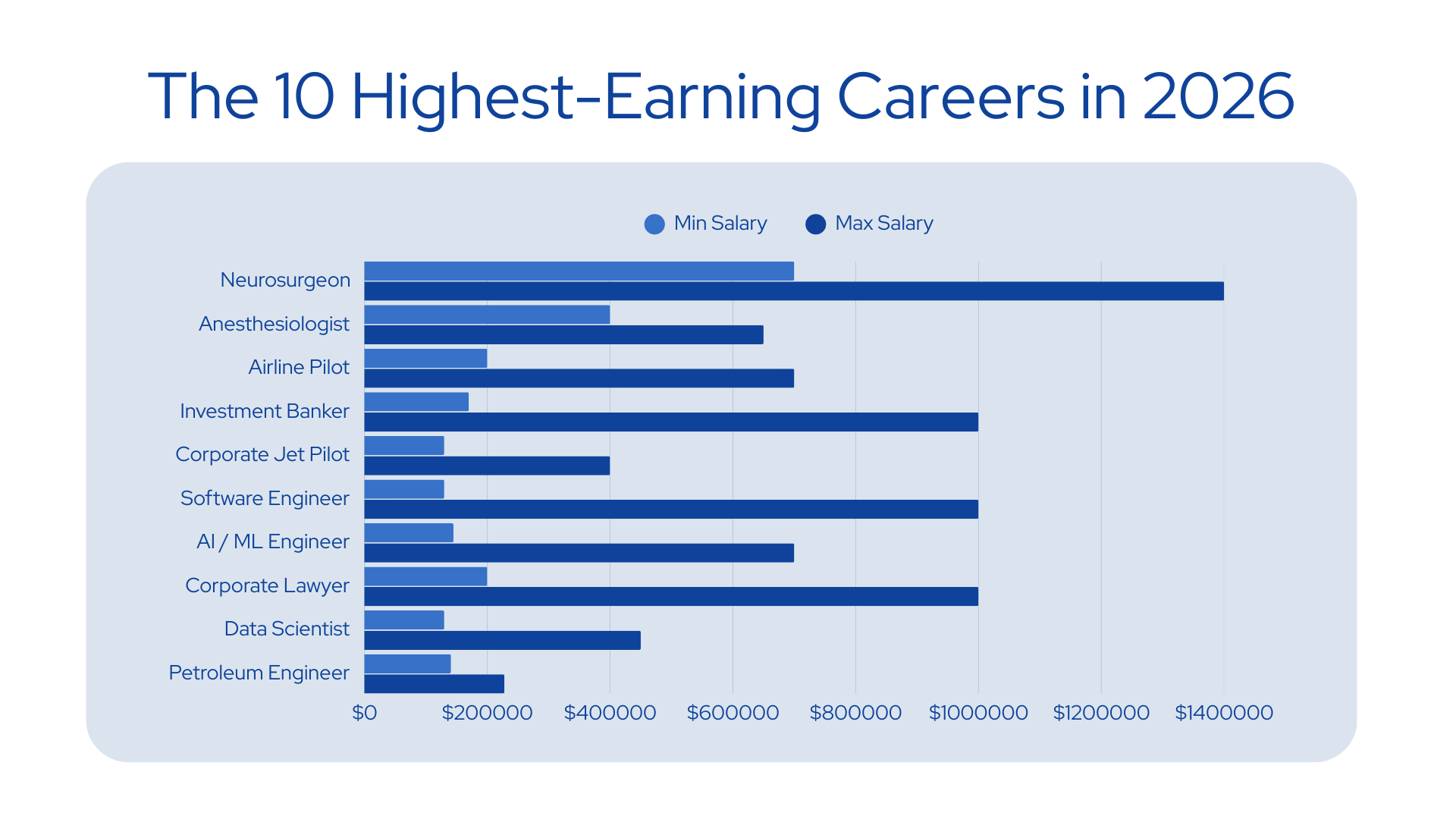
Experienced compensation range: $700,000 to $1,400,000+
Neurosurgeons sit at the top of the physician pay pyramid and consistently rank as the highest-compensated profession globally. MGMA data puts the median neurosurgeon total compensation near $962,900, with high-volume practices in competitive markets reporting offers of $1,200,000 or more. The ceiling is real, but so is the cost of entry: expect 15 to 17 years from the decision to enroll in a pre-med program through residency completion before a full attending salary materializes. Medical school tuition alone runs $286,000 to $391,000, before factoring in undergraduate costs.
2. Anesthesiologist
Experienced compensation range: $400,000 to $650,000+
Anesthesiologists earn a BLS mean wage of roughly $336,000, but Medscape’s 2024 compensation survey puts the average closer to $472,000, and private practice or hospital-employed offers in high-demand markets frequently exceed $500,000. Like neurosurgery, this path requires a four-year undergraduate degree, four years of medical school, and a four-year residency, putting the total runway at 12 to 14 years before high six-figure pay kicks in.
3. Airline Pilot (U.S. Majors and Cargo)
Experienced compensation range: $200,000 to $700,000+
Here is where most lists get it wrong. The BLS median for airline pilots was $226,600 in 2024, already firmly in the top tier of all professions. But the median significantly undersells what senior pilots earn. Widebody captains at major carriers like Delta, United, and American, along with cargo operators FedEx and UPS, routinely report total compensation of $400,000 to $700,000 when base pay, profit sharing, per diem, and retirement contributions are factored in. First-year first officers at major airlines start in the $100,000 to $120,000 range and progress quickly.
What makes this career uniquely compelling in 2026 is not just the ceiling. It is the speed of access, the cost of entry relative to earnings, and the structural demand tailwinds driving pay higher every year. Regional airline starting salaries for first officers have increased approximately 546% since 2000, according to AOPA data. That is not a typo.

Flight schools that understand this story have a powerful recruiting tool. If your school is not leading with pilot career earnings data in your marketing, the Right Rudder Marketing Flight School Marketing System includes a full framework for doing exactly that.
4. Investment Banker (Front-Office)
Experienced compensation range: $170,000 to $1,000,000+
Front-office investment banking is one of the few career paths that genuinely competes with medicine on lifetime earnings. First-year analysts earn $170,000 to $200,000 all-in. Vice presidents earn $445,000 to $580,000. Managing directors at top firms can earn $700,000 to well over $1,000,000, with deal-driven variability that creates substantial upside. The catch is that investment banking demands four to five years of brutal hours, often 80 to 100 hours per week at the analyst and associate levels, and is highly cyclical, with layoffs common in down markets.
5. Business and Corporate Jet Pilot
Experienced compensation range: $130,000 to $400,000+
Often overlooked in these comparisons, business aviation pilots are in exceptional demand. NBAA compensation surveys show business jet captains earning $180,000 to $300,000+, with retention bonuses of approximately $27,000 becoming common as corporate operators compete with airlines for experienced talent. Senior captains at the largest flight departments at Fortune 500 companies can approach $400,000 in total compensation. The lifestyle appeal, consistent schedules, often no overnights, premium equipment, makes this a compelling alternative to airline flying for many experienced pilots.
6. Software Engineer (Senior / Staff at Major Tech Firms)
Experienced compensation range: $130,000 to $1,000,000+
The median software developer wage sits around $131,000 to $147,000 according to BLS data. That number, however, obscures the remarkable upside for engineers who reach staff, principal, or distinguished engineer levels at major technology firms. Levels.fyi data shows total compensation (base, bonus, equity) of $600,000 to over $1,000,000 for senior technical roles at companies like Google, Meta, and Apple. The caveat in 2026 is AI disruption: software engineering employment growth is slowing as AI-assisted coding tools reduce headcount requirements, introducing career risk that did not exist five years ago.
7. AI and Machine Learning Engineer
Experienced compensation range: $145,000 to $700,000+
AI and ML engineering has separated itself from traditional software development as a distinct and extremely well-compensated specialty. Median base salaries run around $145,000, with total compensation at FAANG-tier firms frequently reaching $300,000 to $700,000 for experienced practitioners. Unlike generalist software engineering, demand for AI expertise is accelerating rather than contracting, making this one of the strongest growth trajectories in the technology sector.
8. Corporate Lawyer (Big Law Partner or General Counsel)
Experienced compensation range: $200,000 to $1,000,000+
The BLS median for lawyers is $151,160, and the average is around $182,750. Those numbers are dragged down by public defenders, government attorneys, and solo practitioners. At top-tier law firms, first-year associates earn $225,000 or more. Partners at major firms earn $400,000 to over $1,000,000 depending on book of business. The investment is a four-year undergraduate degree plus three years of law school, with average law school debt around $130,000 at graduation.
9. Data Scientist (Senior)
Experienced compensation range: $130,000 to $450,000+
The BLS median for data scientists is $112,590, but that figure understates what experienced practitioners earn in industry. Senior data scientists at technology companies earn $200,000 to $300,000+. Those in specialized roles with AI/ML crossover skills or those reaching the director and VP level can approach $400,000 to $450,000 in total compensation at major firms.
10. Petroleum Engineer
Experienced compensation range: $141,000 to $228,000+
Petroleum engineering remains one of the highest-paying four-year engineering degrees available. The BLS puts the 2024 median at $141,280 and the 90th percentile at $228,000. Compensation is highly tied to oil market cycles, which introduces earnings volatility that other careers on this list largely avoid. For those with risk tolerance for commodity-driven income swings, the entry point is attractive: a four-year engineering degree, relatively moderate student debt at public universities, and immediate access to six-figure pay.
The Variable Most Lists Ignore
Ranking careers by peak pay is useful, but it tells only part of the story. The more important question for anyone making a career decision is this: given what it actually costs to enter this career in money, time, and opportunity cost, what do I actually earn across a full working life?
When you model careers using net present value (NPV) and internal rate of return (IRR), the same financial tools used to evaluate business investments, the rankings shift considerably. A career that pays $1,000,000 at its peak after 17 years of training and $400,000 in education debt looks very different from a career that pays $500,000 at its peak after three years of training and $120,000 in education costs.
On that measure, airline piloting produces an IRR of approximately 60%, the highest of any career modeled in our analysis. Investment banking comes in second at roughly 45%. Neurosurgery, despite its extraordinary peak earnings, produces an IRR of only 19 to 20% because of the length and cost of training.
We break down the full NPV, IRR, and break-even analysis in greater detail on our blog. If you are advising a student who is weighing career options, that analysis is worth reading.

What This Means for Flight Schools
The career data above is a marketing asset hiding in plain sight. Prospective student pilots are not choosing between flight schools. They are choosing between careers. They are asking whether becoming a pilot is worth it compared to a four-year degree, a coding bootcamp, or a law school application.
When flight schools lead with career earnings data in their marketing, discovery flight landing pages, Google Ads campaigns, email nurture sequences, and social content, they enter the conversation at a much higher level. They stop competing on price and start competing on opportunity.
At Right Rudder Marketing, we work exclusively with flight schools and have built a complete system for recruiting students through exactly this kind of high-value positioning. If you want to explore how career ROI messaging can fill your discovery flight calendar, explore our Flight School Marketing System or browse our resources library for tools you can put to work right away.
The pilot shortage is real. Boeing projects the world will need 660,000 new commercial pilots by 2044. The career earnings are real. The ROI is real. The flight schools winning on student enrollment right now are the ones helping prospective students understand all of that, clearly, compellingly, and before a competitor does.