
Here is a question most career guides never ask: if you treated your education like a business investment, which career would earn the highest return on capital?
Not which career pays the most at peak. Not which career has the most prestigious title. Which career produces the best financial return relative to what you actually spend to get there?
When you run that analysis using the same tools a CFO would use, net present value (NPV), internal rate of return (IRR), and break-even year, the answer is not medicine. It is not investment banking. It is not software engineering.
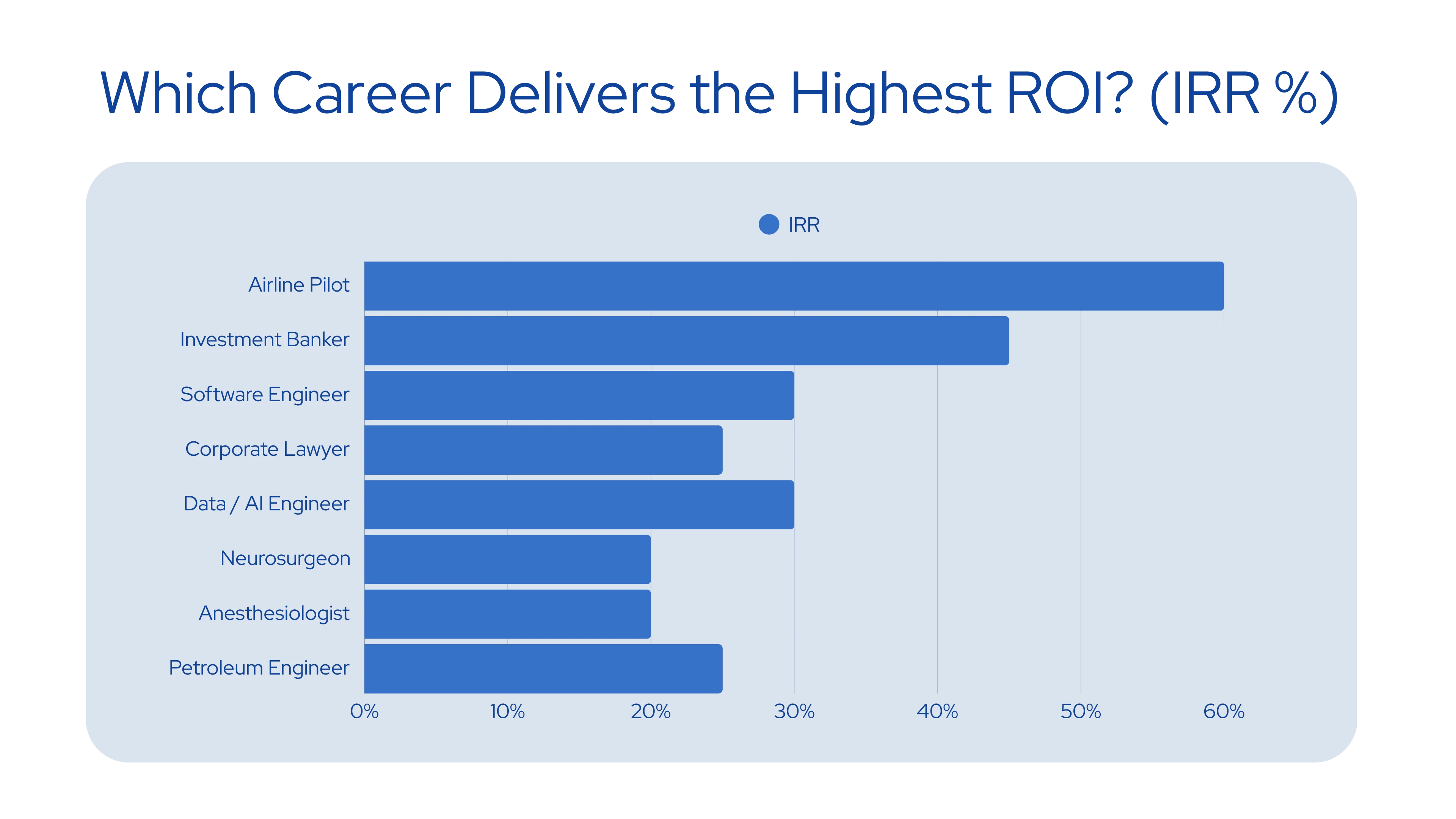
Across every career modeled in the RRM Career ROI and Earnings Intelligence Report (March 2026), airline pilot training produces the highest IRR of any profession: approximately 60%.
That number deserves a real explanation.
Why Most Career Comparisons Miss the Point
The standard approach to comparing careers is simple: look at median salaries, pick the biggest number, call it the best career. That approach has a fundamental flaw. It ignores time.
A career that pays $1,000,000 per year is not necessarily the best financial decision if it requires 17 years of unpaid or underpaid training to access. A career that pays $300,000 per year may be dramatically more valuable if you can start earning that money in three years instead of seventeen, because every year of early income compounds.
This is the insight behind IRR analysis. When you map out every dollar that flows in and out over a 40-year career, including the cost of training, the years of below-market earnings during education, and the full arc of compensation from entry level to peak, you get a complete picture of what a career is actually worth as a financial decision.
For airline pilots in 2026, that picture is extraordinary.
The ROI Framework in Plain Terms
Three numbers tell the story clearly.
Net Present Value (NPV) is the total value of all future career earnings, discounted back to today’s dollars to account for the time value of money. A dollar earned in year 30 is worth less than a dollar earned today, so NPV adjusts for that. A higher NPV means greater lifetime financial value.
Internal Rate of Return (IRR) measures the annualized return on your upfront investment, just like the return on a stock or real estate. A higher IRR means your training dollars are working harder. Careers with low upfront cost and high, fast income generate the best IRRs.
Break-even year is simply the point at which cumulative career earnings surpass your total upfront training cost. The sooner you break even, the faster your investment starts building real wealth.
The Full Career ROI Comparison
Here is how the eight careers modeled in RRM’s analysis compare across all three dimensions, using a 40-year career horizon starting in 2026 and a 5% discount rate:
| Career | Training Cost | Break-Even Year | Year Income Reaches $100K | NPV at 5% | IRR |
|---|---|---|---|---|---|
| Investment banker | ~$120K | Year 5 | Year 5 | $6.70M | ~45% |
| Neurosurgeon | ~$320K | Year 13 | Year 16 | $5.20M | ~19–20% |
| Airline pilot | ~$120K | Year 3 | Year 4 | $4.27M | ~60% |
| Anesthesiologist | ~$300K | Year 13 | Year 13 | $3.84M | ~20% |
| Corporate lawyer | ~$160K | Year 9 | Year 8 | $2.62M | ~25% |
| Software engineer | ~$100K | Year 7–8 | Year 8–9 | ~$1–2M range | ~25–30% |
| Data / AI engineer | ~$110K | Year 7–8 | Year 8–9 | Slightly above SE | ~25–30% |
| Petroleum engineer | ~$100K | Year 6–7 | Year 7–8 | Positive, below SE | ~20–25% |
Source: RRM Career ROI and Earnings Intelligence Report, March 2026. Models use constant 2026 USD, pre-tax earnings by career stage, and exclude ordinary living costs to maintain comparability across professions.
A few things stand out immediately.
Investment banking wins on total NPV at $6.70M. But investment banking also demands 80 to 100 hours per week from analysts and associates, is highly cyclical (layoffs are common in downturns), and the income ramp is heavily back-loaded. The NPV advantage comes largely from years 10 through 40, and requires surviving the brutal early years to get there.
Neurosurgery produces an NPV of $5.20M, but the IRR is only 19 to 20%. That is because $320,000 in training costs and 16 years before earning $100,000 are massive drags on the return calculation, even if the eventual salary is extraordinary. A neurosurgeon earns approximately $150,000 net during the entire first decade of their career after accounting for education costs. A pilot, in the same window, nets approximately $1,400,000.
That gap is not a rounding error. It is roughly $1.25 million dollars of additional early-career wealth, money that can be invested, spent on a home, or simply saved while the neurosurgeon is still paying off medical school debt.

Why Pilots Win on Risk-Adjusted Returns
The 60% IRR figure is driven by three factors that work together unusually well for airline pilots.
Low relative cost of entry. Accelerated Part 141 programs typically run $90,000 to $125,000 from zero flight time to commercial pilot certificate and instructor ratings. That is roughly the same as a four-year undergraduate education at a state university, and dramatically less than medical school, which typically costs $286,000 to $391,000 in tuition alone.
Fast path to meaningful income. A student who starts flight training in 2026 can realistically reach $70,000 to $100,000 in annual earnings by 2028 as a certified flight instructor building hours at a regional airline. By 2029 to 2030, a first officer position at a major carrier puts that figure at $100,000 to $120,000. That progression is measured in years, not decades.
Structural demand that protects earnings going forward. Boeing’s Pilot and Technician Outlook (2025 to 2044) projects that the world will need 660,000 new commercial pilots over the next 20 years. North America alone is currently short approximately 8,000 pilots, with the deficit potentially reaching 13,000 by 2032. That kind of supply constraint does not depress salaries. It drives them higher. Regional airline starting pay has increased approximately 546% since 2000, according to AOPA data, and major carrier captains at the senior widebody level now routinely earn $400,000 to $700,000 in total annual compensation.
The combination of low upfront cost, rapid income ramp, and strong demand-side tailwinds is precisely what generates a 60% IRR.
The 10-Year Reality Check
Abstract financial modeling is useful, but it helps to translate these numbers into a concrete time horizon. Here is what the first ten years look like for each career measured in gross earnings, net of training costs (2026 through 2035):
- Airline pilot: approximately $1.5M gross, roughly $1.4M net of $120K in training costs
- Investment banker: approximately $1.4M gross, concentrated heavily in years five through ten
- Software engineer: approximately $800K gross, roughly $700K net of $100K in education costs
- Neurosurgeon: approximately $150K net after covering residency income and training debt
That is not a cherry-picked comparison. Neurosurgeons earning $1M+ annually do so reliably, in year 16 and beyond. The math simply does not favor early-career wealth accumulation for medical specialties, no matter how impressive the peak earnings look.
For a student starting today and wanting to be financially independent before age 40, very few career paths outperform a disciplined airline pilot trajectory.
What Flight Schools Should Be Doing With This Data
The career ROI case for pilot training is one of the most compelling student recruitment arguments in any industry, and most flight schools are not using it.
Prospective students shopping for flight training are not just comparing your school to the school across town. They are comparing a pilot career to a computer science degree, to law school, to a finance MBA. If your marketing does not address that comparison directly, you are losing those conversations before they start.
At Right Rudder Marketing, our Flight School Marketing System is built specifically around helping flight schools communicate their value at this level. That means landing pages that lead with earnings potential, Google Ads campaigns that target career-decision searches, and email sequences that walk prospective students through exactly the kind of analysis this article presents.
If you are a flight school owner who wants to explore what career-focused marketing looks like in practice, our resources library includes tools you can put to work right away.

The Bottom Line
A $120,000 investment in flight training produces an estimated NPV of $4.27 million over a 40-year airline career, and does it at an IRR of approximately 60%, the highest of any profession modeled. Break-even arrives in year three. Six-figure income follows in year four.
That is not a sales pitch. That is what the financial modeling shows when you run the numbers properly.
The careers that beat pilots on absolute lifetime wealth, investment banking and neurosurgery, come with either extreme lifestyle costs or extraordinary time-to-payback periods. For most people weighing career options in 2026, the pilot path offers the best combination of financial return, speed to income, and career stability available.
In the next article in this series, we go deeper on the comparison that matters most to many prospective students: “Airline Pilot vs. Doctor: Which Career Pays Off Faster?”—coming soon. The numbers may surprise you more than these did.
This article is part 2 of a series on career ROI analysis. Please read part 1, The 10 Highest-Earning Careers in 2026, for the full context and detailed financial modeling behind these conclusions.