On this page
On this page
4 min read
Joe Gilroy walked off a Delta A330 flight deck for the last time on March 6, 2026. He was 65. He had no intention of stopping.
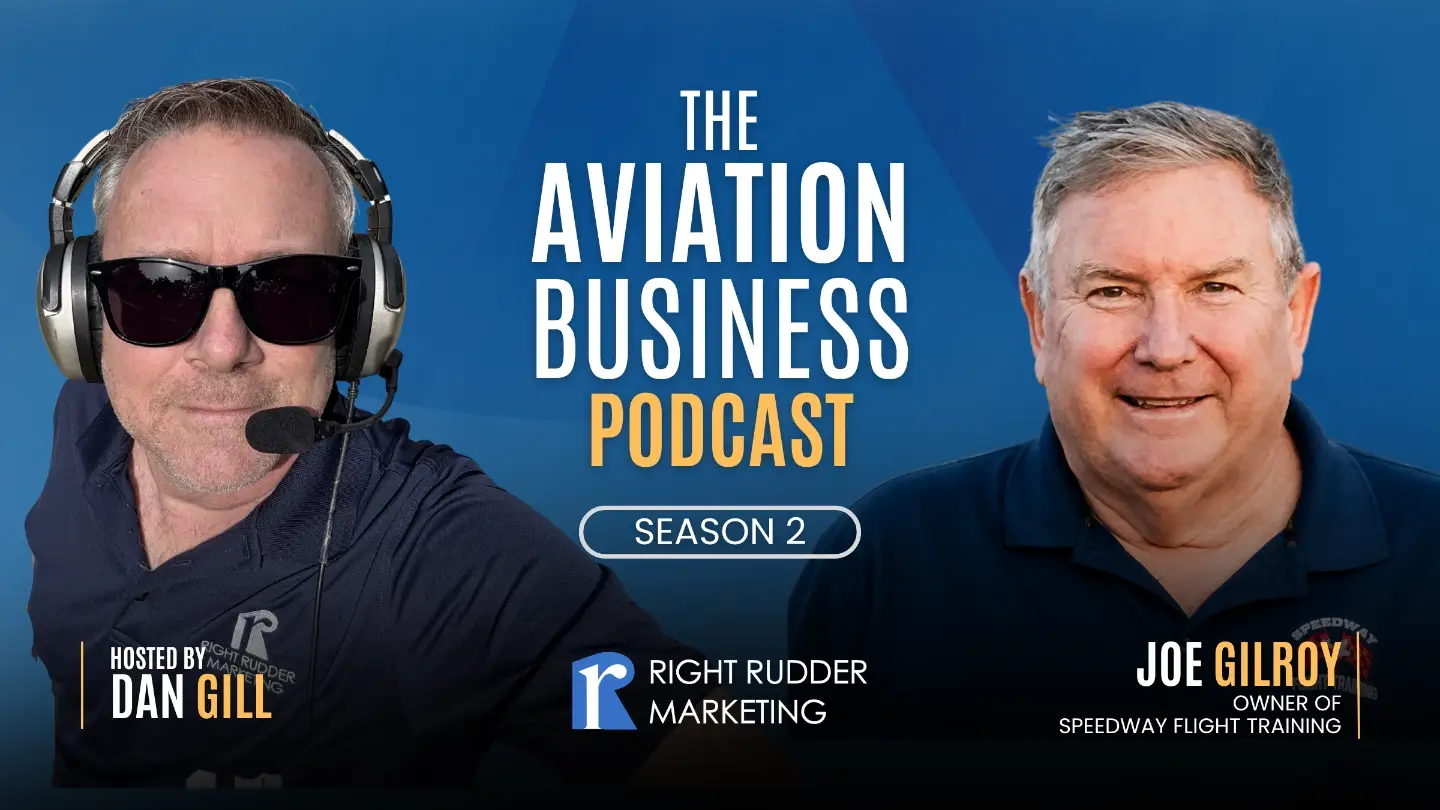
In this episode of the Aviation Business Podcast, Dan Gill sits down with Joe just two months after his mandatory retirement from Delta Airlines. What follows is nearly 90 minutes of aviation stories, career lessons, and a clear picture of what drives a man who spent 41 years doing exactly what he wanted to do.
Joe is the founder of Speedway Flight Training in Hampton, Georgia. He is also a Gold Seal CFII, FAA Training Center Evaluator, Aircrew Program Designee, and the person behind the Speedway Flight Training Scholarship Fund. But the title that matters most to him right now is mentor.
From a Flying Billboard Over the Beltway to an A330 Over the Atlantic
Joe’s first paid flying job was not what most people picture when they think of an airline career.
After leaving Embry-Riddle for a trimester to make money and recharge, Joe ended up fueling planes at Woodbridge Airport in Virginia as what he called a “petroleum transfer engineer.” A friend pointed him toward a man who needed a pilot. Joe had 145 hours, a commercial certificate, and no expectations. That night he had his first job flying for money.
The aircraft was a Cessna 172 rigged with a skycaster, a device that ran a fabric tape punched with holes across a belt of mercury-charged lights to display advertising messages. Joe flew slow circles over football fields and outdoor gatherings around the Capitol Beltway at night with a stall horn going off in the background. He was, by any definition, a professional pilot.
That first gig did not last long. The tower at Andrews Air Force Base ordered him to cease operations after reports of accidents on the highway below. Drivers had been stopping to look at what appeared to be a UFO hovering over the interstate.
The career that followed was anything but accidental. Joe graduated from Embry-Riddle as the outstanding graduating senior, joined Republic Airlines on May 6, 1985, and never looked back. This episode was recorded on May 6, 2026. Exactly 41 years to the day.
A Career Across Every Era of Commercial Aviation
Joe flew the Lockheed Electra at Zantop before Republic hired him as a 727 second officer. Within his first year at the airline, he upgraded to first officer on the same airplane. He describes going to 727 simulator training in Seattle and watching Top Gun at a Tuesday matinee before a night session, then going back into the sim so fired up the instructor barely had to say a word.
The Republic-Northwest merger followed, then the Northwest-Delta merger, and then the Airbus era began.
Joe checked out on the A320 early in his Northwest career and described the experience of flying glass cockpit technology for the first time as vertically steep learning curve. He joined the 787 development team at Northwest and later the A350 development team at Delta. He retired flying the A330 on long-haul international routes.
He had a front-row seat to the full arc of automation in commercial aviation.
On an average 10-hour A330 flight, data from the onboard Quick Access Recorder showed pilots had the autopilot off for about six minutes total. Joe made a deliberate choice to hand-fly up to 18,000 feet on every departure and to disengage the autopilot by 10,000 feet on every arrival. Even with that, his number averaged around 18 minutes. He wanted to stay sharp, and he knew the airplane would not do it for him.
He credits the late Jack Hunt, president of Embry-Riddle, for framing it best. On day one in 1979, Hunt told Joe’s incoming class they would not be pilots in the traditional sense. They would be systems monitors. Their job would be high-quality decision-making, not stick and rudder performance.
Joe thought Hunt was completely wrong. By the end of his career, he says Hunt was 100 percent right.
His own version of it: “I get paid to make good decisions. I fly the airplane for free.”
The Last Landing and the One He Wanted
Joe’s final A330 flight landed at Atlanta-Hartsfield on March 6, 2026. He had come across from Dublin with friends on board, two of them photographers with airport access who planned to film the moment. Everything was lined up for runway 26 Right.
Tower assigned 26 Left. Nobody lands on 26 Left.
Joe took it in stride. The flight deck had been flooded with congratulations from airline operations the entire crossing. A330 retirement flights get that kind of attention. But the day was windy, there was significant burble rolling off the Delta hangars, and the A330 has a trailing gear configuration that makes the second touchdown a point of pride among experienced captains. Joe got a smooth first touchdown. The second one was firm.
He called it what it was and moved on. “All I have is gratitude,” he said. “It was a wonderful ride.”
Speedway Flight Training and the Scholarship That Started With a Retirement Party
Joe started what became Speedway Flight Training in 2016 as a flying club. He called it Happy Goat Flying Club, founded with two fellow Delta pilots, Huey Harris and Glenn Fink. Both partners eventually moved on. Huey is now a professor at Auburn. Glenn runs operations for a corporate flight department in Indianapolis. Joe stayed and built the school.
Speedway is based at Atlanta Speedway Airport (KHMP) in Hampton, Georgia, a non-towered field south of Atlanta. The school offers training from private pilot through CFII and works with Right Rudder Marketing on its digital presence.
The scholarship fund came from a clear-eyed look at the biggest barrier to entry for non-traditional student pilots.
Most aviation universities expect incoming students to arrive with a private pilot certificate already in hand. They insert students into their Part 141 programs at the instrument level. For a kid from a rural Georgia high school or an inner-city Atlanta neighborhood who has the interest but not the connections or the money, that requirement can stop a career before it starts.
Joe’s solution was the Speedway Flight Training Scholarship Fund. The fund covers 100 percent of the cost to earn a private pilot certificate, including the Gleim ground school kit, up to 50 hours of flight instruction, and checkride fees for the first attempt. Recipients must commit to attending an aviation university and pursuing a path to professional piloting.
The first qualifying step is intentional: recipients have 60 days to pass the FAA private pilot knowledge test with a score of 80 percent or better. They get a mentor CFI for support, but the commitment has to be real. Joe says if a student will do that, he has all the confidence in the world they can do the rest.
The program requires awardees to remain drug and alcohol free, maintain a clean driving record, and show up. Those conditions are not punitive. They are the beginning of building a professional culture from the start.
The initial fundraising came from his retirement party. Joe asked his guests to skip the bourbon and donate to the scholarship fund instead. It worked significantly better than he expected.
The fund’s long-term goal is to become fully self-sustaining on investment income, so that when Joe is gone, the school can keep running the program. Speedway itself receives no benefit from the fund. The school provides airplanes and instruction at cost.
Donations and volunteer CFI mentors can be found at speedwayscholarship.com.
What He Wants the Next Generation to Understand
Joe has flown with a range of junior pilots in his final years at Delta. He sees the work ethic in the students at Speedway and he is proud of it. But he also sees something in a subset of newer airline hires that concerns him.
He calls it a sense of entitlement.
He is not blaming anyone. The pipeline disruptions during COVID created unusual pathways into the cockpit. But his message to anyone moving up in this industry is the same message he closes every episode of this conversation with: be humble and be grateful.
Only about 1 percent of the population can fly an airplane. A very small fraction of that 1 percent gets to do it at the level airline pilots do. Don’t call in sick on Christmas to play golf. Don’t forget that someone else flew that trip. Don’t lose the thread of how rare this opportunity is.
His father was an Air Force Colonel and aeronautical engineer who graduated from the University of Illinois after World War II and used a slide rule to design the corrugated floor of the C-97 cargo tanker. Joe showed that slide rule on camera during this episode. Today, he said, he types the same calculation into ChatGPT and gets the answer in seconds. The treadmill never stops. The only choice is whether to keep up or get left behind.
One of the initial Happy Goat Flying Club students sent Joe a photo recently. That student is now in a jetliner. Joe says moments like that are what the whole thing is for.
Listen to the Full Episode
This episode covers a lot more than what’s captured here, including the DB Cooper story and the “Cooper vane” modification it prompted on 727s, the Northwest Republic merger seniority fight, what it was like to watch the northern lights from the A330 flight deck crossing the North Atlantic at night, and Joe’s thoughts on where aviation goes from here, from supersonic flight without a sonic boom to AI-assisted aircraft design.
Dan Gill hosted this episode in Tim Jedrek’s absence. Tim will be back. But Dan handled it well.
- 🎧 Listen to the full episode
- 📺 Watch on YouTube
- 🔗 Learn more about Speedway Flight Training: speedwayft.com
- 🔗 Support the scholarship fund: speedwayscholarship.com
Is Your Flight School Telling Stories Like This?
Joe’s episode works because the story is real, the details are specific, and the mission is clear. That’s the same formula that makes flight school marketing work.
If your school has a story worth telling and you’re not sure how to get it in front of the right people, Right Rudder Marketing can help. We build marketing systems exclusively for flight schools, from websites and SEO to podcast-ready content and paid ads.