On this page
On this page
4 min read
If you run a flight school, you have probably watched a student go from motivated to missing. They come in ready to fly, grind through ground school, show up for their first few lessons, and then somewhere in the middle of it all, they stop retaining. They stop progressing. And eventually, they stop showing up.
Scott Angelo spent 20 years in the U.S. Navy flying missions across the world. He watched the same pattern play out in military aviation. And the moment that changed everything for him happened on the back of a C-130.
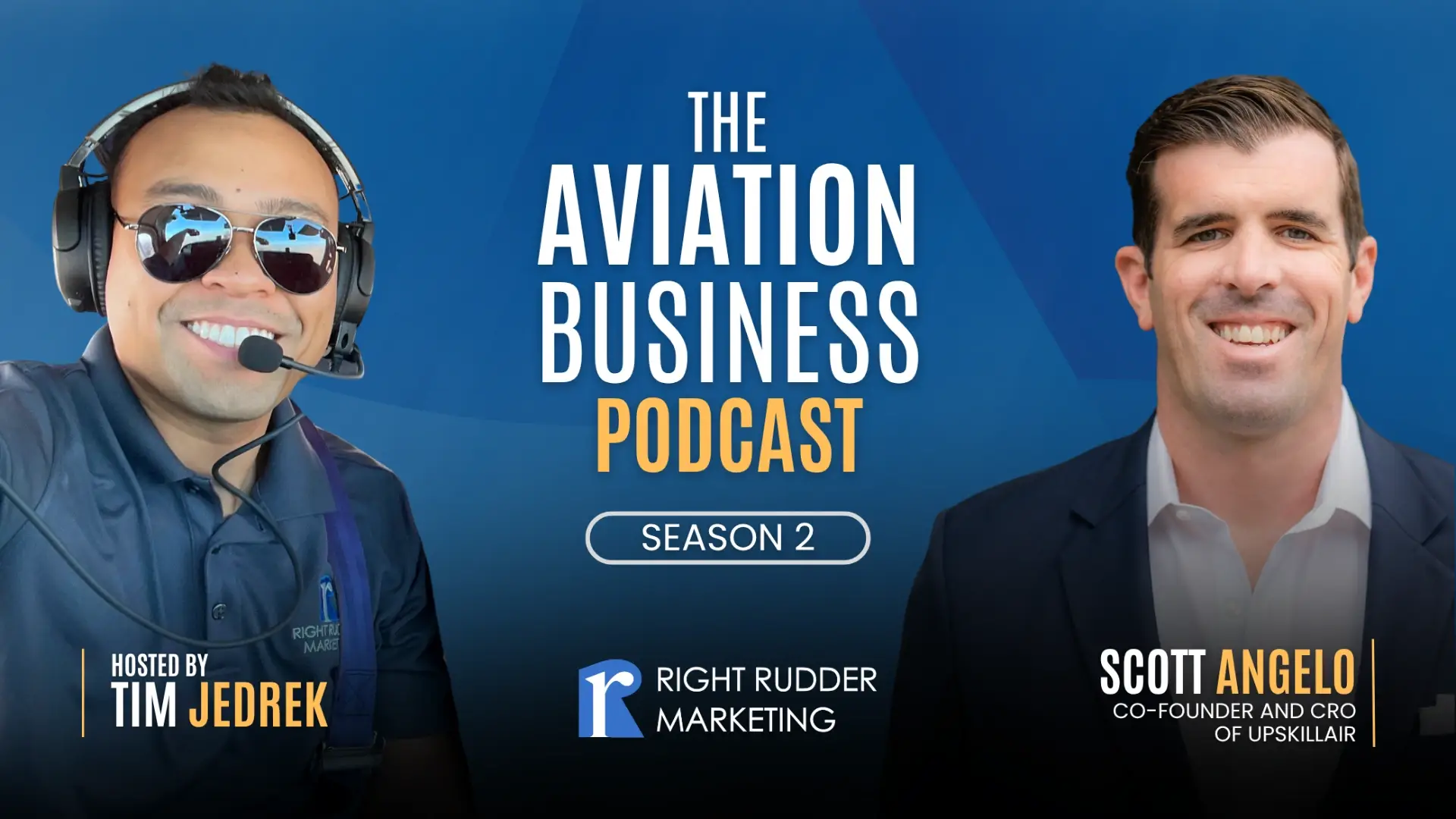
That story, and what he built because of it, is the subject of this episode of The Aviation Business Podcast.
Who Is Scott Angelo?
Scott is the Co-Founder and Chief Revenue Officer of UpskillAir, a mobile microlearning platform built for the aviation industry. He is also a First Officer at United Airlines, flying the Boeing 737. And he is a recently retired U.S. Navy Commander with 25 years of flying behind him.
His aviation path started the way a lot of Navy pilots’ stories do. He grew up watching Top Gun. He enrolled at the University of Maryland on an NROTC scholarship, got his first T-34 ride during his first summer as a midshipman, and never looked back. Before he was done, he had flown the P-3 Orion, the C-130, and the S-3, and had a tour at VX-30, the Navy’s test and evaluation squadron, where his team filmed NASA shuttle launches and chased Tomahawks for weapons development programs.
He retired in September of 2024 after 20 years of service and is now based in Annapolis, Maryland.
The Moment on the Back of a C-130
Scott’s co-founder, Raja Krish, had been developing an early version of the UpskillAir software for years. The two have been friends since their days at the University of Maryland. But the moment the idea fully clicked for Scott happened on the flight line.
He was sitting on the back of a C-130, waiting for an instrument check. Something was broken. And while he sat there, he watched four technicians with an open circuit breaker panel trying to make sense of a wiring diagram, flipping back and forth, cross-referencing, losing their place.
That was the aha moment. Here were experienced, trained professionals burning time and energy because the knowledge they needed was buried in a document that was never designed for the way humans actually learn.
Scott went back to Raja that afternoon. And the idea that became UpskillAir started taking shape.
The Real Problem: The Tyranny of Legacy Systems
At a Naval Postgraduate School innovation course, Scott heard a phrase from professor Paul Boss that stuck with him.
“We live in a tyranny of legacy systems.”
It describes exactly what most flight schools are dealing with. Books in one application. PowerPoints somewhere else. Syllabus in a binder. POH in a folder. Students bouncing between 10 different documents just to prepare for a single flight event.
The problem is not that schools lack information. It is that information is scattered. And when learning is scattered, retention suffers.
Scott puts it plainly. After long-form training, students retain roughly 20 percent of what they learned six months later. The rest is gone. Not because the students are not trying. Because the brain does not store information that is delivered in a single block and never reinforced.
What UpskillAir Actually Does
UpskillAir is a microlearning platform that pulls together short-form video, technical publications, checklists, and AI into one place. Scott’s description of the product is simple.
“We are the missile and the training is the warhead.”
The platform does not replace what a school teaches. It provides a better delivery system for it.
The core unit of content on the platform is what UpskillAir calls an mByte. These are short-form video modules, typically 30 to 90 seconds long. The format is intentional. It matches how attention actually works. It delivers information in a chunk the brain can hold, process, and retrieve.
Scott draws a direct line from Instagram Reels and TikTok to the learning science behind the product. Silicon Valley figured out how to capture attention with short-form video. UpskillAir applies that same principle to aviation training.
The mBytes are linked directly to the relevant sections of a school’s technical publications. A student preparing for a stall demo does not have to hunt through three different documents. The video is right next to the step in the procedure. They see what they are going to do before they go do it.
Scott calls this accelerating the “see one” in the see one, do one, teach one model. If a student watches the stall buffet setup 20 or 30 times before their first flight event, they arrive at the aircraft already a step ahead. The instructor can spend less time on setup and more time on the actual skill.
The Illusion of Competency
One of the sharpest moments in the episode is when Scott explains what he calls the illusion of competency.
You open a manual to study. The content looks familiar. Your brain registers recognition and tells you that you know this. But recognition is not recall. When you get to the aircraft or the test, the information is not there.
This is not a student problem. It is a how-the-brain-works problem. Rote memorization gets people through a test. It does not build the kind of long-term retention that makes a pilot proficient.
UpskillAir addresses this through what Scott describes as the “challenging piece” of their neuroscience approach. Being challenged immediately after learning something, even if you get it wrong, reinforces the neural pathways that move information from short-term to long-term memory. The science on this is clear. The application in aviation training is still rare.
Your Best Trains the Rest
One of the questions every school owner asks about a platform like this is: who makes the content?
Scott’s answer is direct. Your best instructor should be the standard bearer for your organization. Record them once. Distribute that to your entire team.
UpskillAir calls this “best trains the rest.” And Scott is clear that the barrier to getting started is lower than most schools expect. The UpskillAir team comes on-site to help schools film their first content. They walk instructors through camera placement, upload process, and best practices. Then the school owns it.
Short-form video also makes updates easy. If a procedure changes, you replace one short clip, not an entire hour-long recording. The content stays current without a major production effort.
Their advisory team includes former FRS instructors and Top Gun instructors who contribute to how the platform is built and how schools learn to teach on it.
The AI Layer
Scott gave a live demo during the episode, showing the platform’s RAG AI feature.
Unlike a general AI tool that searches the internet, UpskillAir’s AI only searches the documents a school has uploaded to their instance. Ask it what V1 means and it gives a precise answer sourced directly from the 737 manual in that account, with a link to the exact page. The student gets the answer and the context, without having to dig for either.
The platform also allows video to be viewed in a picture-in-picture format alongside publications, so students can watch the procedure and read the documentation at the same time without switching tabs or losing their place.
What This Means for Your School
The aviation industry is growing. Flight schools are taking on more students. And CFIs are still moving up the ladder at the same pace they always have, which means the knowledge they carry walks out the door with them on a regular basis.
Scott frames it well. The industry invests heavily in aircraft, simulators, and hardware. It does not invest nearly as much in the process of transferring knowledge. And that gap is where students fall behind, checkride pass rates get inconsistent, and schools lose enrollments they should have kept.
A better training system does not just produce better students. It produces a better marketing story. Schools with high completion rates and strong checkride outcomes have something worth telling prospective students. That is a competitive advantage.
How to Reach UpskillAir
If you want to learn more or book a demo, visit upskillair.com. You can also reach the team at info@upskillair.com or connect with Scott Angelo directly on LinkedIn.
Listen to This Episode
Scott Angelo does not talk like a vendor. He talks like a pilot who has sat through bad training, commanded operations at scale, and decided to build the fix himself.
If you run a flight school, this episode will change the way you think about what happens to a student between flight events.
Listen to this episode of The Aviation Business Podcast now.
- 🔗 Listen to The Aviation Business Podcast on Spotify
- 🔗 Watch to The Aviation Business Podcast on YouTube
The Aviation Business Podcast is hosted by Tim Jedrek and produced by Right Rudder Marketing, the only full-service digital marketing agency built exclusively for flight schools. New episodes drop weekly. To be a guest, call 314-804-1200 or email info@rightruddermarketing.com.