On this page
On this page
4 min read
Matt Wilkins knows exactly what it feels like to run out of money mid-certificate and stop flying. He started his private pilot at Auburn University in 2007, earned his license, began instrument training, and then quit. The cost was too high, the path forward was unclear, and he became part of the 80% of flight students who start training and never finish. He did not fly again professionally for ten years.
Today, Matt is the co-founder and COO of Hawkins Flight Academy in Shelbyville, Tennessee. In two and a half years of operation, his school has maintained a 0% student dropout rate. Every student who has enrolled in a Hawkins program has completed it.
That is not a typo. Against the industry’s 80% dropout problem, Hawkins has not lost a single student from a program since opening day.
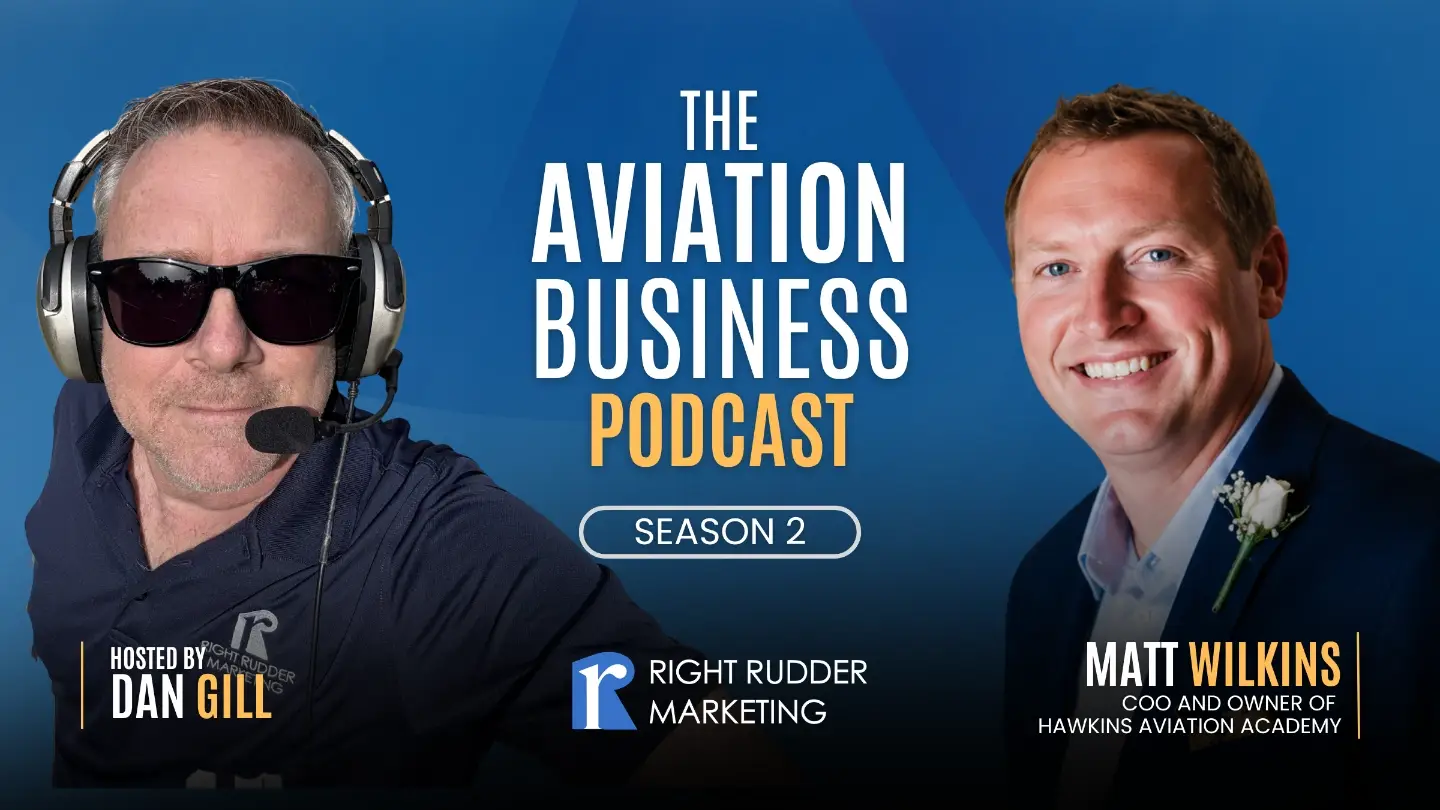
In this episode of The Aviation Business Podcast, Dan Gill sits down with Matt to cover how that happens, how Hawkins went from a travel trailer on a gravel road to 13 aircraft across two locations, and why the school runs a fleet of nine Van’s RV-12iSTs instead of the Cessnas and Pipers most flight schools default to. Hawkins Flight Academy is a Right Rudder Marketing client, and this is a conversation we are proud to share with every flight school owner in our audience.
Who Is Hawkins Flight Academy?
Hawkins Flight Academy operates at two locations: Shelbyville Municipal Airport (KSYI) in Shelbyville, Tennessee, about an hour south of Nashville, and Tupelo Regional Airport (KTUP) in Tupelo, Mississippi. The school offers programs from Private Pilot through CFI, CFII, and MEI, with a Professional Pilot Program designed to take a student from zero flight experience to Certified Flight Instructor.
Matt co-founded Hawkins with Mike Harris. The two spent time before opening interviewing flight school owners and students across the country, asking the same questions: what did you like about your flight school, and what did you not like? The answers shaped every structural decision Hawkins made about pricing, fleet, maintenance, and culture. In 2026, the school was named a Distinguished Flight School by the AOPA Foundation, an award determined entirely by verified reviews from students who trained there.
🔗 Visit Hawkins Flight Academy website at https://hawkinsflight.com/
How Hawkins Started: A Travel Trailer and One Airplane
Before Hawkins was a 3,000 square foot operation with 13 aircraft, it was a used travel trailer parked on a gravel road at Shelbyville Municipal Airport. Matt says he and Mike would greet prospective students at the end of that gravel road and essentially ask them to judge the school by the airplane, not the office.
The choice of Shelbyville was deliberate. With over a dozen airports around the Nashville area to choose from, Matt and Mike zeroed in on Shelbyville after learning that Middle Tennessee State University, one of the largest Part 141 aviation programs in the country with close to 1,000 students and 45 Diamond DA40s, had announced plans to relocate its operation there. They saw what was coming and moved first.
From that travel trailer start in 2022, Hawkins has grown to fill expanded office space above the FBO, a full-motion simulator visible from Matt’s office door, and a fleet that now includes nine RV-12iSTs, a Piper Cherokee 140, a Cessna 172, a Vector Harmony, and a Piper Aztec for multi-engine training. Matt’s summary of the arc: from a travel trailer with one airplane to 13 aircraft and two locations in two and a half years.
The Problem Matt Was Solving: The 80% Dropout Rate
The aviation industry has a widely known but rarely solved problem. Roughly 80% of students who start flight training do not finish. The traditional pay-as-you-go model is a significant driver. Students pay by the Hobbs meter, lesson by lesson, with no clear picture of total cost. The path forward looks like an endless series of ratings and expenses without a fixed destination or number to plan around. Students hesitate. Students stall. Students quit.
Matt lived this personally. He reached instrument training at Auburn and stopped because the financial path was not clear enough to keep going. That experience is directly embedded in how Hawkins is built.
Beyond individual cost uncertainty, Matt also talked through the financing access problem at the industry level. He and Mike are actively working with Tennessee state legislators to make the Tennessee Promise, a scholarship and low-interest loan program currently available for college attendance, accessible to flight training students. He pointed to 18% interest rates on some existing flight training loans as an example of why access is not the same as affordability. His argument to legislators: a career as a commercial pilot is a generation-changing income path, and removing the financial barrier is a public investment worth making.
Program-Based Training and the 0% Dropout Stat
The Hawkins answer to the dropout problem is program-based training. Students do not pay by the hour. They enroll in a program, pay a fixed amount, and train through completion. The Professional Pilot Program runs $74,995 for Package 1 through multi-engine, and $89,995 for Package 2, which adds CFI, CFII, and MEI. Ground school is $499.99 for a 14-week in-person course.
Matt was direct about what this model changes: it is not just a pricing structure, it is a completely different training mindset. When a student knows the total cost and has committed to a program, the relationship between the student, the instructor, and the school changes. The school is invested in completion. The student is invested in completion. The ambiguity that causes 80% attrition in the traditional model is removed.
The result, through two full years of operation, is that Hawkins has not had a single student drop out of a program. Matt acknowledged that maintaining that number will get harder as the school grows. But the model that produced it is not accidental.
For students who need help with the upfront cost, Hawkins works with Stratus Financial and AOPA Finance, which offers lines of credit up to $100,000.
The RV-12 Fleet: Nine Aircraft, 3.1 Gallons Per Hour
The aircraft decision is where Hawkins separates from nearly every other flight school in the Southeast. The core training fleet is built around Van’s RV-12iSTs, a Special Light Sport Aircraft with Garmin G3X glass cockpits, a GFC 500 autopilot, and ADS-B in/out. Hawkins has nine of them, which Matt confirmed is the largest RV-12 training fleet in the country.
The economics are significant. A Cessna 172 burns between nine and ten gallons per hour. The Rotax 912 engine in the RV-12 burns 3.1. That gap compounds quickly across a fleet of nine aircraft running full student schedules. Lower fuel burn combined with lower Rotax maintenance costs compared to Lycoming or Continental engines changes the cost per flight hour in ways that reach students directly.
Beyond economics, the aircraft itself changes the training experience. The RV-12 uses push-rod controls with a stick rather than a yoke, and Matt described the responsiveness as something students notice immediately: the input is nearly instantaneous. Commercial pilots who have come to Shelbyville to see the aircraft have told Matt the GFC 500 autopilot has more capability than some of the jets they fly for work.
Matt was also clear that the RV-12 is not a gimmick or a cost-cutting substitution. The school keeps a Piper Cherokee and a Cessna 172 at each location specifically so students complete training in certificated aircraft and understand how legacy equipment flies. The RV-12 does not replace those aircraft. It is the primary trainer for the bulk of the program, and the Cherokee and 172 fill the gaps the light sport category cannot cover.
Matt also addressed the fleet commonality point directly. All nine RV-12s are factory-built to the same specification with the same avionics. They fly identically. That means if one aircraft needs maintenance, a student does not get shuffled into an unfamiliar airplane with a trim tab that pulls left and avionics nobody has briefed them on. They step into another RV-12 and the training continues without disruption.
Picking Up Airplanes as a Training Flight
When Hawkins takes delivery of a new RV-12 from the Van’s Aircraft factory in Aurora, Oregon, they do not trailer it back. They fly it. Matt and his instructors identified early that the factory pickup flight was a training opportunity. Instructors and students fly the aircraft back from Oregon by way of the California coast, Las Vegas, the Grand Canyon, and Sedona before working back east to Tennessee.
These trips became a formal part of Hawkins culture under the name Adventure Flights. The concept extends beyond factory pickups: Hawkins instructors routinely take students to Lambert’s Cafe in Sikeston, Missouri, a $100 hamburger destination where the restaurant throws rolls at arriving customers and the airport gives priority seating to anyone who flies in. Students fly to Sun n Fun, to Oshkosh, over Niagara Falls.
Matt’s point on this is straightforward. A student grinding through commercial certificate requirements without doing anything enjoyable with an airplane is a student at risk of burning out. The fun flying is not a distraction from the program. It is part of what keeps students in it.
Light Sport, Mosaic, and What Is Coming
One of the more forward-looking parts of the conversation covered the FAA’s Mosaic rulemaking, which is in the process of rewriting the regulatory framework for Light Sport Aircraft and Sport Pilot certificates. The current rules prohibit light sport aircraft from flight into actual instrument meteorological conditions, or IMC. Mosaic changes that.
Matt noted that Van’s Aircraft is already working on IMC-capable versions of the RV-12 expected to arrive this year. He made the contrast explicitly: an aging 1965 Cessna 152 with half a functioning instrument panel has always been allowed into IMC, while a brand-new RV-12 with dual Garmin G3X displays, redundant systems, and a two-axis autopilot could not be. Mosaic corrects that.
For flight school owners, the practical implication is that the light sport category is about to expand in ways that make aircraft like the RV-12 more capable and more versatile as training platforms. Schools that are not paying attention to Mosaic are going to be behind when it takes effect.
About Matt Wilkins
Matt Wilkins grew up in Madison, Alabama, outside Huntsville, where his family heard NASA solid rocket booster tests from their house. His great-great grandfather worked alongside Glenn Curtiss, one of the founding figures of American aviation, a fact Matt traces back to family stories and a museum in Hammondsport, New York near the Finger Lakes that he has visited every summer since childhood.
After earning his private pilot at Auburn in 2007 and dropping out of instrument training due to cost, Matt spent years looking for a way back into aviation. He found it in 2017 through an avionics sales rep job in Nashville, which he landed without industry experience through direct networking. That job eventually led to the conversations with co-founder Mike Harris that produced Hawkins Flight Academy.
Mike Harris runs a podcast called Why We Fly, which Matt referenced as the philosophical center of what Hawkins is trying to be for its students beyond the training itself.
Key Takeaways for Flight School Owners
The 80% dropout rate is a solvable problem, not an industry constant. Hawkins has maintained a 0% program dropout rate for two full years using a model that removes financial ambiguity, standardizes the aircraft experience, and treats students as career candidates rather than hourly customers. The model is described and replicable.
Program-based pricing is a mindset shift, not just a billing change. Moving from pay-as-you-go to fixed program pricing requires new thinking about how your school absorbs variance in student hours and how you structure the enrollment conversation. Matt walked through both sides of that in this episode.
Fleet commonality has direct ROI. Nine identical aircraft means any aircraft is interchangeable for any student. No downtime cascades through scheduling, no students learning the quirks of an unfamiliar airplane. The Southwest Airlines model applied to a flight school.
3.1 gallons per hour versus 9-10 is a business decision. The fuel economy gap between a Rotax-powered RV-12 and a Lycoming 172 is not an aviation trivia point. It is a cost-per-hour calculation that compounds across every flight hour your fleet logs in a year.
Mosaic is coming and it changes the light sport calculus. Schools that are planning fleet purchases or program designs in the next 12 to 24 months should factor in what Mosaic will allow light sport aircraft to do before finalizing those decisions.
Fun flying is a retention tool. If your students are grinding toward commercial hours without ever flying somewhere worth going, you are creating attrition risk. Building adventure into your training culture is not optional.
Frequently Asked Questions
What is program-based flight training and how is it different from pay-as-you-go? Program-based training means a student pays a fixed cost for a full certificate or rating before training begins. There are no per-hour charges and no billing surprises. Hawkins Flight Academy uses this model across all its programs and attributes its 0% student dropout rate in part to the clarity and commitment that fixed-price enrollment creates. Traditional pay-as-you-go training charges students per lesson, which leaves total cost undefined and is a primary driver of the industry’s 80% dropout rate.
What aircraft does Hawkins Flight Academy use for primary training? Hawkins trains primary students in Van’s RV-12iST Special Light Sport Aircraft equipped with Garmin G3X glass cockpits, GFC 500 autopilots, and ADS-B in/out. The school runs nine RV-12s, which is the largest RV-12 training fleet in the United States. Both locations also keep a Piper Cherokee 140 and a Cessna 172 for certificated aircraft training hours and instrument work that requires leaving light sport limitations.
Can you complete all your ratings in a light sport aircraft? Yes. You can complete your Private Pilot, Instrument Rating, Commercial Pilot, CFI, and CFII in a light sport aircraft under current FAA rules. The current limitation is that light sport aircraft cannot be flown into actual IMC, which is why Hawkins uses its Piper Cherokee and Cessna 172 for that portion of instrument training. The FAA’s Mosaic rulemaking is expected to remove the IMC limitation for newer light sport aircraft, and Van’s Aircraft is already developing an IMC-capable version of the RV-12.
What are the FAA Mosaic rules and why do they matter for flight schools? Mosaic is a rewrite of the FAA’s regulatory framework for Light Sport Aircraft and the Sport Pilot certificate. Among other changes, it is expected to allow light sport aircraft with appropriate systems to operate in actual IMC, which current rules prohibit. For flight schools, Mosaic expands what a light sport training fleet can do and makes aircraft like the RV-12 viable for more of the instrument training curriculum. Schools evaluating fleet purchases in the next one to two years should track Mosaic’s timeline before committing.
What is the Hawkins Flight Academy Professional Pilot Program? The Professional Pilot Program is a zero-to-CFI accelerated track. Package 1, priced at $74,995, covers Private Pilot through Multi-Engine Rating. Package 2, priced at $89,995, adds CFI, CFII, and MEI. Students have access to financing through Stratus Financial and AOPA Finance, which offers lines of credit up to $100,000. The program uses RV-12 aircraft for the bulk of training, with legacy aircraft for the portions requiring certificated equipment.
Listen to This Episode
Matt Wilkins joins Dan Gill on The Aviation Business Podcast to walk through the model behind Hawkins Flight Academy and what flight school operators can take from it.
- Recorded: May 4, 2026 at 3:00 PM Central
- Watch on YouTube: https://youtu.be/oDBiaXZaFuU
- Listen on Spotify: https://open.spotify.com/episode/3fuCQZWZBgiNMo3h67yQZ7?si=1ZOOcSnORRaZmzb3RmgP1w
- Full episode library: rightruddermarketing.com/podcast/
Build a Flight School That Keeps Its Students
What Hawkins has done in two and a half years is not luck. It is the result of asking the right questions before opening, then building a model that solves the problems most schools live with. If you are ready to make those kinds of decisions for your school, start with your marketing.
Right Rudder Marketing works exclusively with flight schools. We build and run the full-funnel marketing system so your school gets found, earns trust, and converts the right students. Schedule a strategy call and we will show you what growth looks like at your stage.
The Aviation Business Podcast is produced by Right Rudder Marketing, the only full-service digital marketing agency built exclusively for flight schools. RightRudderMarketing.com