On this page
On this page
4 min read
Search marketing, home simulators, and the AI future of flight training. One conversation with the man running all three at the world’s largest pilot shop.
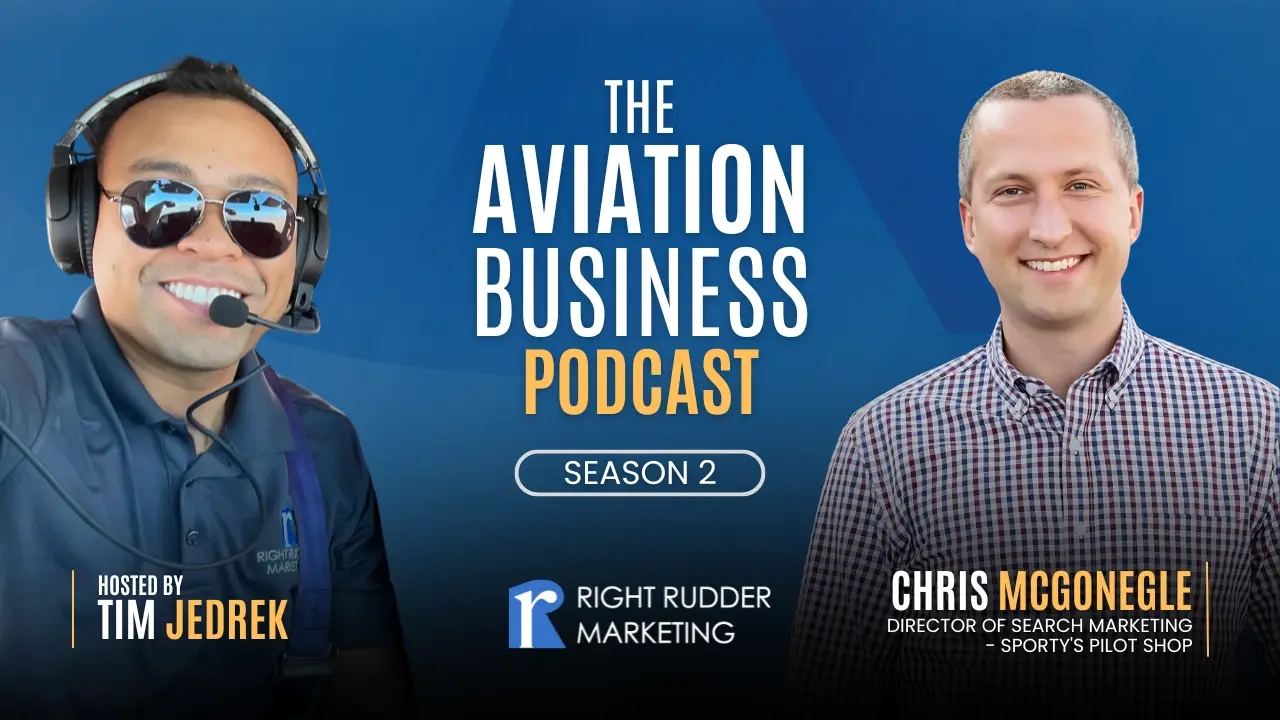
Chris McGonegle has a view of the aviation industry most people never get. He is the Director of Search Marketing at Sporty’s Pilot Shop and the company’s resident flight simulator expert. He also went through Sporty’s Academy as a student, which means he can speak to the pilot journey from the inside as both a practitioner and a graduate. When he sat down with us on The Aviation Business Podcast, the conversation covered more ground than we expected in under an hour.
Here is what flight school owners need to take from it.
From a 747 Cockpit to Warehouse Number One
Chris’s aviation story starts at age seven, when his aunt got him into the front seat of a 747. That single moment, he said, is where the interest began. His father spent a career doing thermodynamic stress testing on jet engines, which meant aviation was always somewhere in the background of his childhood.
He found Sporty’s through the University of Cincinnati’s accredited program, initially because he was looking for something outside of the standard college experience. What he described as “a hobby, frankly” turned into a career. He enrolled in Sporty’s Academy, started training, and then decided to start working at Sporty’s because he was already at the airport so often. His first job was in the warehouse, picking and pulling orders and, as he put it, “pushing a broom around.”
That bottom-up path matters for how he talks about the business. He left Sporty’s in 2016 and came back in mid-2019 when an opening appeared on the aviation side of the company. He has been building his current role for the seven years since.
Sporty’s itself started in 1961 when founder Hal Shevers began selling radios out of the trunk of his car. As Chris told it: “Studebaker was warehouse number one.” Hal also helped pioneer the weekend instrument rating course, a three-day intensive program that helped put Sporty’s on the map in flight training. Today, under roughly 5,000 product listings and a media network that spans blogs, podcasts, and video, that same foundation still drives how the company operates.
“This Is a Relay”: How Sporty’s Thinks About Search Marketing
Chris’s primary job at Sporty’s is search marketing, and he was clear that the work spans more than just Google. The quick metric is return on ad spend, but his framing went deeper than that.
“This isn’t a single person race,” he said. “This is a relay, and I’m handing that baton off to the next runner.”
That relay mindset shapes how Sporty’s approaches the full marketing funnel. Someone in the research phase needs different content than someone ready to buy. Someone scrolling Instagram is in a different headspace than someone who just typed a product name into Google. Chris broke it down simply: Google is intent-driven because it requires a query. Meta is passive because the user is just scrolling. A Bose A30 search on Google signals buying intent. The same person seeing a Bose A30 ad on Instagram might not even register it.
For flight schools, the translation is direct. Your Google Ads should be built around intent signals, not awareness. Your social media is your awareness layer. Treating them as the same thing is one of the most common reasons flight school ad spend underperforms.
Chris also pointed to Reddit as an underused channel for aviation marketers. His reasoning was specific: AI overviews and large language model crawlers are actively pulling from Reddit to populate their answers. Long-tail, topic-specific content posted on Reddit gives you a meaningful shot at showing up when someone asks an AI tool a question that matches your post. “The content you post in there is kind of what they’re going to read as they populate,” he said. Aviation subreddits have a natural audience for exactly this kind of content.
The last piece of his marketing framework was one of the more useful concepts in the episode. He called them “Easter egg keywords.” These are highly specific aviation terms that only a pilot would search. His example was a garb card. When someone types that into Google, you know exactly who you are dealing with. They are not a general consumer. They are an aviation person, and that precision makes your targeting meaningful. For flight schools, the equivalent would be long-tail terms around specific maneuvers, checkride prep, stage check requirements, or currency questions. Flight school owners who publish content around those terms are drawing a self-selected audience of serious student pilots.
The Three-Legged Stool: What Has Changed in Home Simulation
The simulator segment of the conversation was where Chris had the most ground to cover, and he covered it well. His framing for the whole conversation was clean: “Make sure you are using it as a tool rather than a toy.”
His first point addressed the skepticism that still exists among senior instructors. Many CFIs with gray hair have written off home simulators because everything they have seen came from the 80s, 90s, or early 2000s. Chris’s argument was that they have not seen what exists now. The current landscape sits on three legs, and all three have improved dramatically in recent years.
The first leg is software. Microsoft Flight Simulator uses Bing Maps to render an accurate version of the real world: every tree, every lake, every road mapped to actual locations. As Chris put it, the running joke at Sporty’s is that the metaverse everyone talked about is basically what MSFS built. When a student is practicing dead reckoning, VOR navigation, or any task where they are looking outside the aircraft more than inside, they are looking at something that matches reality.
The second leg is compute. Home computers have improved enough that the processing power required to run modern simulators is accessible at standard retail prices. What used to require specialized hardware now runs on a machine from a big-box store.
The third leg is hardware. This is where new entrants like Honeycomb have changed the category. Honeycomb’s yokes and throttle quadrant have become one of the most popular setups in the market. Thrustmaster remains a seasoned option for pedals and flight sticks. And headsets that plug into the simulator to practice communications have opened up a dimension that did not exist before. Chris mentioned that ATC communication anxiety was a real obstacle in his own training. Practicing with a simulator, where you can talk to real people on VATSIM or similar networks, is how he improved.
Chair Flying 2.0 and the Rule Every Student Should Know
One phrase from this episode is worth keeping. Chris described the home simulator as “chair flying 2.0.”
Most pilots who trained before the current sim era know chair flying. You tape the checklist to the back of a door and run through the procedures in your head, moving your hands and building muscle memory without the aircraft. The problem with chair flying is that it is entirely theoretical. You do not know what happens when you pull the mixture in an engine-out scenario. You imagine it.
With a modern simulator, you can see what happens. You get real feedback on the maneuver. You can practice steep turns, S-turns, emergency procedures, and instrument approaches until the procedure is genuinely ingrained. You can save those practice sessions, and tools like Fly Surely, which Chris works with directly, can generate reports showing your altitude, heading, and vertical speed the way ForeFlight does after a real flight. Alex, the founder of Fly Surely, has built a platform that connects to X-Plane, reviews your flights, and can answer questions in real time via microphone. It can tell you the cruising speed for your aircraft weight, suggest when to lean the mixture, and calculate your exact distance from an airport in nautical miles. None of those are things a human instructor can do instantly while you are flying.
The single most important rule Chris gave for using a simulator: only practice things you have already done with an instructor. If you try to learn a maneuver in the simulator first, you will learn it wrong, and the sim will reinforce that wrong technique. But once an instructor has shown you the right way to fly steep turns, there is nothing stopping you from going home and practicing them until your next lesson. Every hour of home simulator time you invest before a lesson is hobbs time you do not have to pay for.
That is the direct line from simulator use to training cost for your students, and for your school.
The Magenta Line, Sullenberger, and Where AI Leaves Pilots Exposed
The final topic was the one with the most texture. Tim asked Chris directly whether all of these tools, including GPS, AI, and automation, are making pilots better or worse.
Chris was measured but honest. “From an average standpoint,” he said, “it may be a couple points toward degrading.” He cited NTSB reports of pilots who were placed in situations they did not expect and did not know how to handle because they had stopped flying the airplane and started managing the automation.
His counterpoint was Sullenberger. The Miracle on the Hudson was not a by-the-book execution. It was a well-trained pilot and crew who knew what to do without a procedure to follow, because the depth of their training left them capable of responding to something no checklist covered.
The children of the magenta line, a phrase used to describe pilots who have never really navigated without a moving map telling them where to go, represent the risk side of that equation. On Chris’s instrument cross country, his instructor turned the backlighting on the 430 all the way down and told him to keep going. He found his way back using a VOR he had tuned as a backup. That is the skill set you lose when you never practice without the tools.
His recommendation was the same balance he applies to everything else: do not be 100 percent in either direction. Embrace the tools. Use the automation. But keep the ability to set them aside. As he put it, “We really should be able to jump in a Piper Cub and go fly a landing.” The book he recommended for that foundation is Stick and Rudder by Wolfgang Langewiesche, an older title that still holds up for everything it says about the physical act of flying.
What This Means for Your Flight School
Three things from this conversation are directly actionable if you own or operate a flight school.
On search marketing: your Google spend should be built around intent, not awareness. Build tight ad groups around high-intent queries. Save your social budget for brand awareness and upper-funnel reach. And start posting on Reddit. Long-tail aviation content in the right subreddits is showing up in AI overviews, which means it reaches prospective students at the exact moment they are researching.
On simulators: get a basic setup in your school and recommend one to your students. The software is accurate enough to reinforce real training. The hardware is affordable enough to be realistic for most student budgets. The rule is simple: only practice what you have already learned with an instructor. Done right, home sim time reduces the hours students need to pay for in the aircraft, improves their readiness for each lesson, and keeps them engaged between sessions.
On automation and pilot skills: the best thing you can do for your students is make sure they can fly without their tools before they learn to fly with them. Stage checks and checkrides that strip away the automation are not just regulatory requirements. They are the mechanism that keeps students from becoming the NTSB report no one wants to read.
About Chris McGonegle
Chris McGonegle is the Director of Search Marketing at Sporty’s Pilot Shop, where he manages pay-per-click and SEO initiatives across Sporty’s aviation, home brand, and aviation enthusiast product verticals. He is also Sporty’s resident flight simulator expert, running the company’s sim content network and managing vendor relationships with Honeycomb Aeronautical, Microsoft Flight Simulator, X-Plane, Thrustmaster, and Fly Surely. Chris is a graduate of the University of Cincinnati Aviation Technology Program through Sporty’s Academy, holds a Commercial Pilot certificate with Instrument Rating, and has spent his career at the intersection of aviation education, product, and digital marketing.
Learn more about everything Sporty’s offers at Sporty’s Pilot Shop. Browse their flight simulator resources and hardware at FlightSimUpdate.
Ready to Grow Your Flight School?
If this conversation brought up marketing or operational challenges you are working through at your own school, we can help.
Request your free copy of the Flight School Marketing Handbook for a full breakdown of the five-part marketing system RRM uses to help flight schools grow enrollment across the country: Request Here.
Schedule a free strategy call with our team at Right Rudder Marketing: rightruddermarketing.com or call us at 314-804-1200.
Subscribe to The Aviation Business Podcast on YouTube and Spotify so you do not miss the next episode.
Tim Jedrek is the CEO and Founder of Right Rudder Marketing, the digital marketing agency specializing exclusively in flight school growth. A pilot and entrepreneur, Tim helps flight school owners across North America increase student enrollments and build sustainable, profitable businesses through strategic marketing.
Connect with us:
- YouTube: @rightruddermarketing
- LinkedIn: Right Rudder Marketing
- Spotify: The Aviation Business Podcast
Ready to be the best flight school in your area?
We are pilots too, and we know how to market flight schools. If you want to attract more students and grow your business, we can help. Schedule a free strategy call with us today to learn how we can help you achieve your goals.