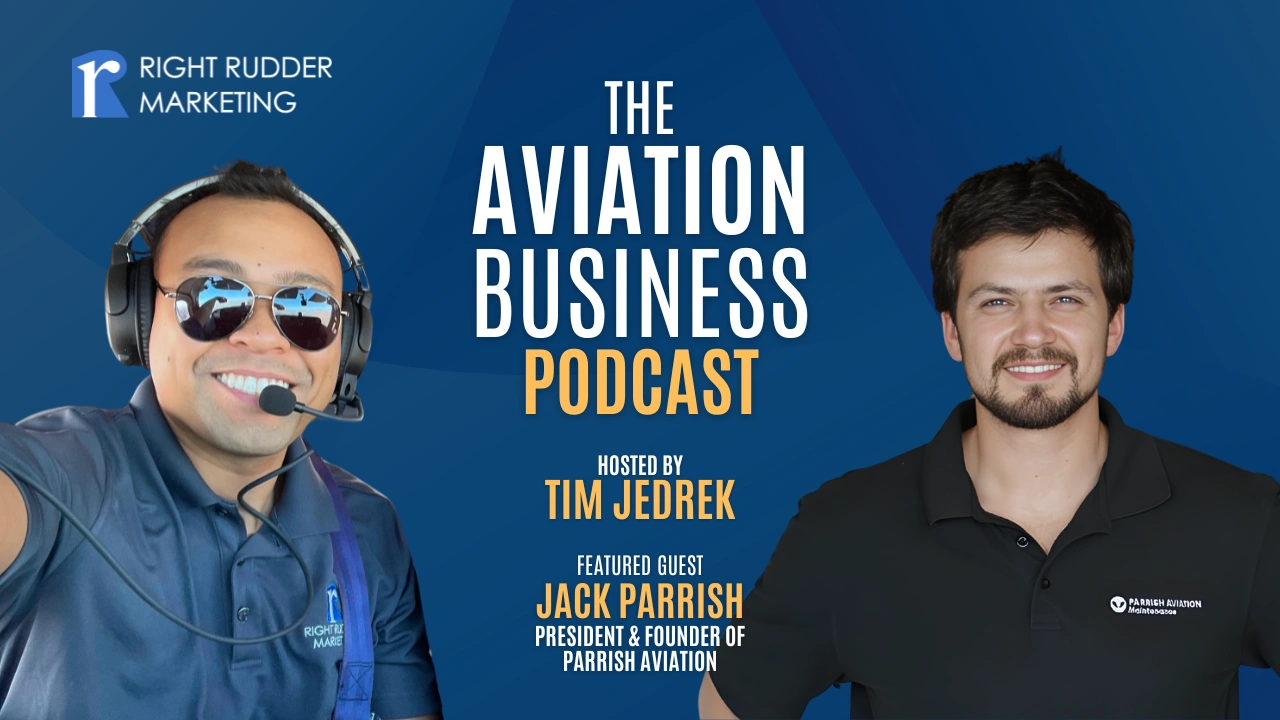
Jack Parrish resigned from Envoy Air with shaking hands at a coffee shop. Six years later, Parrish Aviation has 12 aircraft, nine more on order, a second location opening this month, and a glider-first training program that’s dropping solo times below 20 hours.
In this episode of The Aviation Business Podcast, Tim Jedrek sits down with Jack Parrish, President and Founder of Parrish Aviation, an FAA Part 141 Career Program flight school at Dallas Executive Airport. Jack is a former airline pilot on the Boeing 767, the current Part 141 Chief Flight Instructor, a NAFI Master CFI, and a newly appointed board member of the Flight School Association International (FASI, formerly FSANA).
This conversation covers how Jack went from flying the Embraer 175 on reserve at Envoy Air during COVID to co-founding a flight school with his brother, buying him out two years later, and building one of the fastest-growing Part 141 operations in Dallas. The episode gets specific: in-house maintenance as a growth threshold, a glider-first training program that’s cutting solo times in half, a Sling NGT fleet bet that Jack says is the future of GA training, CFI compensation tied to pass rates, and a second location going 141 from day one.
If you run a flight school or you’re thinking about starting one, this episode is loaded with operational detail you can actually use.
Episode Highlights
The resignation that started everything. Jack was flying the E175 at Envoy when COVID hit. He was on reserve, barely flying. His brother had just graduated flight school and needed a job. They started Parrish Aviation together. Two years later, Jack sat in a coffee shop with his best friend, hands shaking, and sent a resignation letter to the chief pilot at Envoy. His friend told him to bet on himself. He bought out his brother, who went to the airlines. They traded places.
In-house maintenance is the growth threshold. Jack says a flight school can’t break even for very long without bringing maintenance in-house, and the threshold is around four to five aircraft. It’s not just a cost play. It’s about keeping aircraft flying, maintaining a reliable standard, and controlling your schedule. If you’re a flight school owner running five planes and still outsourcing maintenance, this is the segment to listen to.
Why 141 and why Jack says it’s foolish not to. Parrish Aviation’s Part 141 certification took years of waiting on the FAA before it came through. But Jack’s position is clear: 141 opens doors for students (financing, university partnerships, 529 plans) and forces the operation to mature. His 61 students follow the same 141 curriculum and stage check process. And his second location will be 141 from day one, with the FAA inspector doing the site inspection that same week.
Self-examining authority is next. Jack expects to apply for self-examining authority in July 2026. If approved, he would be able to conduct checkrides for his own students. That’s a significant operational milestone for any Part 141 school and a direct benefit for students enrolled now.
The Sling NGT bet. Jack firmly believes the Sling NGT and platforms like it are the future of GA flight training. The Rotax engine burns 3.5 gallons per hour, roughly half of a legacy Lycoming or Continental. A new Sling costs about half of a comparable Cessna or Piper and is available now, not years out on backorder. The fleet runs full Garmin G3X with GFC 500 autopilot. Jack picked up the first one at the factory in Torrance, California, and the second was already ready with branding when he got back. Nine more are on order, with another order being placed now.
The glider-first training program that’s cutting solo times in half. This is one of the most specific operational innovations in the episode. New students at Parrish Aviation start with a hyper-focused ground block on radio communications, then do their first five flights in a self-launching glider focused on energy management and stick-and-rudder skills, followed by an upset recovery flight. Only then do they move to the primary aircraft. The result: solo times are dropping well below 30 hours, with many students soloing in the 10 to 20 hour range. One student finished his entire private pilot checkride at exactly 40.0 hours.
CFI pay is tied to pass rates. Parrish Aviation gives flight instructors a pay raise when their students’ pass rates hit a certain threshold. Jack’s point: your instructor is financially incentivized for you to succeed, not just to push you through. He acknowledges a few other schools do this, but it’s far from the industry standard.
A dedicated student success role. As the team has grown, Jack has been able to create a position whose entire job is getting students from enrollment to the airline. The goal isn’t just to get students in the door and take their money. It’s to get them into the right seat of an Embraer 175.
TikTok got the school off the ground. When Jack started Parrish Aviation, nobody knew who he was. No social proof, no reputation. So he posted day-in-the-life airline pilot videos on TikTok from the Envoy cockpit. Some hit 800,000 to a million views. That organic content got the initial momentum going before the school had any track record. His advice: if you’re at the airlines and thinking about starting a school, this is the lowest-hanging fruit and it’s free.
FASI (formerly FASANA) is doing more than most owners realize. Jack is a newly appointed board member and says the organization is going to DC at least once a year to advocate with lawmakers. Real legislation has come out of it. Glenn and Bob have personally helped schools in significant, tangible ways. Jack credits a single FASI connection with saving Parrish Aviation $40,000 on insurance at the next renewal. His message: if you’re a flight school owner and you’re not connected with FASI, you should be.
Notable Quotes
“I was at a coffee shop with my best friend and my hands were shaking because I was sending an email to the chief pilot at Envoy, sending in a resignation letter.”
“I firmly believe, and this is being recorded so there’s accountability, that the Sling and platforms like it are the future of general aviation flight training.”
“Your instructor is incentivized for you to succeed. Their compensation is tied to you doing well.”
“You don’t want to be learning in the plane as much as you can help. You want to be training in the plane.”
“We’re not just trying to push people through. We really, really want to see you succeed.”
“It’s foolish not to, to be honest.” (On going Part 141.)
Chapter Markers
- 00:00 - Introduction and guest welcome
- 05:00 - Jack’s aviation background and the family legacy (Thunderbirds, F-16s, American Airlines)
- 08:00 - Starting Parrish Aviation during COVID with his brother
- 10:00 - The full origin story: growing up flying with his grandfather in an Aeronca Champion
- 11:45 - Resigning from Envoy: the coffee shop moment
- 13:00 - What convinced him to leave the airlines for GA
- 15:00 - Growing the business and the decision to buy out his brother
- 16:00 - Building toward the best flight school in the country: PSI testing, AME, financing, all on campus
- 17:30 - Part 61 vs. Part 141: why Jack chose 141 and why he says every school should
- 22:00 - 529 plans, VA benefits, and the financial doors 141 opens
- 25:00 - The flight training industry is immature on the business side
- 28:00 - Marketing a flight school: TikTok videos that hit a million views
- 30:00 - The student success role: getting students from enrollment to the airline
- 33:00 - SEO, AI search, and why consistent marketing effort matters
- 37:00 - Why the Sling NGT: fuel burn, cost, availability, Mosaic, and the Garmin G3X suite
- 41:00 - Stick vs. yoke and the Sling NGT flying experience
- 42:00 - The glider-first training program: radios, energy management, upset recovery
- 45:00 - Solo times dropping below 20 hours; one student finished PPL at 40.0 hours
- 47:00 - FASI (formerly FASANA): advocacy, DC lobbying, and a $40K insurance save
- 51:00 - Jack’s new role on the FASI board
- 52:30 - Call to action: reach out to Parrish Aviation
- 53:30 - Why choose Parrish: pass rates, self-examining authority, CFI pay tied to outcomes
- 55:00 - Closing and how to connect
About Jack Parrish
Jack Parrish is the President and Founder of Parrish Aviation Flight Academy, an FAA Part 141 Career Program flight school at Dallas Executive Airport (KRBD) in Dallas, TX. He is a former airline pilot on the Boeing 767 (ATP, type-rated 757/767 and E170/190), the current Part 141 Chief Flight Instructor, a NAFI Master CFI (top 1% of all U.S. flight instructors), and a board member of the Flight School Association International (FASI).
Jack founded Parrish Aviation in 2020, grew it to 12 aircraft with nine more on order, and is opening a second location that will be Part 141 from day one. He comes from a five-generation aviation family: his great-grandfather flew for the family dairy farm in Illinois, his grandfather Roger commanded the USAF Thunderbirds (1973-74), his father Brian flew F-16s and currently captains at American Airlines, and his brother Michael co-founded the school before moving to the major airlines. Jack learned to fly in his grandfather’s Aeronca Champion, which he inherited and keeps at the school today.
Connect with Jack Parrish and Parrish Aviation
- Website: parrishaviation.com
- Instagram: @parrishaviation
- Email: [email protected]
About The Aviation Business Podcast
The Aviation Business Podcast is produced by Right Rudder Marketing, the only full-service digital marketing agency built exclusively for flight schools. Each episode features operators, founders, instructors, and industry leaders talking about what actually works in the business of flight training.
If you own or operate a flight school, this podcast is built for you.
Right Rudder Marketing helps flight schools grow with SEO, paid ads, email marketing, content, and strategy. To learn how RRM can help your school attract more students,