On this page
On this page
4 min read
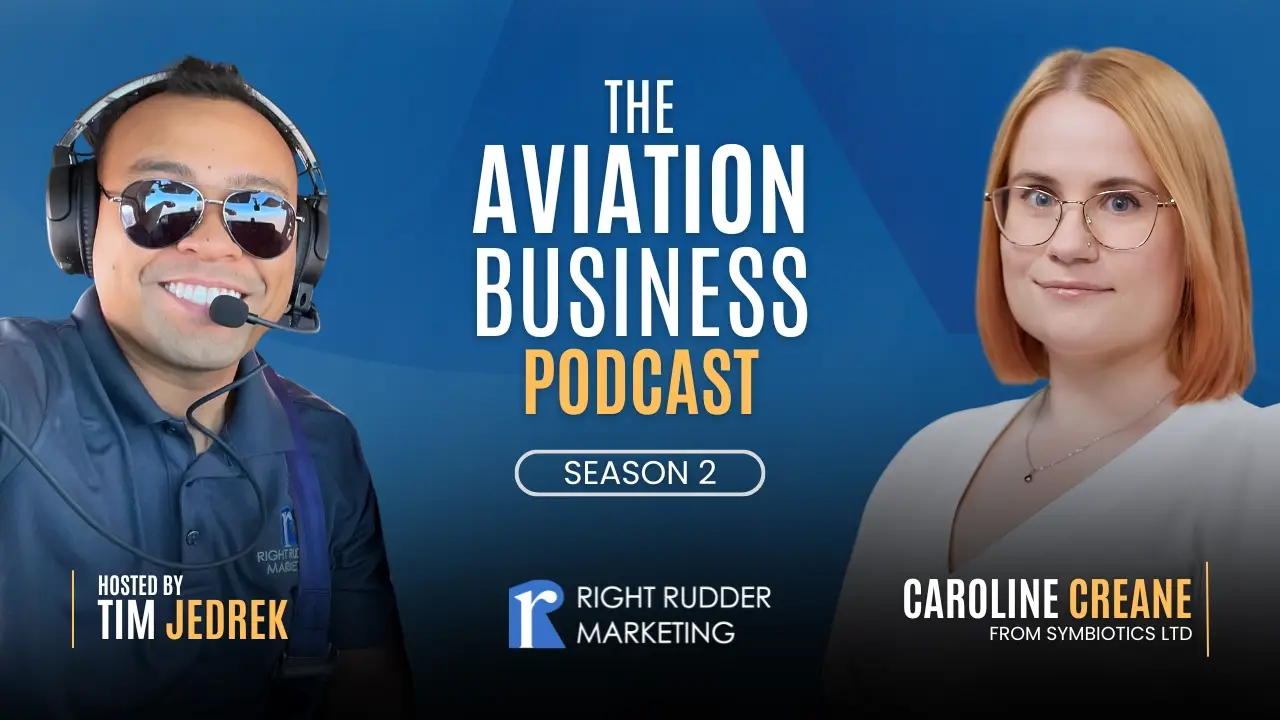
You have watched students quit. Some made it through their solo and disappeared. Others struggled from the first lesson and you sensed it early, but you had no objective way to act on the feeling. On this episode of The Aviation Business Podcast, Tim Jedrek sat down with Caroline Creane, an aviation psychologist who has spent 11 years helping flight schools turn that feeling into data they can use before a student ever touches the controls.
Caroline is certified with the European Association of Aviation Psychology and works at Symbiotics, a human performance company that has specialized in aviation psychometric testing for around 30 years. Her message to flight school owners is direct. The traits that predict who finishes training can be measured up front, and knowing them changes how you enroll, how you train, and how you protect your school.
Why Washout Rates Are a Business Problem, Not Just a Training Problem
Every student who does not finish costs you money. The refund conversations, the instructor hours, the aircraft time, the scheduling gaps. Caroline pointed to something that should get every owner’s attention. When students do not complete, some head to online forums to complain. In a few cases, parents have even tried to sue flight schools, arguing the school took their money and promised a license that never arrived.
Her question reframes the whole issue. Wouldn’t it be better to let people know up front what their real chance of success is before they make a six-figure investment? That is what prescreening does. It moves the hard conversation to the start, where it protects both the student and the school.
🔗 80% of Student Pilots Quit Before PPL: Here’s Why
What ADAPT Actually Measures
ADAPT is the Symbiotics testing platform. It runs entirely online through a web link, so a school does not need special local software, and it works for students coming in from anywhere in the world. The system is used in more than 80 countries across 130 or more locations.
Caroline was clear that this is not an aviation knowledge exam. A student walking into their first assessment will not be quizzed on material they have not learned yet. The tests measure natural ability and underlying traits, built around the core pilot competencies the industry already recognizes. The assessment covers three broad areas:
Knowledge. Foundation areas like math and physics that a student builds theory training on.
Aptitude. Natural abilities such as psychomotor skills, processing speed, working memory, and the capacity to handle a multitasking environment.
Personality and behavior. Traits like emotional stability, teamwork, motivation, and self-discipline that predict how a person performs once the workload climbs.
She also explained that ADAPT screens for hazardous attitudes, the same risk-taking tendencies the FAA emphasizes in decision-making training. A naturally anti-authority person who dislikes following rules is flagged early, because aviation is built on rules and regulations.
🔗 Pilot Aptitude Testing for Aviation Training Organisations
It Is Not a Pass or Fail Tool
This was one of the most important points in the conversation. ADAPT does not tell a school to reject anyone. Caroline stressed that Symbiotics is not in the business of crushing dreams. The school decides how to use the information, and she gave two real examples from US flight schools.
One school assesses every student up front but rejects no one. They use the report as a development plan, pinpointing where a student might struggle and which instructor to pair them with to get the best result. A second school uses the report as an informed-consent debrief. They might tell a strongly motivated student that their processing speed is below average, so the student can decide whether to invest now, or spend a year strengthening weak areas before committing.
Caroline also shared research Symbiotics ran on how Gen Z and older generations feel about psychometric testing. The results were positive. Most candidates saw the value in understanding their strengths and weaknesses before training started.
The Data Flight School Owners Asked About
When an audience member asked for proof, Caroline delivered specifics. Some Symbiotics clients have pushed their washout rates below 5 percent, which means a 95 percent training success rate, because screening helps them select the students most likely to finish.
She also shared a result from a school in India. Under the DGCA ranking system that compares schools on key metrics, this school sat in 19th place. After implementing ADAPT and building a more rigorous quality system, they climbed to second. The predictive power comes from combining cognitive ability with personality traits like conscientiousness and emotional stability, a pairing that research has tied closely to training success.
The Accreditation Angle You Cannot Ignore
Symbiotics has partnered with the Flight School Association of North America for three to four years. The connected story is the International Aerospace Accrediting Commission, which is building an accreditation program for flight schools focused on producing career pilots. That accreditation standard requires some form of prescreening. It does not force a school to reject anyone, but it does require an up-front understanding of whether each student has a reasonable opportunity to pass.
Caroline noted the IAAC is set to become the first aviation accreditor recognized by the US Department of Education. As Tim pointed out, accreditation is also the path to Sallie Mae loan access, which makes prescreening a practical requirement for schools chasing that funding. Schools that come to Symbiotics through the FSANA or IAAC relationship receive a discount on testing.
Cheating, AI, and Eye Tracking
Tim raised the obvious modern concern. With AI tools everywhere, how do you keep an at-home assessment honest? Caroline walked through the safeguards. Symbiotics uses large question banks so candidates do not all see the same items, controls how a test is taken in one sitting, and offers remote invigilation, which she noted Americans call proctoring, so a whole cohort can be monitored on one screen.
The company is also exploring embedded eye tracking, on the logic that a candidate running an AI tool on the side will keep shifting their gaze away from the task. On AI more broadly, Caroline took a cautious line. Schools can feed ADAPT reports into their own AI systems, and Symbiotics is exploring AI itself, but she will not recommend tools until there is evidence validating their accuracy. For now, the system runs on human-built, human-validated science.
What Implementation Actually Looks Like
For an owner wondering about the lift, Caroline said it is easier than most people expect. The process starts with a message through the website contact form and a call with the sales team to understand your school’s specific challenges, because the service is not one size fits all. From there, Symbiotics recommends a test battery, anywhere from a single multitasking screening tool to a full seven-test battery covering multitasking, math, physics, and personality.
Once the contract is in place, setup usually takes a week or two. Everything runs through the ADAPT portal, where you follow each candidate’s journey and track remaining access codes. After a student finishes, a report is generated within about five minutes. For larger groups, a matrix report puts an entire cohort’s results in one spreadsheet view.
What the Best Pilot Candidates Look Like
Drawing on decades of research and the Big Five personality model, Caroline described the profile that predicts pilot success. Strong candidates score high on conscientiousness, meaning follow-through, attention to detail, and a sense of duty. They score low on neuroticism, meaning stress resistance and emotional stability. They sit reasonably high on extraversion, not in a life-of-the-party sense, but in the willingness to speak up and be assertive, including the courage to flag a captain who is breaking the rules.
ADAPT also looks at what Caroline called preferences under pressure, the traits that surface in high-stress moments when trained behavior falls away. These include being untrusting and unwilling to ask for help, arrogance and overconfidence, and over-reliance on an instructor instead of showing initiative. Crucially, scores are compared against an aviation-specific population, not the general public, so a school sees how a student stacks up against thousands of others in the same position.
One memorable example was the FAST test, which throws everything at a candidate at once. They control an aircraft to avoid obstacles, answer cognitive questions, and monitor a cockpit view with traffic, beeps, and voices, all at the same time. They take it twice, so the system can measure how quickly they learn.
What It Costs
Caroline was refreshingly open about pricing. Tests start from about $20. Battery discounts stack as you add tests, and volume discounts apply for larger cohorts. There are no setup fees, no upfront costs, and no retainers. It runs on a pay-as-you-go basis, and a self-purchase option lets a school grab access codes instantly. As Tim noted, that is a fraction of what many general personality and assessment tests cost, and this one is built specifically for flight training.
About the Guest
Caroline Creane is an aviation psychologist certified with the European Association of Aviation Psychology, with a background in occupational psychology and psychometric testing. She has spent 11 years at Symbiotics, where she helps develop the company’s psychometric tests and guides flight schools and airlines through implementing efficient selection programs. Symbiotics is a UK-based human performance company with around 30 years in aviation and a team of just under 20 specialists.
Connect With Symbiotics
If you want to explore prescreening for your school, visit symbioticsltd.com. The team can set up a consultation, and the site holds client testimonials and ebooks on assessing pilot competencies. You can also follow Symbiotics on LinkedIn, where they share their event schedule.
And if you run a flight school and want help growing and scaling your business, that is what Right Rudder Marketing does. Visit rightruddermarketing.com or call 314-804-1200. If you have a product or story that brings value to the aviation industry, reach out about being a guest on the podcast.