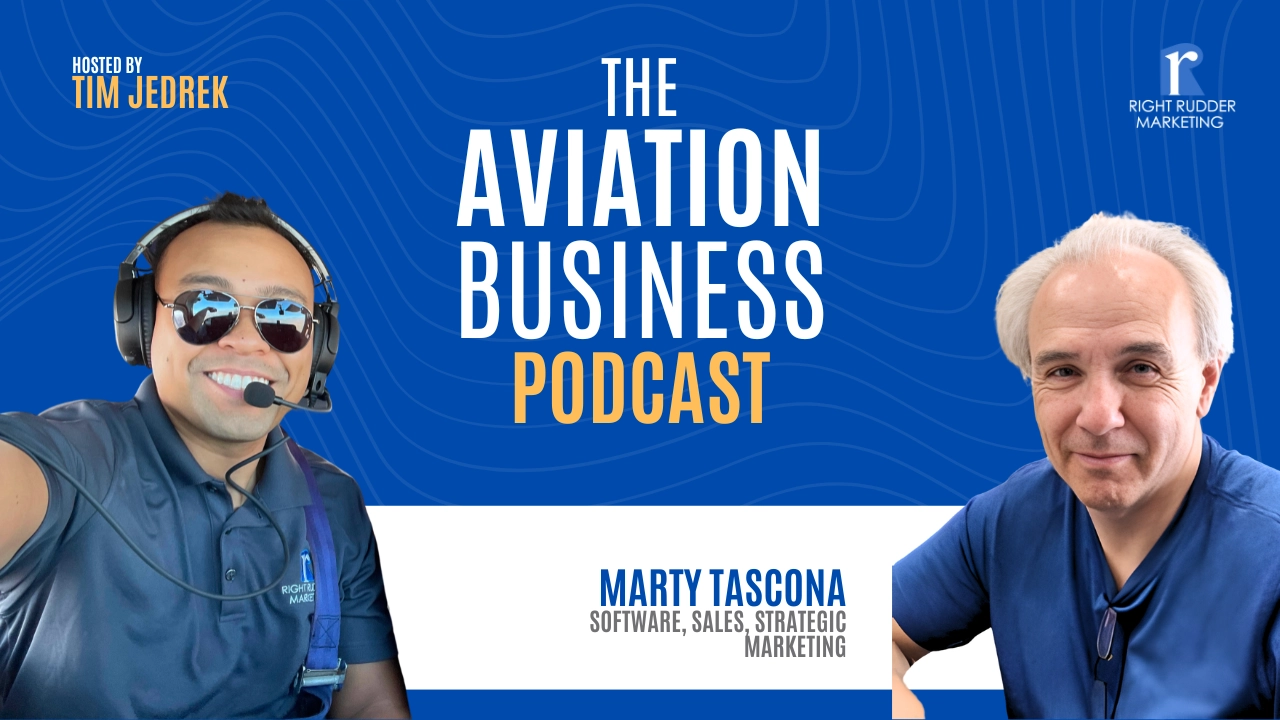
Lessons from an unexpected conversation about positioning, innovation, and standing out in aviation
When Marty Tascona called me a few weeks ago, I’ll admit—I was confused. He was talking about aerospace art, sales strategy, and his father’s pioneering work in the Canadian aviation industry. I thought, “Is this guy trying to sell me a painting?”
What followed was one of the most valuable business conversations I’ve had this year, packed with insights that every flight school owner needs to hear about positioning, differentiation, and creating your own category in a crowded market.
The Man Behind the Art: Tony Tascona’s Aviation Legacy
Marty’s father, Tony Tascona, wasn’t just an artist—he was an aviation industry worker who bridged two worlds. Working as an electroplating technician for Canadian Aviation Electronics (CAE) and Trans-Canada Airlines (which became Air Canada), Tony spent decades working with aircraft materials: aluminum, epoxy resin, and lacquer paints.
But here’s where it gets interesting for us in the aviation business world.
Tony took those same materials—the aluminum sheets, the industrial resins, the aviation-grade lacquers—and created a pioneering body of work that earned him the Order of Canada in 1996. His “aerospace aesthetic” art now hangs in major institutions across Canada, and more importantly, it tells a story about innovation, differentiation, and creating value from what you already have.
Sound familiar? It should .
The Marketing Lesson: If You Can’t Be First, Create a New Category
During our conversation, Marty shared a piece of advice he received from a Silicon Valley executive in the 1990s: “If you can’t be first in category, invent a new category and then be first in the new category.”
This is the marketing gold that flight school owners need to understand.
Think about your local market right now. How many flight schools are competing for the same students? How many are saying essentially the same thing: “We offer quality flight training with experienced instructors and well-maintained aircraft”?
You’re not going to win by being another flight school. You win by being the only flight school that does what you do.
The 3 Pillars of Strategic Positioning
Based on Marty’s sales and marketing expertise, here are the three fundamentals every flight school must nail:
1. Know Your Niche (Market)
Stop trying to be everything to everyone.
Are you targeting:
- Recent high school graduates looking for career paths?
- Mid-career professionals seeking lifestyle changes?
- Affluent hobbyists who want to fly for recreation?
- International students pursuing Part 141 training?
Each of these markets requires different messaging, different aircraft, and different program structures. The flight schools that win are the ones that choose their niche and commit to it .
As Marty put it: “It’s hard to be in two places at once if you’re really no place at all.”
2. Craft Your Message (Your UVP)
Once you know your market, you need a message that resonates.
Your Unique Value Proposition (UVP) isn’t just what you do—it’s why someone should choose you over every other option, including doing nothing at all.
Tony Tascona didn’t just make art. He created “aerospace aesthetic”—a completely new genre that positioned his work uniquely in the market. What’s your flight school’s equivalent?
Maybe you’re:
- The only school offering accelerated zero-to-hero programs with guaranteed CFI employment
- The family-owned school with a 30-year safety record and personal attention
- The technology-forward school with full-motion simulators and glass cockpit training
- The affordable option that makes aviation accessible to underserved communities
Whatever it is, own it.
3. Choose Your Medium Strategically
Once you have your market and message dialed in, then—and only then—do you choose where to market.
Where does your ideal customer spend their time?
- Career-focused millennials: Instagram, LinkedIn, YouTube
- Retired professionals: Facebook, local newspapers, aviation magazines
- International students: Google Search, education forums, social media
Don’t spread yourself thin trying to be everywhere. Be strategic about where you invest your marketing dollars .
STEM vs. STEAM: Why Adding Creativity Matters
One of the most fascinating parts of our conversation was Marty’s push for STEAM education (adding Art to Science, Technology, Engineering, and Math).
Here’s why this matters for flight schools:
Right now, there’s a massive shortage of pilots, mechanics, and aviation professionals. We’re all competing for the same pool of STEM-focused students. But by adding the creative element—whether that’s through marketing, facility design, or program offerings—you expand your audience.
The Canada Challenge (And Why It Applies to You)
Marty mentioned that in Canada, attracting people into the aviation industry is a significant challenge. Sound familiar?
The U.S. faces similar issues. We need more:
- Certificated Flight Instructors (CFIs)
- Airframe and Powerplant (A&P) mechanics
- Aerospace engineers
- Aviation business professionals
By making aviation more accessible, creative, and appealing to diverse audiences, you’re not just growing your flight school—you’re growing the entire industry.
The Sales Process: From Curiosity to Commitment
Marty’s background in sales provided another valuable framework: the three-stage sales process:
Stage 1: Curiosity
Your marketing’s job is to spark interest and capture attention. This is where your social media content, Google rankings, and word-of-mouth reputation come into play.
Stage 2: Enlightenment
Once someone’s curious, they need information. This is where your website, discovery flight offerings, and introductory consultations matter.
Stage 3: Commitment
Finally, you convert interest into enrollment. Clear calls-to-action, compelling offers, and personalized follow-up seal the deal.
But here’s the critical insight for flight schools: This process repeats at least twice.
First commitment: The discovery flight Second commitment: Starting actual training
Many flight schools lose students between these two stages because they don’t maintain engagement.
The Perseverance Principle
Tony Tascona had a philosophy that resonated deeply: “This whole notion of waiting till you’re in the mood is complete bullshit.”
Whether you’re an artist, a pilot, or a flight school owner, you have to show up and do the work—especially when you don’t feel like it.
The flight school owners who succeed aren’t the ones with the most aircraft or the biggest budgets. They’re the ones who persevere:
- Consistently marketing even when leads are slow
- Maintaining aircraft even when budgets are tight
- Training instructors even when turnover is high
- Innovating even when it’s easier to do things the old way
Practical Applications for Your Flight School
So how do you apply these lessons? Here are actionable steps:
1. Conduct a Positioning Audit
- What makes your flight school genuinely different?
- What do your best students have in common?
- What do competitors in your area emphasize?
- Where are the gaps you can fill?
2. Define Your Category
Instead of being “a flight school,” become:
- “The accelerated career-track program”
- “The family aviation experience center”
- “The technology-forward training facility”
- “The affordable path to the airlines”
3. Align Your Entire Operation
Once you’ve defined your category:
- Update your website messaging
- Revise your Google Business Profile
- Adjust your social media content
- Train your team on the new positioning
- Design your facility to reflect your brand
4. Consider the Aesthetics
This is where Marty’s art conversation comes full circle. Your flight school’s physical environment matters:
- Lobby design and artwork
- Aircraft livery and branding
- Office and classroom aesthetics
- Student lounge atmosphere
These details communicate professionalism, care, and attention to detail—exactly what nervous prospective pilots need to see.
Key Takeaways
✈️ Positioning beats budget - You don’t need the most aircraft to win; you need the clearest position in the market
✈️ Create your own category - If you can’t be first, invent a new category where you can dominate
✈️ Know your niche deeply - Stop marketing to “anyone interested in flying” and start targeting your specific ideal student
✈️ STEAM > STEM - Adding creativity and design thinking attracts broader, more diverse audiences
✈️ Perseverance wins - Consistent effort over time beats sporadic brilliance
✈️ Sales is a process - Guide prospects through curiosity → enlightenment → commitment (twice!)
The Bigger Picture
This conversation with Marty reminded me why I started Right Rudder Marketing in the first place .
Flight schools aren’t just businesses—they’re gateways to careers, dreams, and aviation’s future . But too many great flight schools struggle with marketing because they’re using generic strategies that don’t account for aviation’s unique challenges .
Just like Tony Tascona took aviation materials and created something entirely new, flight school owners need to take proven marketing principles and adapt them to our industry’s specific needs.
That’s exactly what we do at Right Rudder Marketing .
Ready to Position Your Flight School for Growth?
If this article resonated with you, it’s time to evaluate your flight school’s positioning strategy .
Watch the full podcast episode to hear the complete conversation with Marty Tascona, including his father’s incredible artwork and more insights on sales, marketing, and standing out in aviation.
Want help defining your flight school’s unique position? Right Rudder Marketing specializes in helping flight schools clarify their message, reach their ideal students, and grow enrollment through proven digital marketing strategies .
📞 Schedule a free discovery call to discuss your flight school’s marketing challenges and opportunities: rightruddermarketing.com
📥 Download our free Flight School Marketing Handbook for more strategies to grow your student enrollment and revenue. Download Here
Tim Jedrek is the CEO and Founder of Right Rudder Marketing, the leading digital marketing agency specializing exclusively in flight school growth. A pilot and entrepreneur, Tim helps flight school owners across North America increase student enrollments and build sustainable, profitable businesses through strategic marketing.
Connect with us:
- YouTube: @rightruddermarketing
- LinkedIn: Right Rudder Marketing
- Spotify: The Aviation Business Podcast