On this page
On this page
8 min read
Part 3 of 7 in the Flight School Marketing Blueprint series.
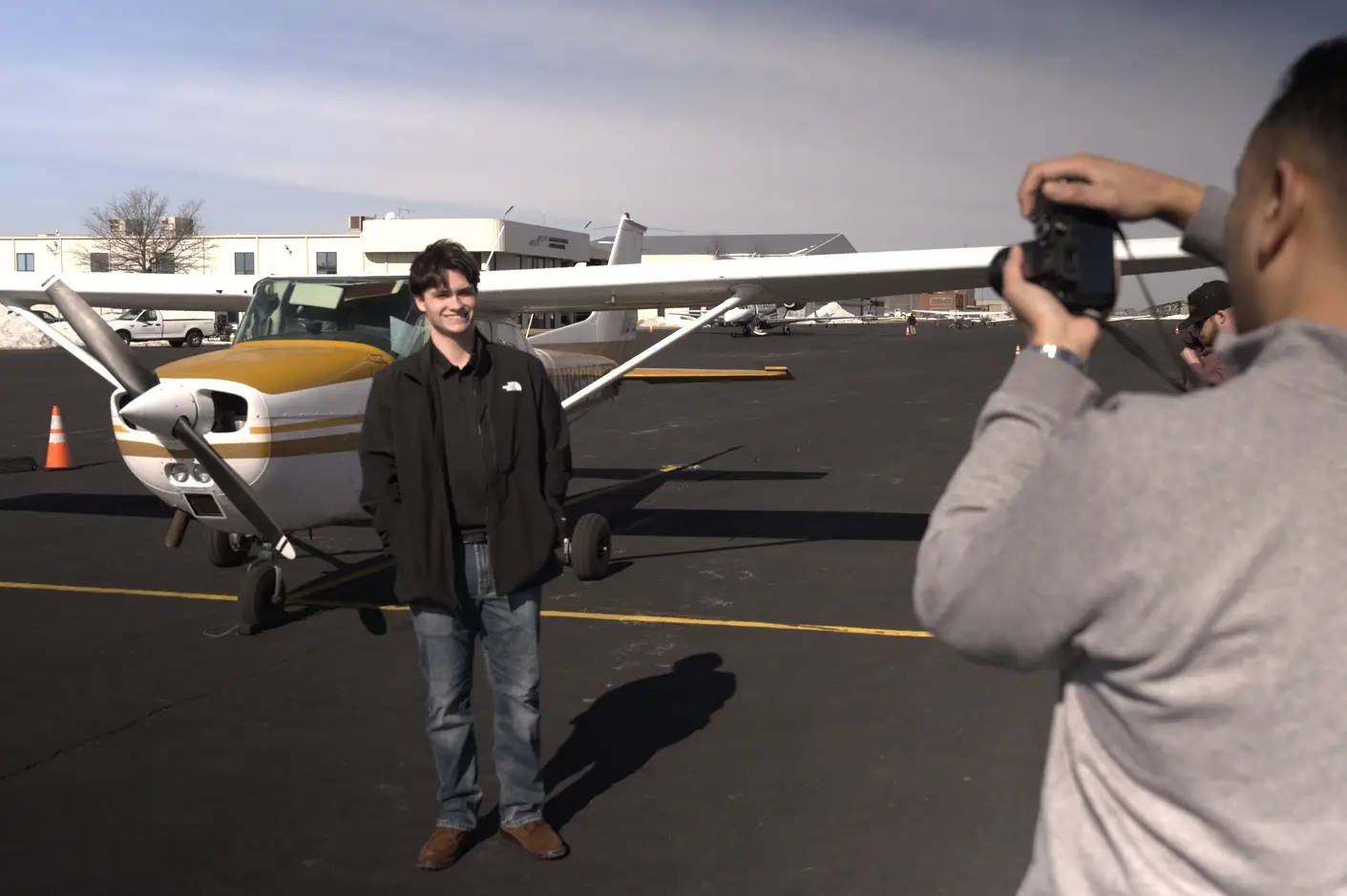
Here’s a scenario that plays out in flight school marketing departments every week. Someone spends a Saturday filming at the airport. The lighting is good. The aircraft look clean on the ramp. The chief instructor delivers a confident thirty-second introduction to the school and its programs. The editor adds a music bed, a title card with the school’s logo, and a clean lower-third. The video goes up on YouTube and Facebook. It gets forty-three views in a month — twenty of them from staff.
The problem isn’t the production quality. It isn’t the platform. It isn’t even the message.
The problem is the first three seconds.
Brendan Kane spent years leading digital strategy for major consumer brands before turning his attention to a single question: what actually makes people stop scrolling? His research team tested thousands of content variations across social and video platforms to identify the precise creative mechanics that earn attention before the algorithm decides whether to distribute a piece of content further. The finding is unambiguous — and it has direct consequences for every flight school trying to build an audience online.
You have approximately three seconds. What you do in those three seconds determines whether any of the content that follows ever gets seen.
This Is Infrastructure, Not Style
The most important reframe in Kane’s Hook Point framework is this: the hook is not a stylistic preference. It’s not a trend or a platform quirk or something the social media generation cares about more than serious viewers. It’s infrastructure.
Here’s why. Video platforms — YouTube, TikTok, Instagram, Facebook — distribute content based on retention signals. The algorithm watches how long people watch. A video that loses 30% of its audience in the first fifteen seconds sends a clear signal: this content didn’t earn attention. The platform responds by showing it to fewer people. The organic reach collapses. The content effectively disappears regardless of how valuable the remaining seven minutes might have been.
Conversely, a video that retains a high percentage of viewers through the first thirty seconds gets distributed more broadly, shown to more non-subscribers, and recommended to more people in the target audience. The hook is the mechanism that unlocks everything downstream — the trust-building content, the enrollment conversation, the community relationship. Without it, none of the other investments in your flight school content strategy have a chance to function.
YouTube’s own internal data confirms this: 20% of viewers abandon a video within the first ten seconds. For flight school content competing against entertainment, news, and algorithmically optimized media for the same viewer’s attention, that abandonment window is not a theory. It’s the operating environment.
What Makes a Hook Work — Kane’s Three Triggers
Kane identified three primary mechanisms that stop the scroll and earn the next thirty seconds of attention. Each one translates directly to aviation content.
Tension
Open with an unresolved question or an unexpected statement — something that creates a gap the viewer needs to close. The brain is wired to seek resolution. An opening that introduces tension and withholds the answer drives viewing time in a way that a polished introduction simply cannot.
Weak opening: “Hi, I’m [Name] from [School Name], and today I want to talk to you about what it’s like to train for your private pilot certificate here.”
Tension-driven opening: “Most student pilots quit within the first ten hours. Here’s what the ones who finish do differently — and it has nothing to do with natural talent.”
The second opening creates a question the viewer wants answered. The first gives them no reason to stay.
Specificity
Concrete and particular always outperforms general. Specific numbers, specific timelines, specific outcomes signal that what follows is based on real experience rather than generic content. They also trigger self-identification — the viewer who has logged 47 hours and is preparing for their checkride recognizes themselves immediately in a specific scenario.
Weak opening: “Thinking about getting your private pilot license? Here are some things to know about the process.”
Specificity-driven opening: “I passed my private pilot checkride on the first attempt after 61 hours. These are the three things I did in the final two weeks that I think made the difference.”
Identity Signal
The most efficient hook speaks directly to a specific person and signals immediately that this content was made for them. Done well, an identity signal functions as a filter — it repels viewers who are not the target audience and magnetizes the ones who are.
Weak opening: “Whether you’re flying for fun or pursuing a career, we have a program that fits your goals.”
Identity-driven opening: “If you’re in your 30s, you’ve got a career you’re done with, and you’ve always wanted to fly — this is exactly what the ATP pathway looks like when you start from zero.”
That opening will not appeal to a 19-year-old recreational flyer. It will stop a 34-year-old career-changer mid-scroll and hold them for the next eight minutes.
Aviation’s Hook Advantage — and the Trap Most Schools Fall Into
Aviation has a structural content advantage that almost every other service industry would envy. The visual drama is built in. Takeoffs. Approaches in marginal weather. The instrument panel during a hold. The moment a student lifts off alone for the first time. These images are intrinsically compelling to the audience you’re trying to reach — people who are drawn to flight.
The trap is that most flight schools bury this material. They open with the logo. Then the music bed. Then the name of the school and the name of the instructor. By the time the Cessna finally lifts off the runway, a meaningful portion of the potential audience has already scrolled past.
The editorial fix is straightforward, even if the instinct runs against it: lead with the most visually arresting moment in the video, then build the story backward. Open on the wheels leaving the pavement. Open on the altimeter climbing through 3,000 feet. Open on the student’s face when the controller says “traffic in sight.” Then pull back and tell the story of how you got there.
Kane’s principle: earn the next thirty seconds before you earn the right to introduce yourself.
Before-and-After Hook Examples for Common Flight School Content
Discovery Flight Promo Video
- Before: “[School Name] offers discovery flights for anyone who’s ever wondered what it’s like to fly. Here’s what you can expect when you visit us.”
- After: “In about 45 minutes, I’m going to hand the controls of this airplane to someone who has never flown before. Watch what happens.”
Instructor Spotlight
- Before: “Meet [Name], one of our experienced CFIs here at [School Name]. He has over 2,000 hours and loves helping students reach their goals.”
- After: “This instructor has helped 47 students pass their private pilot checkride. I asked him what the ones who struggle have in common — and his answer surprised me.”
Student Testimonial
- Before: “Hi, I’m [Name], and I trained here at [School Name]. I had a great experience and would recommend it to anyone.”
- After: “I almost quit at hour 22. Here’s what my instructor said that made me keep going — and why I’m glad I did.”
Ground School Tip Content
- Before: “Today we’re going to go over some important concepts from the FAR/AIM that you’ll need to know for your written exam.”
- After: “There’s one question on the private pilot written that eliminates more students than any other. It’s not about weather. It’s not about airspace. And most ground school courses don’t explain it the right way.”
The content of each of these videos may be identical before and after. The hook determines whether anyone watches it.
Short-Form and Long-Form Require Different Hook Strategies
Kane’s framework applies differently depending on the format — and both formats matter for a complete flight school content strategy.
Short-form content (YouTube Shorts, TikTok, Instagram Reels) operates on a compressed timeline. The hook must deliver the core value or payoff within the first fifteen to thirty seconds, because that’s often all the format allows. The goal of short-form is not deep trust-building — it’s discovery. A short-form hook that performs well brings the right viewer into contact with your school’s content ecosystem for the first time.
Long-form content (full YouTube videos, podcast episodes) operates differently. The three-second hook earns you the next thirty seconds, which earns you the first two minutes, which earns you the full video. Long-form is where trust is actually built — where a prospective student spends twelve minutes inside your school’s worldview and begins to feel that your instructors understand them. But none of that trust-building begins without a hook that holds them past the first ten seconds.
Both formats are needed. Neither replaces the other. The short-form hook brings them in. The long-form content converts passive curiosity into genuine relationship.
Need help building a content strategy that puts these principles into practice consistently? Explore our flight school marketing resources for planning tools designed specifically for aviation operators — then see how the Right Rudder Marketing Flight School Marketing System supports schools from content strategy through enrollment conversion.
What Comes Next: Building the Media Infrastructure
You know who you’re creating content for (Godin). You know how to earn their attention in the first three seconds (Kane). Now the question is: where does that content live, how do you build an audience around it, and how do you make sure that audience is one you own — not one you’re renting from a platform that can change the rules tomorrow?
In Part 4 of this series, we walk through Joe Pulizzi’s Content Inc. model — the architectural blueprint for building owned media that compounds in value over time rather than disappearing the moment your ad spend stops.