
On this page
On this page
8 min read
The twelve-month plan was taped to the wall by the coffee maker.
By week three, nobody looked at it anymore. Not because it was wrong, but because a year is not a unit anyone can act on. You cannot do a year on a Tuesday between a stage check and a maintenance call.
So the plan became wallpaper, and the school went back to doing whatever was loudest that week.
The fix is not a better plan. It is a rhythm short enough to actually run.
The Plan Nobody Runs
There are two failure modes here and the second one is worse.
The first is the good plan with no cadence. Real strategy, real sequencing, and no recurring moment where anyone holds the work up against the numbers. It turns into a document, and documents do not fill flight lines.
The second is the agency with no plan at all. A monthly invoice, a report full of impressions and clicks, and an account manager who describes activity rather than results. Nothing to run, because there was never anything to run.
Both end in the same place: an owner who cannot tell whether the money is working, and who eventually cancels out of fatigue rather than evidence.
What Five Unwatched Months Cost
Say a keyword bet is wrong. Not catastrophically wrong, just aimed at people who will never enroll.
If nobody looks until the month six review, that bet gets five months to run. Five months of budget, five months of content built on the wrong foundation, and five months you cannot get back, because the compounding you were counting on in month nine was compounding in the wrong direction.
A thirty-day check catches the same mistake in thirty days. Same plan, same budget, one third the damage.
That is the entire argument for a quarterly rhythm, and it is why the Flight School Marketing System is built around measurement rather than activity.
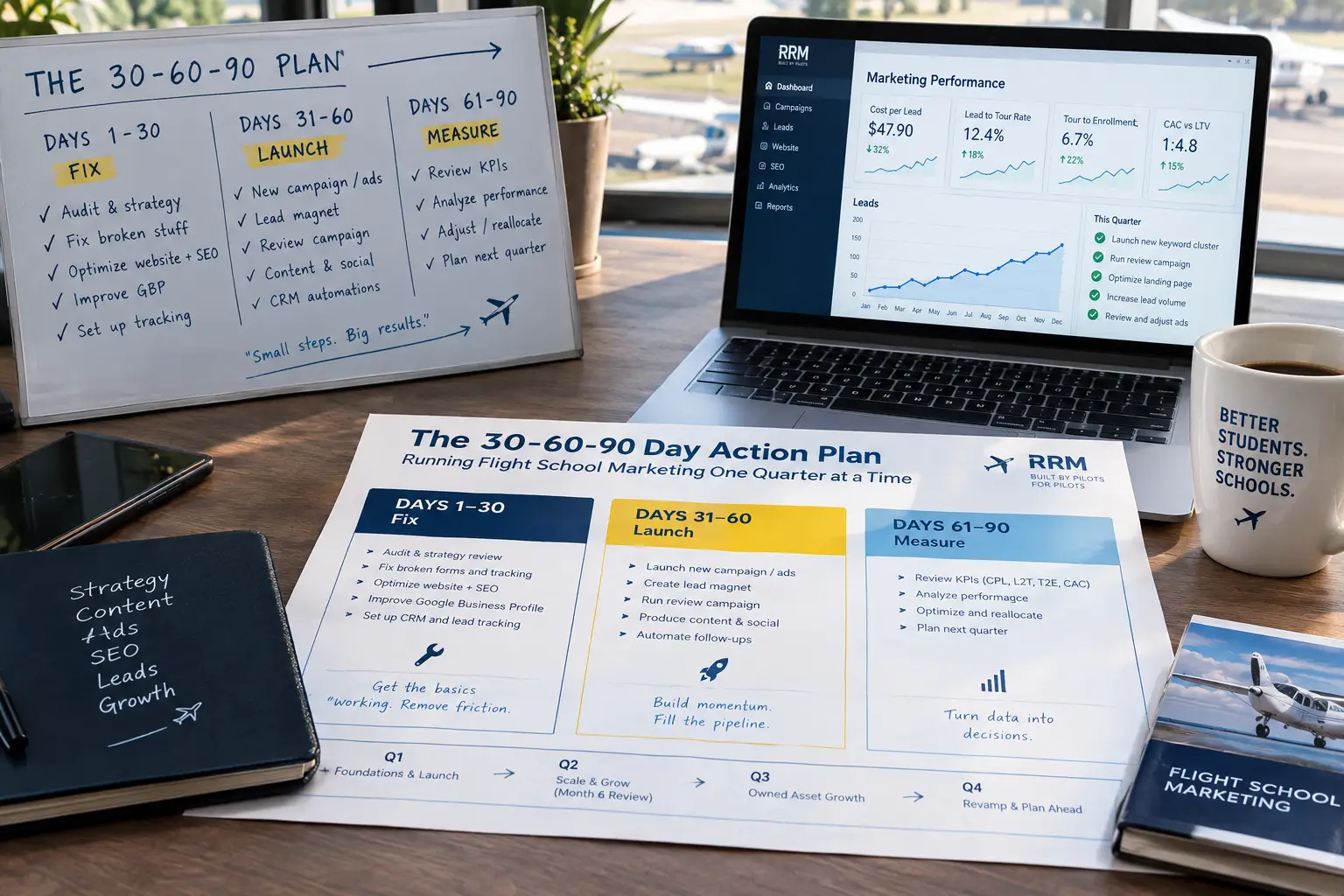
Days 1 to 30: Fix What Is Already Broken
Every quarter opens with repairs, not launches.
In the first quarter these come straight off the audit findings. A contact form quietly routing to a spam folder. A Google Business Profile with last decade’s hours and photos of an aircraft the school sold. A pricing page that never says a price. Call tracking that was never installed, which means every phone lead has been anonymous.
In later quarters, the fix list comes from the previous quarter’s measurement. Something broke, something drifted, something stopped converting.
None of this is glamorous and all of it is cheap. It is also the highest-return thirty days on the calendar, because a school with a working funnel and no traffic is one step from growth, while a school with traffic and a broken funnel is just buying strangers.
Days 31 to 60: Launch One Thing
The middle month is for the one new asset this quarter is responsible for.
One thing. Not five. A new keyword cluster with the content that supports it. Or a lead magnet for the people who are curious but not ready to call. Or a review campaign to move a listing from nine reviews to forty. Or a genuine re-optimization of the ad account against real conversion data instead of launch assumptions.
Which one depends on where you are in the twelve-month plan and what the last quarter’s numbers said. The discipline is the singular. Schools that launch four things in a month cannot tell you which one worked, which means they learn nothing and have to guess again next quarter.
One launch per quarter is four clean readings a year.
Days 61 to 90: Measure, Then Decide
The last month is not more work. It is looking, honestly, at two sets of numbers.
The Leading Numbers
These move first and you can act on them.
Website traffic. Who is arriving and from where. Ad conversions. Not clicks. People who called or submitted something. Total leads. Calls, form fills, and walk-ins together, because a school that counts only forms is usually undercounting by half. Cost per lead. Total marketing spend divided by total leads.
Those four tell you more about whether the system is working than anything else on a dashboard.
The Lagging Numbers
These tell you whether any of it mattered.
Enrolled students. Revenue. Cost of acquisition, which is your marketing spend in a month divided by the new students that month.
Between the two sits the pipeline itself: inbound lead, contacted, school visit or discovery flight, follow up, enrolled. Watching the rate at which people move between those stages is how you find out whether your problem is traffic, follow-up, or the conversation that happens after someone lands.
Then one decision, and only one. Keep, adjust, or pivot.
Where This Rhythm Comes From
Tim Jedrek ran production in food manufacturing before he ran a marketing agency, and the cadence came with him.
On a factory floor, teams review production numbers daily, work through problems weekly, take a bird’s-eye view monthly, and reassess at the quarter and the year. Nobody waits six months to find out whether a line is running badly, because the cost of finding out late is obvious to everyone.
Flight training is a slower business than a production line, so the intervals stretch. The logic does not change. Look consistently, at numbers you decided in advance mattered, on a schedule nobody has to remember.
How Four Quarters Add Up to a Year
Stack the quarters and the twelve-month plan stops being wallpaper.
Q1 is foundations. Tracking, the website, the first campaigns, the Google Business Profile, the CRM. The leading numbers appear for the first time and the early cost per lead looks bad.
Q2 builds out. Lead magnets, location pages, media day, more content. It ends in the month six review, which is the one meeting where the whole strategy can be declared wrong and changed.
Q3 is where owned assets start carrying. The clusters planted in month three begin ranking, the review campaign matures, ads get re-optimized against nine months of real data.
Q4 consolidates. Website performance review, a revamp plan built on evidence, testimonials collected while the wins are fresh, and next year’s strategy written by people who now know how your market behaves.
The Numbers Only Move Because Someone Looked
Hawkins Flight Academy makes the case better than an argument does.
Their Google Ads cost per lead opened at $145. By month six it was $52, with a blended cost of $47.90 across every channel and 71 leads in that single month. That improvement was not automatic. It happened because somebody was looking at the account on a regular cadence and making changes based on what the numbers said rather than what the plan assumed in July. The full six months are earlier in this series.
At Blue Skies Above in Lanett, Alabama, the first thirty-day fix was an automated text reply to missed calls. Not a campaign, not a redesign, just catching the people already calling while the owner was flying. The ninety-day measurement showed leads holding instead of leaking. Within a year the school had doubled and built a waitlist of ten to eleven students.
The honest part is that not every quarter produces a chart worth framing. Some quarters the right decision is to hold and let slow work finish, and holding on purpose is a decision, not a failure. What you cannot afford is not knowing which kind of quarter you just had.
Three Columns on the Whiteboard
Back to the whiteboard on the office wall, the one that used to hold nothing but the week’s schedule.
The schedule lives on a screen now, because the whiteboard has a better job. Three columns across the top: this month, next month, the month after. Fix, launch, measure. A number at the bottom of each one.
The owner still flies the 7am block. He just also knows, on any given Tuesday, what his school is working on and what it is waiting to find out.
If you want to know which repairs your first thirty days would start with, get your free Growth Audit. It costs nothing, it is not a sales pitch, and the findings are yours to keep either way. For checklists and guides to run alongside it, everything is on the resources page.
That closes this series. You now have the definition, the case for doing it, the system, the audit that starts it, the twelve-month plan, and the quarterly rhythm that keeps it running. The only part left is the part that was always yours: deciding to start.
More in This Series
This is part 6 of a six-part series on flight school marketing, written to be read in order.
- What Is Marketing, Really? A Plain Answer for Flight School Owners. The three jobs every school is already doing, and why word of mouth cannot be dialed up.
- Why Your Flight School Needs Marketing, Even With a Full Schedule. The word-of-mouth ceiling, the four places students rule you out, and what a leak costs a year.
- Why the Flight School Marketing System Works When Piecemeal Marketing Doesn’t. Why five vendors fail, what one system does instead, and six months of numbers from Hawkins Flight Academy.
- What a Free Flight School Marketing and Website Audit Actually Shows You. The six areas the audit walks for your school, and why you keep the findings either way.
- Your First 12 Months: The Flight School Marketing Plan, Month by Month. What launches when, which months stay quiet, and why month nine pays for month three.
- The 30-60-90 Day Action Plan for Flight School Marketing. You are here.