
Flight school near me
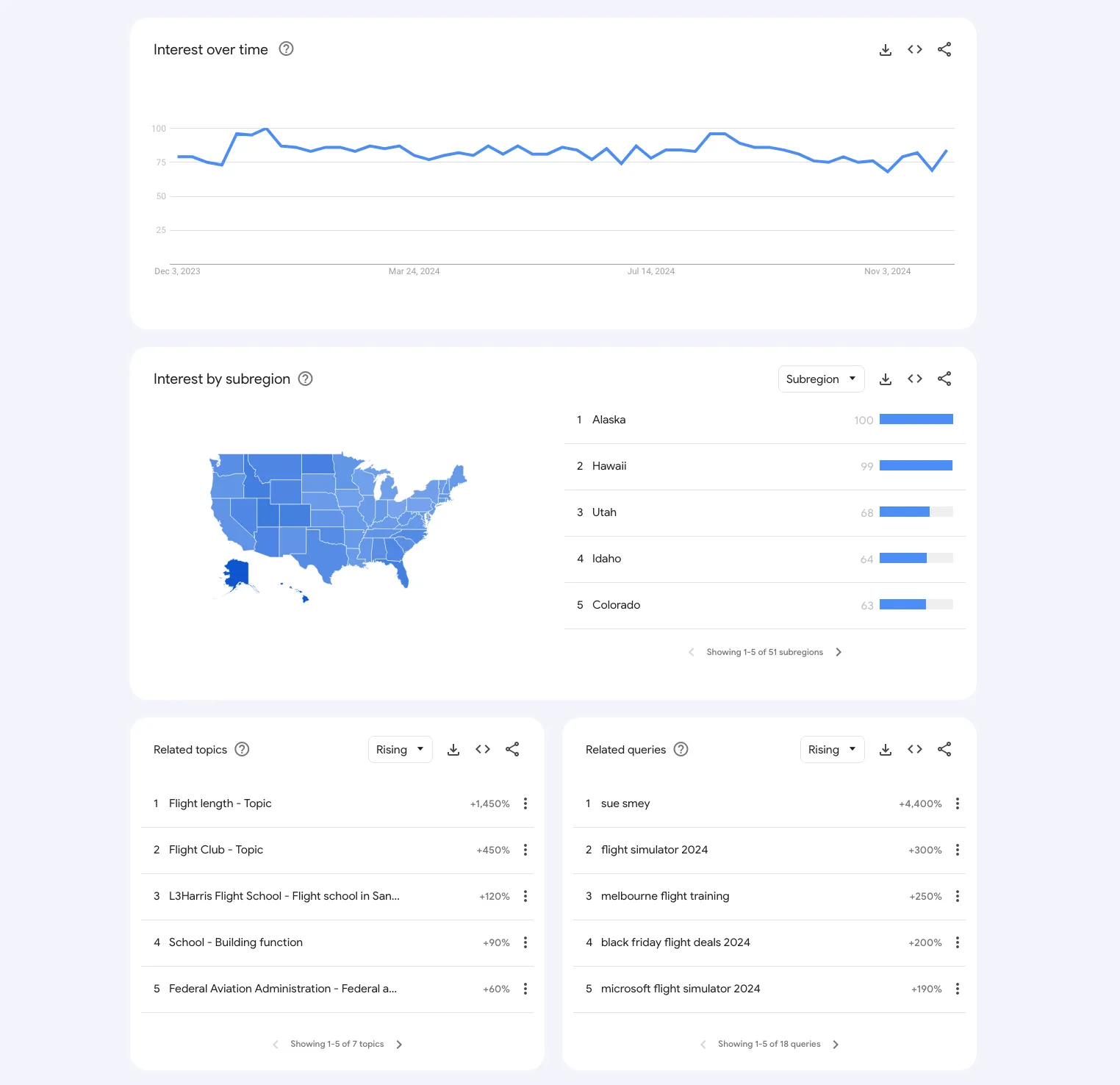
The map pack wins this one, and it runs on your Google Business Profile, your reviews, and your listings more than on your website. Three schools appear. If yours is not one of them, the search is over.

Students search for flight training in the town they live in. Flight school SEO puts your school first for those searches: the map pack, a page for each program, and the questions they ask before they call.
A prospect does not search for flight training in general. They search for it near them, for a specific certificate, and with a specific question. Each of those three searches is won by a different part of your site, and most flight school sites are built to win none of them.
The good news is that the competition is thin. In most markets the schools at the top of the results are there because nobody else did the work, not because they did it well. A school that builds the right pages and keeps its profile current can pass them inside a year.
The catch is that SEO is one job in a chain of eight. It sends the traffic; the website has to turn it into a booking and the Google Business Profile has to hold the map pack. The how it works guide grades your school on the search job in a minute.
The map pack wins this one, and it runs on your Google Business Profile, your reviews, and your listings more than on your website. Three schools appear. If yours is not one of them, the search is over.
One page per program, each with its own price, aircraft, and next step, wins this one. A school with one Programs page loses to a school with a page for each certificate, every time.
Question pages win this one: cost, how long it takes, what a discovery flight is, Part 61 versus Part 141. They reach a prospect weeks before they are ready to call, and they are what the AI tools quote when someone asks which school to pick.
SEO is not a setup you do once. It is a monthly job with a list, and the list is the same at every school we run. Here is what is on it.
Not a list of five hundred keywords you will never act on. One cluster a month, pulled from what students in your market actually type, with each phrase assigned to a page that will carry it.
A page for each certificate you teach and a page for each town your students drive from. Written for the search, with the price and the booking on the page, not a brochure paragraph.
Page speed, titles, headings, schema, sitemaps, redirects, and the crawl. This is what lets Google and the AI tools read the site instead of guessing at it. Most of it is invisible to you and all of it shows up in the rankings.
The Google Business Profile, the citations across aviation and local directories, and the review flow. These decide the map pack, and the map pack decides the near me search.
Five to six pieces a month on the Six Pack program: pages, FAQ pages, and posts that answer what a prospect asks before they call. Each one carries a keyword from the cluster and links to a program page.
Positions for the keywords you care about, organic leads by page, and what changed. Rankings are the means; the number we report on is the leads the search job produced.
Reviews and AI answers get their own jobs in the system. The reputation job keeps the reviews coming and the AI search job makes your school the one ChatGPT and Google AI name. SEO feeds both.
Averages hide failures, so here are three schools by name, with the months.
Hawkins Flight Academy started in July 2025 with 61 indexed pages sitting at an average organic position of 40.9, page five of Google. Six months later the average position was 13.0, page two, and organic click-through rate had gone from 2.38% to 5.12%. Forms from organic and direct traffic produced 121 of the school's 348 tracked leads in that period.
Summit Flight Academy reached the first page of Google for its core flight training keywords in Missouri within three months of the new site and the search work behind it. Monthly visitors went up 105% and inquiries went from 22 a month to 53.
Sun City Aviation Academy came to us on page three of the results with a map listing at position 18 in the Miami market. Over two years of program pages, profile work, and a steady review flow, the school moved into the map pack and tripled its monthly leads.
When we audit a school's site, the same six problems come up in almost every one. None of them is exotic. Fixing them is most of the first quarter's work.
Private, instrument, commercial, and CFI on a single page cannot rank for any of them. Google needs one page per search, and so does the prospect who came for one certificate.
How much does flight school cost is the most searched question in the market. A site with no price cannot rank for it and loses the click to a forum thread with a number from 2019.
Speed is a ranking factor and a booking factor. A site that takes six seconds on a phone at the airport loses the prospect before the page paints, and Google notices that they left.
No posts, old photos, the wrong hours, and eleven reviews from three years ago. The map pack rewards the profile that looks alive this month.
Suite 200 on the site, Ste. 200 on the profile, and the old hangar on a directory from before the move. Google reads that as three businesses and trusts none of them.
A rebuild without redirects throws away every ranking the old pages earned. The traffic drops the week the new site launches and the owner blames the design.
The Website and SEO Performance Checklist lets you check your own site for all six in about twenty minutes.
Rankings move in three to six months and keep compounding after that. The first quarter of SEO is mostly invisible: the pages go up, the technical fixes ship, and Google takes its time. Leads from search usually show up in months four to twelve and then keep coming without a media bill.
That timing is why the system runs ads in the first quarter. The paid advertising job carries the quarter while SEO builds, and then SEO takes over the cost per lead as the rankings hold.
The Ramp Up program includes the site and one blog post a month, but no keyword strategy. The monthly keyword cluster, the program and local pages, and five to six content pieces a month start on the Six Pack program. Enterprise roughly doubles the content. The prices and every inclusion are on the pricing page.
The Flight School Keywords Guide lists the terms prospective students search for, mapped by intent, so you can see which ones your site already answers and which ones it misses.
Rankings start to move in three to six months, and leads from search usually show up in months four to twelve. After that it compounds: the pages keep ranking without a media bill. Hawkins Flight Academy went from an average organic position of 40.9 to 13.0 in six months; that is the pace to expect when the site and the profile are both being worked.
It is the work that wins the near me search: your Google Business Profile, your reviews, your listings in aviation and local directories, and a page for each town your students drive from. Most prospects search for training near where they live, and the map pack shows three schools. Local SEO is how you become one of the three.
From what students in your market actually type, checked against search data and against what your competitors already rank for. One cluster a month, each phrase assigned to the page that will carry it: a program page for the certificate searches, a local page for the town searches, a question page for the cost and how long searches. The Flight School Keywords Guide shows the map.
Yes, for the opposite reason ads need SEO. Ads produce leads the week you start and stop the week you stop. SEO takes a quarter to move and then keeps producing. Running both means ads carry the first quarter while SEO builds, and SEO lowers the cost per lead every month after that.
No, and neither can anyone else. Google does not sell positions, and a promise of page one by a date is a guess dressed up as a plan. What we can show is what happened at named schools with the months attached, on this page and on the case studies page.
Ramp Up includes the site and one blog post a month, with no keyword strategy. The monthly keyword cluster, the program and local pages, and five to six content pieces a month start on Six Pack. Enterprise roughly doubles the content. Every inclusion is on the pricing page.
It is most of the foundation. The AI tools quote pages that answer questions plainly, carry structured data, and are cited elsewhere, which is what the search job builds. The AI search job in the system adds the structured data and the citations on top. One foundation, two audiences.
Send us your URL. A real person goes through your website, your rankings, your Google Business Profile, and what happens after someone fills out your form.
 Free checklist
 The audit points we run on every school's site: technical SEO, page speed, schema, and the local signals that decide the map pack.