
On this page
On this page
9 min read
He ran Google Ads for one summer.
The calls came in, the discovery flights filled, and it felt like the problem was solved. In October, cash got tight and he turned the campaigns off. The phone went quiet the same week.
He drew the obvious conclusion: marketing only works while you are paying for it.
He was half right, and the half he was missing is the whole reason we ask schools to plan on twelve months.
Rented Visibility
Paid ads are rented. That is not a criticism, it is just what they are.
You pay, you appear. You stop, you disappear, and you disappear immediately. Nothing you bought last month is still working for you this month.
Rented visibility is genuinely useful. It is the fastest way to put a school in front of people while slower assets are still being built, and it produces data about what your market actually responds to within weeks instead of quarters.
The trap is treating it as the whole strategy. A school that only rents is starting from zero every single month, forever, and the generic agency is fine with that because it reports quickly and hides the fact that nothing was built.
Owned visibility works the other way. Your pages, your search rankings, your Google Business Profile, your reviews. Slow to build, and they keep working when the card is not being charged.
The whole point of a twelve-month plan is to shift the load from rented to owned while never letting the flight line go quiet during the handoff.
Month 1: Foundations, and Nothing Rings Yet
Month one is onboarding, and it produces no students. Owners should hear that plainly before it happens rather than after.
The work is a real conversation about the business, then the unique value proposition and a market analysis. Who are you actually competing with, what do people in your market search for, and what makes your school the right answer for a specific kind of student.
Alongside that come the quick wins, the things that are broken and cheap to fix, usually straight off the audit findings, and the website launch. Conversion tracking goes on before anything else, because a cost per lead you never measured is a cost per lead you can never improve.
If you judge the program in month one, you will cancel it. Month one is the runway, not the climb.
Months 2 and 3: Ads Go Live, the CRM Goes to Work
Now campaigns launch, and the first real numbers appear.
The first cost per lead is going to look bad. At Hawkins it opened at $145 before settling to $52 over the following months, and that early stretch is the account learning which searches are worth paying for. The full six months at Hawkins are in the previous post in this series.
Backlink work starts in parallel, slowly. The Google Business Profile gets rebuilt properly: categories, hours, current photos, and a plan for reviews. That listing is often the highest-return item on the entire plan and it costs nothing but attention.
The CRM comes online here too, with training for the staff who will actually use it. Automated follow-up, missed-call text back, and a place where every inquiry lands instead of an inbox somebody checks between lessons.
Months 3 Through 5: Lead Magnets, Location Pages, Media Day
This is where the owned assets start getting built in volume.
Lead magnets give the people who are not ready to call a reason to raise their hand anyway. Location-based pages go up for the towns and airports around you, because a search from thirty miles away is a different search than one from your own zip code. Additional site pages fill the gaps the audit found.
Somewhere in here is media day. Someone comes out and shoots real photo and video of your actual aircraft, your actual instructors, and your actual ramp, which ends the era of your website showing a stock Cirrus you do not own.
Additional ad platforms come into the mix if the data supports it, not because a checklist says so.
Month 6: The Review and the Pivot
Halfway through, everything stops for a real review.
KPIs on the table. Trends analyzed. What produced students, what produced noise, and what quietly did nothing. Then the strategy gets reassessed and changed where the numbers say it should be.
This is the meeting most agencies skip, because it is the meeting where a plan can be declared wrong. A plan nobody will change at the halfway point is a subscription with a slide deck attached. Running that check every ninety days instead of every six months is the subject of the last post in this series.
By this point at Hawkins, the school had produced 348 trackable leads in six months at a blended $47.90, including 71 in month six alone.
Months 7 Through 9: The Owned Assets Start Carrying
This is the stretch that a school quitting at month six never sees.
More SEO campaigns build on the clusters started in month three. The Google Business Profile and review campaign get revisited, because reviews go stale and a listing that was accurate in March may not be in September. Ad campaigns get re-optimized against real conversion data rather than launch assumptions.
The character of the traffic changes here. Organic starts contributing meaningfully instead of trickling. At Hawkins, average search position moved from 40.9 to 13.0 and indexed pages went from 61 to 79 inside the first six months, with the organic side still climbing after that.
Position matters more than most owners realize. Only 0.63 percent of searchers ever click a result on page two (Backlinko). Moving from position 40 to position 13 is not an incremental improvement. It is the difference between existing and not.
Months 10 Through 12: Revamp, Testimonials, Next Year
The last quarter is about consolidating and setting up year two.
Website performance gets reviewed against a year of real behavior, and a revamp plan comes out of what the data showed rather than what looked dated. Testimonials and reviews get collected while the wins are fresh. And the strategy for the next twelve months gets built by people who now know exactly how your market behaves.
Year two starts from a school that ranks, has reviews arriving steadily, and knows its cost per lead. That is a completely different starting line than year one.
What a Year Actually Costs
Owners deserve a real number rather than a range with a shrug attached, so here is one from an actual school.
Across their first six months, Hawkins Flight Academy invested $16,668 total. That was $9,000 in fees and $7,668 in advertising, and the ad money went directly to the platforms rather than through us. It produced 348 trackable leads at a blended $47.90 each.
Two things are worth pulling out of that. First, more than a third of the total was ad spend the school controlled and could see in its own account. Second, the fee side is knowable in advance, which means you can decide whether the math works before you start rather than discovering it in month four.
Programs are built in tiers by fleet size, starting around $1,000 a month for owner-operated schools with a few aircraft and scaling up for larger operations with account management, monthly keyword work, and heavier content production.
Whatever tier a school sits in, the shape of the year is the same. Front-loaded work, a quiet stretch, a review at the halfway point, and a back half where the assets you already paid for start doing the work for free.
Why Month Nine Pays for Month Three
Here is the whole argument in one sentence, and it is the reason for the term.
The keyword clusters and content built in month three are what rank in month nine. A school that stops in month seven pays for the setup and misses the return.
That is not a contract argument dressed up as a strategy argument. It is how compounding assets work in every industry, and flight training is slower than most because the buying cycle is long. Somebody who finds you in March may not start training until August.
The schools that see the biggest numbers are the ones that stayed long enough for the slow half to pay off. Sun City Aviation Academy tripled its monthly leads and went from buried at number 18 in Maps to being the local authority, over two years. SimpliFly moved from number 14 in Maps to the top of the pack. Those are not 90-day stories and nobody should sell them as such.
A Year Later
Back to the owner who turned off his ads in October.
A year into a real plan, he still runs ads. The difference is that roughly half his inquiries now arrive through pages, listings, and reviews he owns outright. When cash gets tight and he turns the ad budget down for a month, the schedule does not empty out.
That is the whole point. Not to stop paying for attention, but to stop being the only thing holding the flight line up.
If you want to see which parts of this your school would start with, get your free Growth Audit. You keep the findings either way. For the wider picture, the Flight School Marketing System page shows how these pieces connect, and How We Take Flight Schools to Multiple Seven Figures goes deeper on the compounding argument.
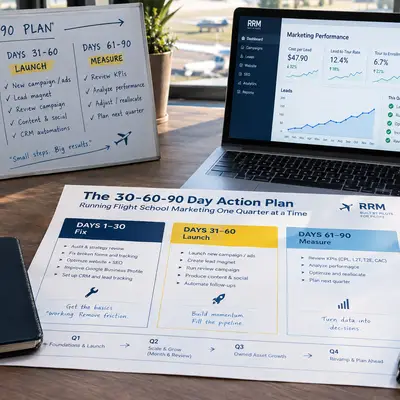
Next in this series: the 30-60-90 day rhythm that turns a twelve-month plan into something you can actually run, one quarter at a time.
More in This Series
This is part 5 of a six-part series on flight school marketing, written to be read in order.
- What Is Marketing, Really? A Plain Answer for Flight School Owners. The three jobs every school is already doing, and why word of mouth cannot be dialed up.
- Why Your Flight School Needs Marketing, Even With a Full Schedule. The word-of-mouth ceiling, the four places students rule you out, and what a leak costs a year.
- Why the Flight School Marketing System Works When Piecemeal Marketing Doesn’t. Why five vendors fail, what one system does instead, and six months of numbers from Hawkins Flight Academy.
- What a Free Flight School Marketing and Website Audit Actually Shows You. The six areas the audit walks for your school, and why you keep the findings either way.
- Your First 12 Months: The Flight School Marketing Plan, Month by Month. You are here.
- The 30-60-90 Day Action Plan for Flight School Marketing. Fix, launch, measure. The quarterly rhythm and the four numbers that decide what happens next.