
On this page
On this page
7 min read
A new flight school starts with airplanes, instructors and a lease on the hangar. What it doesn’t start with is a history. No years of Google reviews. No pages that have been ranking since 2015. No alumni telling their friends where they learned to fly.
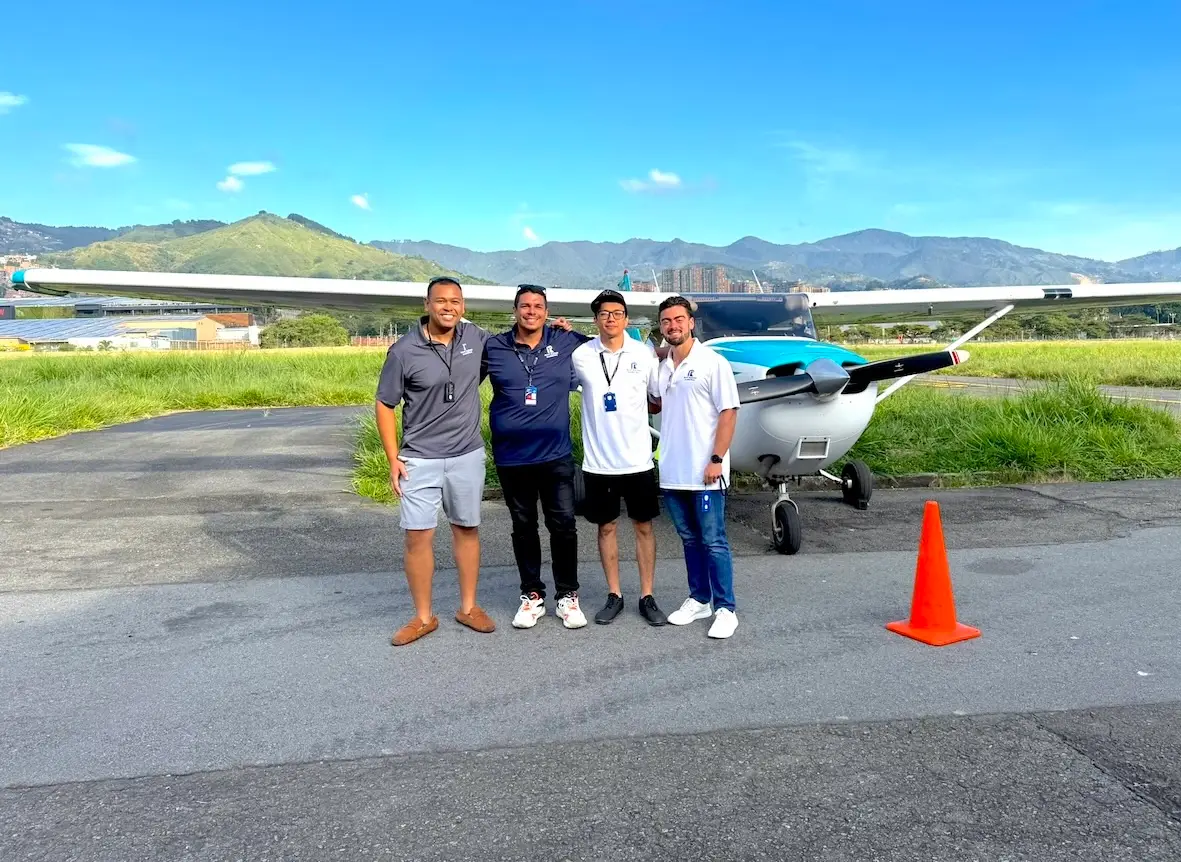
Volair Aviation opened in 2026 at Charlotte-Monroe Executive Airport (KEQY) in Monroe, N.C. As of this week, it’s running the full Flight School Marketing System with Right Rudder Marketing.
This post covers who they are, why marketing a new flight school is a different problem than marketing an established one, and exactly what the first 90 days look like.
A School Built Against the Rush
Volair is family-owned. President Robert Muhlsteff and Vice President Veronica Ramos own it. Chief Pilot and Chief Flight Instructor Christopher Duarte and Director of Operations David Kerr, a former Part 121 airline pilot with more than 5,000 hours, run training.
The school exists because of a pattern its founders kept seeing. Students were being pushed through accelerated programs on a timeline, earning certificates without the proficiency or confidence to match. Duarte went through one of those programs himself. Muhlsteff watched it happen from the outside.
So Volair is built the other way. Their line is “Structured like an academy. Personal like it should be.” Every student gets a defined syllabus with clear lesson objectives, one-on-one ground instruction instead of group classes, and progression tied to skill rather than a calendar.
The equipment backs it up. The fleet is Diamond DA40s with Garmin G1000 glass cockpits, rented at a published $165 an hour wet. Two Redbird FMX full-motion simulators sit on campus, set up to match the airplanes. Training runs from private pilot through instrument, commercial, CFI and CFII under Part 61, and a partnership with Purdue Global lets students put up to 45 transfer credits toward a degree.
The Problem With Being New
Most marketing advice for flight schools assumes the school already exists online. Fix your website. Ask for more reviews. Tune your ads. That’s all true, but it skips the first problem a new school has: almost nobody knows it’s there.
When a future pilot in Matthews or Indian Trail searches “flight school near me,” Google shows the schools it trusts. Trust, to Google, looks like history. Reviews piled up over years. Other websites linking in. A Business Profile that’s been answering questions since before most of today’s students were in high school.
A new school can have better airplanes, a sharper syllabus and more patient instructors, and still sit on page two. Being better isn’t the same as being found.
Charlotte makes this harder. It’s a big, growing metro with an airline hub at its center and plenty of established training options around it. Volair isn’t competing for attention in an empty market. It’s walking into a crowded one.
The Message That’s Hard to Fit on a Billboard
There’s a second challenge, and it’s the one we find most interesting.
Accelerated programs have an easy pitch. “Private pilot in 30 days” fits on a banner ad. Volair’s pitch takes a sentence: you’ll move on when you’re actually ready, and you’ll be a better pilot for it.
That sentence doesn’t win a scroll contest. But the student it’s written for is real. They’ve read the forum threads about washed-out students and stalled training. They’ve talked to someone who quit at 50 hours and $12,000 in. They’re not looking for the fastest school. They’re looking for the one where they’ll finish.
Generic marketing will flatten Volair into “another flight school near Charlotte” and compete on price and speed. That’s the fight Volair was built to avoid. The job is to say the longer thing, clearly, to the person who needs to hear it.
The Flight Plan: Volair’s First 90 Days
Volair didn’t hire us for one campaign. They’re running all five parts of the Flight School Marketing System: the website, SEO, paid ads, reputation and a sales process backed by a CRM. For a new school, those five pieces are the history it doesn’t have yet.
Days 1 to 30: Listen, Map, Fix the Foundation
Before a single ad runs, we learn how Volair actually sells training. We study the Monroe and greater Charlotte market, map which schools students are comparing, and sharpen the proficiency story so it reads in five seconds instead of fifty.
Then we fix the foundation. That means website pages, forms and calls to action, and a Google Business Profile built out completely. For a new school, the Business Profile is often the first thing a student sees. It has to look as finished as the hangar.
Days 31 to 60: Turn On the Traffic
A new school can’t wait for search to catch up, so paid ads carry the early load. Campaigns launch aimed at future pilots around Charlotte, with the $310 discovery flight as the front door.
Volair’s team also gets onboarded onto the CRM, with training classes on how to use it. Every inquiry gets logged, followed up and tracked to the end, whether that’s a booked discovery flight or a “not now.” When you’re new, every lead is expensive. None of them can fall through the cracks.
Days 61 to 90: Start Building the History
This is where the long game starts. Backlinks, local search work and a steady review rhythm begin stacking up. Volair already holds a 5.0 rating on Google. The goal is to keep that number and grow the count behind it.
Search work is back-loaded. The pages built now are what rank months from now. After day 90, the 12-month plan keeps going: lead magnets, location pages, a video and photo media day, and a full KPI review at month six.
What We’ll Measure, and What Will Be Slow
We don’t have results to show you yet. That’s the honest version of a partner announcement. What we can show you is the scoreboard.
Every month, we’ll track four numbers with Volair’s leadership:
- Leads, counting calls and form fills
- Discovery flight bookings
- Enrollments
- Cost per enrolled student
We’ll also watch review count and search visibility closely, because for a new school, those are the leading signs that the history is building.
Here’s the hard part, said plainly. Paid ads will move first. Organic search will be slow, slower than it would be for a school with ten years of reviews behind it. The first real read comes at the month six review, and if something isn’t working, that’s when it changes.
“We started Volair because we saw too many students pushed through training on a timeline instead of learning to fly,” Muhlsteff said. “That message only works if the right students hear it.”
What Other Owners Can Take From This
You don’t need to be new to learn from Volair’s setup. Three questions are worth asking about your own school this week:
- Can a student tell what makes you different in five seconds? Read your homepage headline out loud. If it could belong to any school in your state, it isn’t doing its job.
- What does your Google Business Profile say about you? Search your school’s name from your phone. Check the photos, the hours, the review count and when you last answered a review.
- Who owns the follow-up? If the answer is “whoever’s at the desk,” leads are already slipping.
Building the History on Purpose
Every established flight school was new once. Most of them built their reputation by accident, one happy student and one review at a time, over a decade.
Volair is doing it on purpose. The airplanes, the simulators and the training philosophy are already in place at KEQY. The next 12 months are about making sure the students who want that kind of training can find it.
Robert, Veronica and their team will do the flying. We’ll hand them the map and keep the numbers honest. We’ll report back at month six.
If you want to see your own school’s map first, start here. Get Your Free Growth Audit. You keep the findings either way.