
On this page
On this page
13 min read
Last year the FAA added nearly 39,000 pilots to the rolls. In the same year, fewer people started flight training than the year before.
Both numbers come from the same agency. Active pilots climbed from 848,770 to 887,519. New student pilot certificates fell from 61,353 to 58,761.
Somewhere in that gap sits a Part 61 school with three 172s, a Warrior, and a Tuesday with one lesson on it. The owner has a Search Console tab open on his phone. Average position: 3.1. Calls: quieter than last spring.
He is not doing anything wrong. The map changed under him, and nobody sent a memo. This post is the new map.
Page One Is Not the Finish Line Anymore
For about a decade, flight school marketing had one rule. Rank on page one, get the click, get the lead.
That rule built a lot of good schools. It also built a lot of agency retainers. And it is now only part of the job.
Here is what changed. When Google shows an AI-generated summary at the top of the results, people stop clicking. The Pew Research Center tracked 68,000 real searches from 900 US adults and found the click rate drops from 15% to 8% when a summary appears. That is a 46.7% cut.
The links inside those AI summaries do worse. Users clicked one on 1% of visits.
Roughly 43% of Google searches now end with no click to any outside website at all. On long-tail questions, the kind your future students actually type, AI summaries show up on more than half of searches.
Think about what a prospective student types at 10pm on a Tuesday. “How much does it cost to become a pilot.” “Part 61 vs Part 141.” “Am I too old to start flying.” “Do I need perfect vision.”
Those are exactly the queries the AI answers before a single blue link appears. Your school can own the number one spot for every one of them and still get nothing.
The villain is not Google. It is the playbook nobody updated
The generic agency is still selling the old model. Rank reports. Impression graphs. A monthly PDF full of green arrows.
They do not know a Part 61 from a Part 141, so they cannot tell you that “flight school near me” and “how to become an airline pilot” now behave like two completely different channels. They are running the same template they ran for a dental office in March.
You were handed tools that were never built for flight schools. That is the whole problem, and it is not your fault.
What the Waiting Costs
There is a fueled 172 sitting in the sun right now with nowhere to go. Multiply that by four Saturdays and you have a month of margin gone.
The schedule board fills with white space. Your best CFI, the one students request by name, has a regional interview on Thursday. He is not leaving because he is unhappy. He is leaving because the hours dried up.
And the school across the field is answering inquiries in five minutes while yours sit until the evening.
Most owners have already tried to fix this. The list usually looks the same.
- The nephew running Instagram. Great kid. Posts beautiful sunset shots. None of them answer a question a nervous 38-year-old is typing at midnight.
- Boosted posts. They buy reach from people who were never going to call. Reach is not intent.
- The $99 website. It loads slowly, says “welcome to our website,” and gives an AI system nothing it can quote.
- The last agency. They sent one report you could not read, then went quiet after the third invoice.
Each of those failed for the same reason. Nobody involved understood aviation, and nobody built a system. They built activity.
If you want to see where your own site stands before you read another word, our free flight school website and SEO performance checklist walks you through it in about twenty minutes. No call required.
Visibility Has Four Layers Now
This is the part worth taping to the office wall. Getting found used to be one job. Now it is four, and they feed each other.
Layer one: search
The classic blue link. Someone types a question, scans results, clicks yours.
This still works. It still produces students. It is just no longer the only door, and on informational questions it is no longer the busiest one. What happened to those clicks, and why your position report never showed it, is the subject of Why Your Flight School Rankings Stopped Working.
Keep doing it. Stop expecting it to carry the whole school. The mechanics of that layer, from the technical setup to the content that earns the click, live on our flight school SEO page.
Layer two: the map
When Blake called us about SimpliFly in Mesa, Arizona, his school sat at number 14 on Google Maps. Fourteen. Nobody scrolls to fourteen.
He had a website, social profiles, and a Google listing. From the outside it looked like he was doing everything. From a student’s phone, he did not exist.
Mesa has a lot of flight schools at the same field. Every one of those students was calling somebody. It was never going to be him at number 14.
The map is the closest thing aviation has to a walk-in customer. Around 86% of the impressions a business gets on Google come from people searching a category, not a business name. They are not looking for you. They are looking for a flight school, and Google decides who they see.
What Blake changed to get off number 14, and how to check your own coverage from somewhere other than your office, is the subject of The Map Pack Is Still Your Flight School’s Front Door.
Layer three: the AI answer
Here is the number that surprises most owners. Last year, 45% of US consumers used an AI tool to find a local business. The year before, that figure was 6%.
That comes from BrightLocal’s 2026 Local Consumer Review Survey of just over a thousand US adults. In the same study, 31% had asked ChatGPT specifically for a business recommendation. AI is now the third-largest local discovery channel, behind Google and Facebook, and ahead of Yelp. We walk through the rest of that survey, and a six-minute test you can run on your own school, in 45% of People Now Ask AI to Find a Local Business.
Now look at who is doing it. Among people aged 30 to 44, 64% have asked an AI for a business recommendation. Among people 60 and over, 24% have.
That 30 to 44 bracket is your career changer. The one with a mortgage, a real budget, and eleven years of wanting this. The single most valuable student most schools will enroll this year is also the one most likely to ask a machine which school to call.
Ranking gets you listed. This layer is about getting named. They are different jobs, and how AI decides which flight school to recommend breaks down the four questions a machine runs before it names anybody.
Layer four: mentions
An AI system does not just read your website. It reads what the rest of the internet says about you.
Reddit is currently the most-cited domain across most major AI answer engines. One analysis of 30 million sources put it at number one across ChatGPT, Gemini, Perplexity, Google AI Mode, and AI Overviews.
But the weight varies a lot by platform, and honesty matters more here than a clean headline. Perplexity leans on Reddit heavily. ChatGPT cites it far less. One study of 139,601 Claude grounding sources found no Reddit citations at all.
The practical takeaway holds anyway. When somebody posts in r/flying asking for a school near Denver and gets eleven replies with four school names in them, that thread becomes source material. Your reviews, your local news coverage, your YouTube transcripts, the AOPA forum post where your CFI explained DPE scheduling honestly: all of it is input now, and r/flying is recommending schools right now covers how to earn a mention there without getting banned. Reviews are the piece of this you can actually build on purpose, and how to build them properly covers the four milestones to ask at and the three lines not to cross.
You cannot buy your way into that. You earn it by being useful in public. That is slower than a backlink campaign and much harder to fake, which is exactly why it holds up.
The Good News: Most of the Foundation Has Not Moved
Owners hear all this and assume they need to throw everything out and start over. You do not.
The work that fed the old model feeds the new one. It just has to be done properly instead of once in 2021.
- Keywords still matter. They are how you find out what your market is actually asking. Our guide to why keywords are the foundation of a flight school’s online presence covers the basics.
- Your Google Business Profile still matters. More than ever, because it feeds both the map pack and the AI answers for “near me” questions.
- Reviews still matter. They persuade humans and they train the machines that recommend you. Both jobs, same asset.
- Site speed and mobile still matter. If a page will not load, no crawler and no student waits around.
- Accurate content still matters most of all. Flight training sits in the category Google treats with the most scrutiny, because bad information here costs people money and occasionally safety. Every technical claim needs a CFI’s eyes on it before it publishes.
What is genuinely new is narrower than the hype suggests. Structured data so machines can read your programs. Pages that open with a direct answer instead of “at our school, we believe.” Cost information in a real table instead of a graphic. A steady, honest presence in the places pilots actually talk.
That is it. Four additions to a foundation you already have.
If you want the full picture of how these layers connect, the flight school marketing system page lays out every component and how each one feeds the next.
What This Looks Like When It Works
Blake’s school in Mesa went from number 14 on the map to the top of the map pack. Same airport, same competitors, same aircraft. The school did the work. We handed him the map.
He also made a decision most owners would find uncomfortable. He narrowed admissions to career-track students only, which shrank his prospect pool and raised the lifetime value of everyone who enrolled. Narrower beat broader.
In Lee’s Summit, Missouri, Jeremy Davis at Summit Flight Academy was sitting on page two and three for the keywords that mattered in the Kansas City metro. He was getting traffic. It was not turning into inquiries.
Three months after the work started, his site traffic was up 105% and inquiries went from 22 a month to 53. That is a 141% increase in people raising their hand.
Here is the part Jeremy will tell you that most case studies leave out. His words: “We went from barely getting inquiries through our website to having more leads than our staff could handle.”
More leads than staff can handle is a real problem. It is a better problem than an empty Tuesday, but it is still a problem, and a school that grows visibility without fixing follow-up just leaks faster.
Two honest hard parts
Months one and two look like nothing is happening. The technical foundation, the schema, the profile rebuild, the crawler access, the content restructuring: none of it shows up on a graph while it is being done. Anyone who promises you leads in week three is selling something they cannot deliver.
AI attribution is genuinely incomplete right now. When ChatGPT recommends your school and someone types your name into Google an hour later, that shows up as branded search, not as an AI referral. Branded search volume is the best proxy anyone has. It is still a proxy, and we say so.
How to Sequence This Without Stopping Everything Else
You are not rebuilding the school. You are adding layers in an order that makes each one cheaper than the last.
Months 1 to 2. Foundation. Schema markup, crawler access, page speed, Google Business Profile rebuild, name and address consistency across the web. Nothing visible happens. This is the preflight. Our schema markup setup guide covers the six types worth installing and includes a starter block for your web person.
Months 3 to 5. Content. Rewrite the pages that answer real questions, starting with cost and Part 61 versus Part 141. Put the answer in the first fifty words. Put prices in a table. Add FAQ sections to program pages. Map movement usually starts here. The answer-first method walks through exactly how to write those pages.
Months 6 to 8. Authority. A review request tied to real milestones, first solo, written exam, checkride. Video with transcripts. Directory listings cleaned up. Real participation where pilots talk. First AI citations tend to show up in this window.
Months 9 to 12. Compounding. Citations produce mentions. Mentions produce more citations. This is the stretch where owners stop checking the ad account and start pricing a fourth aircraft.
Back to That Tuesday
The owner with the Search Console tab is still checking his phone between lessons. Average position still hovers around 3.1. That number never was the problem.
What changed is what sits under it. His school shows up on the map when somebody in his county pulls out a phone. His cost page answers the question in the first two sentences, so the machines quote it instead of skipping it. His students leave reviews after their first solo because somebody finally built the habit.
Tuesday has four lessons on it now. His problem this quarter is finding a fourth CFI, and that is a much better problem.
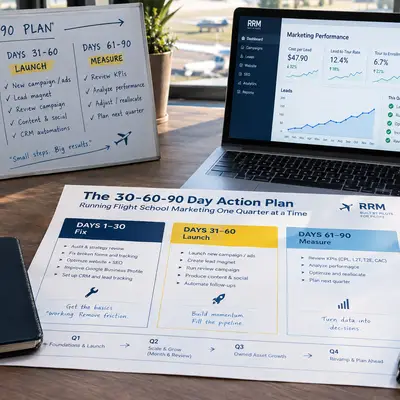
If you want to know which of the four layers is costing your school the most right now, we will tell you. Send us your website and we will send back what is actually wrong with it, ranked worst to best, plus a 30/60/90-day plan. It is free, it is not a pitch, and you keep the findings whether we ever speak again.
More in This Series
This is part one of a nine-part series on how flight schools get found in 2026.
- Flight School SEO in 2026: The Visibility Playbook — you are here.
- Why Your Flight School Rankings Stopped Working — why the clicks fell while the rankings held, and what to track instead.
- 45% of People Now Ask AI to Find a Local Business — the demand-side numbers, plus a six-minute test you can run tonight.
- How AI Decides Which Flight School to Recommend — the four questions every AI system runs on your school.
- Schema Markup for Flight Schools: The Setup Guide — the six structured data types that matter, with starter code.
- Write Pages AI Will Quote: The Answer-First Method — how to write a page a machine will quote instead of skip.
- The Map Pack Is Still Your Flight School’s Front Door — how to move up the three local results that take the calls.
- Your Flight School Reviews Are Now Training Data — why reviews now feed the AI answer, and the four milestones to ask at.
- r/flying Is Recommending Flight Schools Right Now — how to earn mentions in the conversations AI systems read.