

Facebook & Instagram Ads for Flight Schools
The volume channel, at about a third of Google's cost per lead. It also carries a compliance risk most agencies will never raise with you, and a lead quality problem that only shows up on your flight line.
Part of the paid advertising system
Cheaper leads. Not the same leads.
This is the honest version of a pitch you have probably heard dishonestly. Meta really is cheaper. The part that gets left out is what you give up for the discount.
Start with the numbers. Meta's education vertical runs about $14.72 to $29.61 per lead, and averages around $21.31. Google Search in the same category runs $77.48 to $90.02. So roughly a third of the cost, at similar conversion rates.
Two caveats before you plan against those. The Meta number comes from a global sample, so a US school should expect to sit above it. The Google number comes from 13,474 US campaigns in Education and Instruction. That category blends tutoring with online courses. Neither is flight training data. No cost per lead benchmark for flight training has ever been published, and anyone who hands you one has guessed.
Now the part that decides whether the discount is real. Colleges running the same play describe it like this. Marketing teams report a better cost per lead and more leads. Admissions teams report weaker engagement and fewer finished applications. That is reported experience, not a controlled study, and it should be read that way.
Swap finished application for discovery flight flown and you have the flight school version exactly. The lead counter goes up. The flight line does not.
So we measure the show rate from the first week. Not the lead count, the number of people who actually get in the airplane. It is the only number that settles this argument, and it can only come from your data.
None of that means avoid Meta. It means run it knowing which number you are sold and which one you buy. A school with gaps in the schedule and good follow-up often does well here. A school already full, or one where nobody calls a lead back for two days, will burn money and blame the channel.

The compliance problem nobody warns you about
Meta limits targeting on ads it treats as employment, housing, credit or social issues. There is a fair reading under which some flight school ads land in the employment category. Almost nobody in this industry talks about it.
Meta's definition of the employment category names professional certification programs. An FAA commercial pilot certificate is one. So is a CFI certificate. So a school that advertises a career track has a real question to answer. Become an airline pilot, zero to airline, and CFI programs all sit close to that line.
If it applies, here is what you lose. Two independent sources agree on every limit below.
| Restriction | What it costs a flight school |
|---|---|
| Age locked to 18 through 65 plus, and it cannot be narrowed | You cannot reach 17-year-olds at all, in a market where the student pilot certificate has no minimum age and solo is legal at 16. |
| A 15-mile minimum radius, and ZIP code targeting is prohibited | A single-airport school is forced to advertise across roughly 707 square miles, most of which cannot reach it on a Saturday morning. |
| Lookalike audiences are unavailable | Your best-performing audience strategy is gone rather than degraded. Building a lookalike from enrolled students is simply not an option. |
| Lead forms cannot collect age or location | Your two most useful qualifying questions are removed from the form that most needs them. |
Now the part that matters most. Meta has not said whether flight training triggers this category. No source we could find settles it. We treat it as an open question.
That has a practical result. We split an account by offer, so the limits only bind where they might apply. Discovery flight and private pilot campaigns run one way. Career track and CFI campaigns run another. If Meta ever rules that career-track training is employment advertising, the damage stays in the campaigns that were always closest to the line.
The alternative is to find out through an account restriction. That is a bad way to learn and an expensive one, because enforcement at the account level does not politely pause one ad set.
What you cannot say in a flight school ad
This part is not vague. Meta publishes it. Flight school copy walks into it constantly, because the natural way to sell training is to talk about the career at the end of it.
The prohibited category is guarantees or promises of employment, financial gain, or other benefits without information on the specific job or title. Meta's own example of a violating ad is make $1,000 every month.
| Do not run this | Run this instead |
|---|---|
| Earn $50K a year after graduation | Career support and job placement assistance included |
| Guaranteed airline job | A named role, with compensation context you can substantiate |
| Never too old to learn to fly | Copy that does not reference age at all, since age is a protected attribute |
Two enforcement mechanics are worth knowing, because both surprise people.
First, your landing page is reviewed too. The policy covers the creative, every copy field, and the page the ad points at. Meta crawls that page in real time. A clean ad pointing at a page that claims a $300,000 airline salary is still a rejection. The whole funnel is in scope, not just the ad.
Second, there is no intent test. A violation applies whether or not you meant it, and whether or not you knew the rule existed. Good faith is not a defense and there is no warning shot.
So your strongest angles, the career, the salary, the life change, carry the most policy risk. That is workable. It just has to be written on purpose, rather than discovered in a rejection queue.
Where the content goes after the ad
The Six-Pillar Social Media System is the posting structure that turns social attention into booked discovery flights, so your paid reach lands somewhere that keeps working after the campaign stops.
Lead forms or landing pages?
This is the question that decides your economics on this channel, and it does not have a published answer. Here is what is actually known, and where our recommendation comes from.
There is no controlled study, no platform test, and no published practitioner test comparing Meta lead forms to landing pages on show rate or close rate. We searched hard for one. The question that decides whether this channel works for you has never been answered in public.
What is known is narrower. Meta offers three form types, and there is a catch that rarely gets mentioned. Higher Intent and Rich Creative both narrow where your ads can run. Higher Intent shows only in the Facebook and Instagram feed, on mobile. So part of any rise in cost per lead comes from fewer placements, not better leads. Forms also allow up to 15 custom questions, which is more room to qualify than most schools use.
The closest match we could find is a truck driving school. It reported a 36% lower cost per lead and 53% more leads using instant forms. Similar buyer, similar price, same local catchment. It is also a vendor success story with no method attached, so treat it as a hunch rather than evidence.
Our default is a landing page that states a price and books a flight. The reason is specific, not dogma. A school with a tight schedule and a phone-heavy funnel is hurt more by fifty weak form fills than helped by them. Each one costs staff time that could have gone to a caller who was ready.
We use lead forms with qualifying questions and phone checks where volume really demands it. That usually means a school with schedule to fill and the staff to work a longer list. Then we measure show rate on both and let your data settle it. Your data is the only evidence that exists here.
The 730-day exclusion that may be hiding your best prospects
If your account has been running since spring 2026, this one is worth checking today. It costs nothing to look, and it is the kind of thing that quietly halves an audience.
Meta raised the limit on purchase-event custom audiences from 180 days to 730 days on May 18, 2026. Existing audiences were updated for you unless you opted out. This came from practitioner reports rather than a Meta help page, so check your own account rather than taking it on faith.
The risk is not in retargeting, where a longer window is mostly harmless. It is in exclusions. A 730-day buyer exclusion on a prospecting campaign now hides everyone whose buying cycle is shorter than two years.
For a flight school that is exactly the wrong group to exclude. Someone who took a discovery flight 18 months ago and never enrolled is not a spent customer. They are one of the best targets you have. A 730-day exclusion hides them from the campaign built to reach them.
The fix takes ten minutes. Open any prospecting campaign that ran through May 2026 and look at its exclusion audiences. Check the window on each one. If it says 730 days and used to say 180, choose what it should be rather than letting a default choose for you.
Questions owners ask about Facebook ads
Why are my Facebook leads cheaper but worse than my Google leads?
Because they are answering a different question. Someone on Google typed a search, which means they were already looking for flight training. Someone on Facebook was scrolling and your ad interrupted them, which is why the lead costs about a third as much. Both are real leads and they need different follow-up. The number that settles the argument is your show rate, meaning how many booked discovery flights actually get flown, and it can only come from your records. We instrument it from the first week for exactly this reason.
Can I target people under 18 who want to learn to fly?
Meta's minimum targeting age is 18, so you cannot target a 17-year-old directly. You can reach the parents, which is often the better audience anyway since they are usually the ones paying. There is a second consideration: if your ads fall into Meta's employment special ad category, age targeting locks to 18 through 65 plus and cannot be narrowed at all. Whether career-track flight training triggers that category is an open question that Meta has not answered, which is why we segment accounts by offer.
Can I advertise flight training financing on Facebook?
Carefully, and with the expectation of restrictions. Financial products and services is itself a special ad category on Meta, and a school advertising tuition financing plausibly falls inside it. That would bring the same targeting limits as the employment category. Meta publishes nothing specific about tuition financing for vocational training, so anyone telling you definitively either way is guessing. Our approach is to keep financing messaging in a separate campaign so that if restrictions apply, they apply there and not to your discovery flight advertising.
Should we use lead forms or send people to our website?
There is no controlled study comparing the two on show rate or close rate for this kind of buyer, so treat any confident answer with suspicion. Our default is a landing page that states a price and books a flight, because a school with limited schedule capacity is hurt more by fifty low-intent form fills than helped by them. We use lead forms with qualifying questions where a school has gaps to fill and the follow-up capacity to work a longer list. Then we measure show rate on both and let your own data decide.
How much should a flight school spend on Facebook ads?
Less than you spend on Google Search if you only have budget for one, because search catches people who are already looking. Meta earns its place when you have schedule to fill and a follow-up process that works. Education leads run about $14.72 to $29.61 in a global sample, so a US school should plan above that range. The more useful budget question is not how much, but whether you can call every lead back the same day. If you cannot, more volume makes your numbers worse rather than better.
Find out whether your Facebook leads are reaching the flight line
Send us your URL. A real person goes through your website, your rankings, your Google Business Profile, and what happens after someone fills out your form.
- Your full marketing audit, ranked worst to best
- A 30/60/90-day action plan you can start Monday
- A 12-month plan of exactly what we would do
 Free system
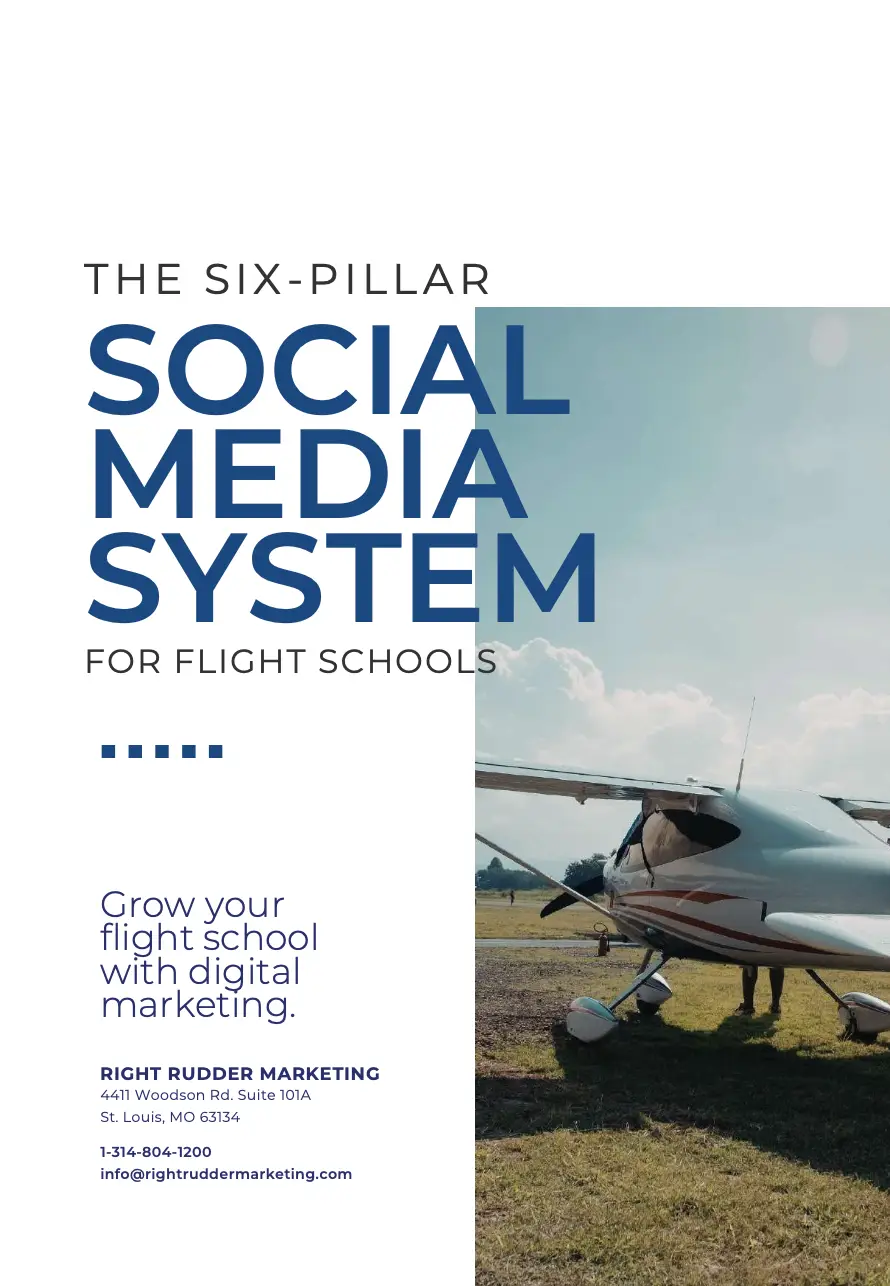
 The Six-Pillar Social Media System for Flight Schools
Where the footage goes after the shoot: the posting system that turns social attention into booked discovery flights.