On this page
On this page
9 min read
Your CFI lands with a student, ties down the airplane, and says, “Nice job today. See you Thursday.” That’s the whole debrief. Nobody learned much, and nobody will remember it by Thursday.
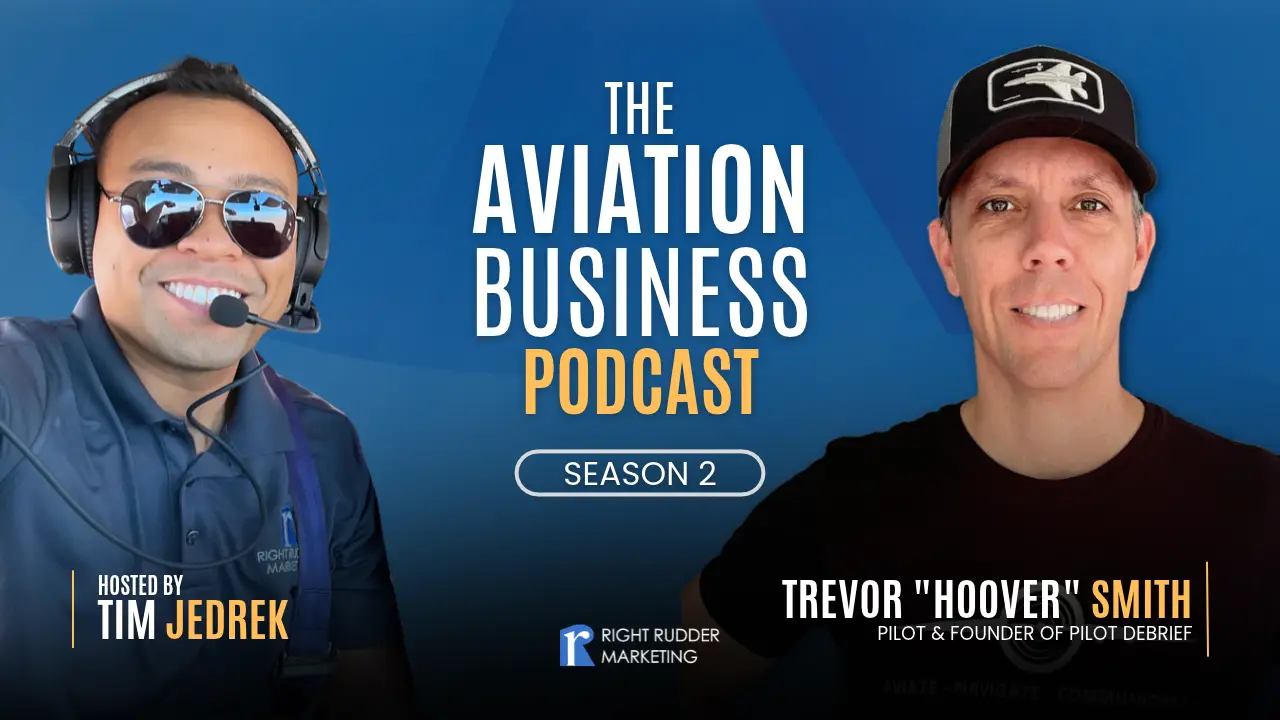
Trevor “Hoover” Smith thinks your flight school can do a lot better than that. Hoover is a former F-15E Strike Eagle pilot, a former Air Force chief of safety, and the creator of Pilot Debrief, a YouTube channel that breaks down real aviation accidents to find the human factors behind them. He joined Tim Jedrek for a live recording of The Aviation Business Podcast, with flight school owners and pilots watching and asking questions in the chat.
Here’s what he shared about briefing, debriefing, safety culture, and even how to market your flight school.
Episode Highlights
From the Air Force Academy to the Strike Eagle
Hoover went to the Air Force Academy at 17. He was set to be the first person in his family to go to college, and money was tight. He had never flown before. After graduation, he was selected to fly the F-15E Strike Eagle. He also flew the F-18 Hornet with the Marine Corps on an exchange program and became carrier qualified.
He served 20 years on active duty. Along the way, he became chief of safety at one of the larger Air Force bases for the Strike Eagle.
He retired in the spring of 2020, planning to fly for the airlines. Then COVID hit. While he waited for the airlines to start hiring again, he got real estate and mortgage licenses and started making videos about the housing market. That’s where he learned how YouTube and social media actually work. A year or so later, the airlines called him back.
How Pilot Debrief Started
Hoover realized he didn’t enjoy making housing videos. He did enjoy talking about flying. When the B-17 and P-63 midair collision happened at the Wings Over Dallas airshow, he made a quick video breaking it down. It did well, so he kept going. Pilot Debrief grew from there as he learned what his audience wanted.
Why Pilots Run Out of Margin
Most pilots don’t plan to make a fatal mistake. Hoover says some pilots in the accidents he studies were reckless. But many more were making decisions that felt reasonable at the time, doing things they had always done. Each choice quietly took away a little of their safety margin until none was left.
His advice: be proactive. Spot threats early, plan for contingencies before you fly, and stay ahead of the airplane. If you aren’t sure about something, ask a mentor or another pilot.
He also uses the Swiss cheese model. A crash is never one simple mistake. It’s a stack of small holes that finally line up. To find the root cause, you keep asking “why” until you get there.
Three Types of Errors Your CFIs Should Know
Tim compared Hoover’s approach to root cause analysis and CAPA (corrective action and preventive action) from his manufacturing days. Hoover added a tool from the fighter world: name the type of error before you try to fix it, because each one needs a different fix.
- Perception error: The pilot didn’t understand what was happening. This is common in new pilots. They hear a radio call and don’t know what it means, or they misunderstood the instructor.
- Decision error: The pilot understood what to do but chose to do something else. This shows up more in experienced pilots who trust their own judgment.
- Execution error: The pilot knew what to do and made the right call, but the technique was off. Not enough power, not enough back pressure. It’s a skill problem.
Hoover’s point for your instructors: don’t assume a student is “just not good” and send them off to practice or read more. Ask what they saw, what they thought was supposed to happen, and what they did. Then fix the right thing.
How to Brief a Training Flight
A good briefing starts with objectives. What are you trying to accomplish today? Your CFI should review the student’s grade sheet and history before the flight and pick objectives that fit.
Hoover recommends two or three primary objectives per flight, no more. With more than that, the student can’t keep track, the instructor can’t either, and the debrief wanders.
He also stressed standards. In a fighter squadron, he had 50 minutes to an hour to brief a complex mission with as many as 10 or 12 aircraft. He could only do that because everything routine was “standard.” Fighter pilots call those basics “motherhood”: the things mom shouldn’t have to tell you to do, like taxi procedures. The briefing focuses on the mission, not the motherhood.
Tim connected this to your flight school. The ACS guides Part 61 training, but he encourages schools to write their own operating manual. How do you expect steep turns to be flown? What’s the procedure to get to the practice area from your airport? Those standards are specific to your flight school, and your team should know them cold.
The Four-Question Debrief
Hoover’s debrief framework comes straight from the fighter squadron:
- What was the plan? Start here. Maybe the instructor picked a practice area with weather or heavy traffic. The plan itself can be the problem.
- What actually happened? Fighter pilots call this “truth data,” because everything in the jet is recorded. In general aviation, you can use tools like CloudAhoy, FlySto, or ADS-B data. Even without them, your CFI can take good notes in flight.
- Why was there a difference? Use the three error types to find the cause.
- What’s the fix for next time? Spell out the corrective action.
A few rules that make it work:
- Save corrections for the debrief unless it’s a safety-of-flight issue.
- Keep the debrief to 15 minutes or less. If Hoover can debrief a complex fighter mission in about an hour, any training flight can be done in 15.
- The instructor critiques themselves first. Admitting “I didn’t brief that maneuver well, that’s on me” makes the student more willing to be honest about their own mistakes.
Standardization and Culture in GA
Tim asked how military training compares to the civilian side. Hoover said he’d like to see more standardization in general aviation, especially at Part 61 schools. His estimate is that about 70% of them don’t use a syllabus at all and just teach to the ACS.
He pointed to a parallel your flight school already knows: turnover. Fighter squadrons constantly turn over pilots, just like you constantly lose CFIs who build hours and move on. That’s why the military depends on standards.
Culture is different too. Military pilots aren’t paid by the flight hour. In GA, pay is often tied to flight hours, so time spent briefing and debriefing may or may not be paid, depending on the school. That makes it harder to build a strong safety culture.
Tim shared that when RRM onboards a new flight school, more than half don’t have defined core values or a clear culture yet. Getting owners to think about mission, vision, and values helps the whole business, not just the marketing.
Cameras, Social Media, and AI in the Cockpit
If you or your students create aviation content, Hoover says safety comes first, no matter what. Set your own standards and never break them. For example, only touch the cameras when the aircraft is stopped, or have a passenger handle them.
He compared it to using your phone while driving, with one big difference. A distraction in a car might mean a fender bender. In an airplane, it’s often fatal.
Used the right way, though, these tools help you learn. With FlySto, you can sync GoPro video to your flight data and replay the whole flight, radio calls included. Hoover added that anyone can now use AI tools like ChatGPT, Codex, or Claude Code to build their own app that analyzes their flight data. Even without a CFI on board, you can learn something from every flight.
Marketing Advice: Know Your Avatar
Tim asked what Hoover learned about growing a channel that your flight school could use. His answer: know exactly who your audience is.
About 60% of Pilot Debrief’s audience is over 55. If Hoover made flashy, fast-cut videos, half his viewers would leave. By making content for his core viewer, he still draws younger viewers too. He just serves his main audience first.
His avatar even has a name: Fred, his father-in-law. Fred used to be a pilot and loves watching aviation videos in his basement on a Saturday afternoon. Before Hoover makes a video, he asks if it’s something Fred would want to watch.
The lesson for your flight school is the same. You might think you want “everyone who wants to fly.” But a recreational flyer, a career-track student, and a mid-career changer all need a different message. Define who your flight school is really for, and you’ll grow faster.
Tim called this the three M’s: your market (your target avatar), your message, and then your marketing channels. Too many owners jump straight to tactics like ad settings and click-through rates before they know who they’re talking to.
Notable Quotes
“Fighter pilots don’t fail less than anyone else. They just learn faster from failure and apply those corrections to the next sortie.” Trevor “Hoover” Smith
“It doesn’t matter how many hours you have or how much experience you have or what type of aircraft you’ve flown, we’re all prone to make mistakes.” Trevor “Hoover” Smith
“In the course of making those decisions, it was slowly taking away their margin for safety.” Trevor “Hoover” Smith
“You should be able to debrief any GA sortie in fifteen minutes or less.” Trevor “Hoover” Smith
“You really have to know who your audience is that you’re trying to connect with.” Trevor “Hoover” Smith
Episode Chapters
- 00:00 Welcome and introduction
- 02:30 From the Air Force Academy to the F-15E Strike Eagle
- 08:37 COVID, a plan B, and advice for new pilots
- 13:07 Military vs. civilian training: standardization and culture
- 16:30 How Pilot Debrief got started
- 19:14 Preventing accidents: margin and the Swiss cheese model
- 24:42 Root cause analysis and the three types of errors
- 29:02 How to brief and debrief a training flight
- 36:01 Building your flight school’s own standards
- 37:53 Social media, cameras, and AI in the cockpit
- 42:36 Marketing advice: define your avatar
- 46:32 Meet “Fred,” the Pilot Debrief avatar
- 48:41 Pilot Debrief resources for CFIs and flight schools
- 52:24 Wrap-up
About Trevor “Hoover” Smith
Trevor “Hoover” Smith is a graduate of the Air Force Academy who served 20 years on active duty. He flew the F-15E Strike Eagle and, on an exchange program with the Marine Corps, the F-18 Hornet, where he became carrier qualified. He served as chief of safety at one of the larger Air Force bases for the Strike Eagle. Today he flies for a major U.S. airline and runs Pilot Debrief, where he breaks down aviation mishaps to explain the human factors and root causes behind them.
Connect With Hoover
- The Pattern newsletter: Each week, Hoover breaks down a single mishap and sorts it into the same patterns the NTSB finds in its investigations. About 5,000 pilots subscribe. Sign up at pilotdebrief.com.
- Coming soon: Hoover is working on risk management and mishap learning tools, including tools that help CFIs teach lessons, plus a safety management system option for flight schools that want hazard identification without the full FAA Part 5 requirements. Newsletter subscribers will hear about it first.
- Speaking for your team: Hoover and fellow fighter pilot Brandon Williams speak to flight instructors and flight schools about the debrief, instruction, and safety. Reach out through Pilot Debrief to bring them to your school. Brandon shared his own safety framework on an earlier episode of The Aviation Business Podcast.
Grow Your Flight School With Right Rudder Marketing
Think back to that CFI who said, “Nice job today. See you Thursday.” Better debriefs build better pilots. Better marketing fills your schedule with the right students to train. If you want to know how your website, search rankings, and lead flow stack up, start with a free Flight School Marketing Audit from Right Rudder Marketing.
Get your free Flight School Marketing Audit
Want to be a guest on The Aviation Business Podcast? Call 314-804-1200 or email info@rightruddermarketing.com.