On this page
On this page
7 min read
A flight school in Pennsylvania has been trying to get its Part 141 certificate for three and a half years. They applied early. They made one administrative mistake on the paperwork. They were allowed to resubmit, and they went to the bottom of the list.
There are now 169 applications ahead of them.
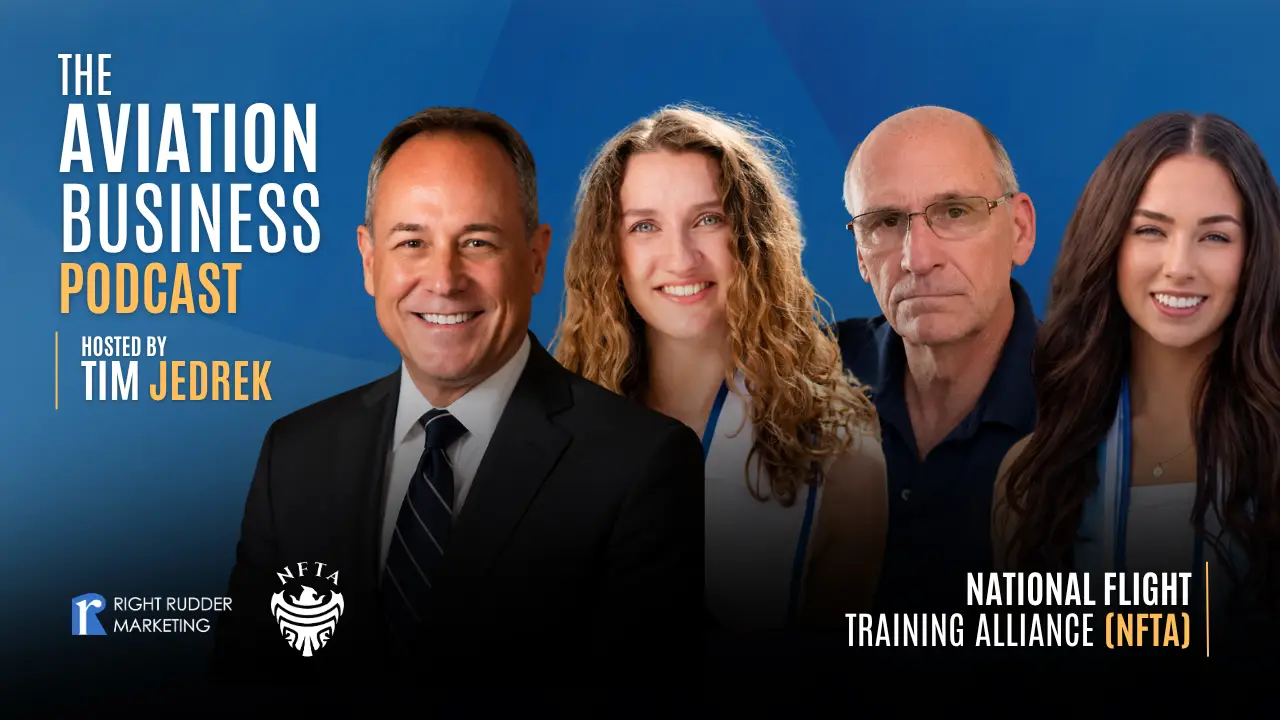
That story came from Paul Preidecker on this episode of The Aviation Business Podcast, and it is not an outlier. Tim and Sebastian Bruno sat down with four people from the National Flight Training Alliance to talk about the 471 page report now sitting with the FAA, and about why so many good operators decided Part 141 was not worth the wait.
First, it is not an act
Tim opened by calling it the 141 Modernization Act. Lee Collins corrected him before the sentence finished.
There is no bill. There is no legislative vehicle. The industry had pushed for a full rewrite of Part 141 for years, and language mandating it was in the 2024 FAA reauthorization work. Then in spring 2024 the FAA proposed doing it another way.
That other way was faster. Collins said legislative projects like this take two and a half years at the quickest and more typically five. So instead the FAA asked NFTA to serve as its industry co-lead and run listening sessions around the country.
The work started in fall 2024. The meetings ran in earnest through 2025, monthly and quarterly, in cities across the country. More than 200 industry participants took part.
The result went to the FAA administrator on April 1. NFTA has spent about four months socializing it. Collins said there is some smoke rising from the chimney about where it might land, but nothing firm until the end of September.
Why owners walk away from 141
The first two-day meeting in Atlanta had one agenda item: pain points.
Collins said the team thought they knew what the complaints were. There were more than they could have imagined. What they centered on was inefficiency, and the inability to move in real time on safety decisions the school already had the data to make.
Here is the number that frames the whole episode. Collins said barely 30 percent of flight training in America is seen by the feds. Everyone else operates under Part 61, which he called the Wild West, and many of them chose it on purpose.
Preidecker put the mechanism plainly. One FSDO interprets the processes one way. The next FSDO interprets them another. Owners kept reporting the same thing across the country.
Collins added the part that explains it. The FAA farmed this work out to FSDO operations that by their own admission handle 50 to 60 different responsibilities. A flight school’s day-to-day paperwork sits near the bottom of that pile. An operator filing an application or a certificate change should plan on months, and sometimes years.
He was careful here. He said he is not indicting the FAA’s system, and that the agency has admitted it is short on both people and money. That is between the FAA and Congress. But as he put it, the industry cannot stay held captive while that gets sorted out.
Tim brought up Dayton Aviation, a flight school partner that had its own long fight to get a 141 certificate.
🔗 Part 61 vs Part 141 for flight schools → Part 141 explainer
Recommendation number one
The report’s first recommendation is a Central Management Office inside the FAA, dedicated to nothing but Part 141 certificates. Initial issuance and ongoing upkeep, handled by people who do only that.
Collins said people at the congressional level who have read the report keep landing in the same place. The CMO piece alone probably takes care of 70 percent of the problem.
The logic is not complicated. Those staff would not be juggling 50 other job classes. That alone cuts the delay.
The stated design goal for the whole report was not enforcement. It was incentive. Write a rule that makes a school’s operation easier to run, and Part 61 operators will look at 141 and see something worth joining. Collins also wanted it built so the industry is not back here in another 30 or 40 years with an archaic rule to tear up again.
The simulator argument, and 85 hours
Preidecker came out of 20 years in airline training where simulator work is simply the standard, and the output is high quality.
He was clear that nobody proposed moving flight training into simulators wholesale. The proposal is a modest shift in credit.
Collins put a number on it. Roughly an 18 percent increase in simulator usage across hours zero to 250, covering private, instrument, and commercial. Not the ATP debate. Those three courses.
Then he gave the reason it matters. He said the national average for a private pilot certificate is now over 85 hours and moving the wrong direction, in an industry that has more technology available than ever.
The waste is visible if you have sat in it. Preidecker asked Katie Braddick and Kat Stein what an hour of flight time looked like at Embry-Riddle. They described canceling for ground delays, and burning six or seven tenths on the Hobbs sitting on a taxiway waiting for a release.
Preidecker also flagged VR and XR. Schools are already using it because it makes the transition to the airplane more efficient. There is no FAA credit for any of it.
And there is a second kind of technology in the report that has nothing to do with flying. Preidecker described the paperwork side as laborious, and asked why a school should wait on an inspector to review a small change to a training course outline when it could post the change to a dashboard.
SMS, QMS, and the ISO comparison
When Tim asked what SMS and QMS actually mean, Collins gave the working version.
A safety management system is where an operator looks at a regulation, states how they plan to operate, and then runs a defined process when conditions call for something different. The data decides whether the flight goes safely or does not go. The FAA allows it because the FAA approved the process.
Quality management is the audit on top. Are you running your SMS the way you said you would, and is it producing what you said it would produce.
Tim’s background before aviation was food manufacturing, where he worked on quality systems. His summary: say what you do, do what you say, then prove it. Preidecker’s response was immediate. That is ISO 9000.
Collins pushed back hard on the idea that this is a burden. He said an SMS operation can be stood up in a week now, and that the software platforms flight schools already buy are embedding these modules. For many operators it becomes a matter of turning the module on.
The report also proposes an industry consensus standards group meeting annually to review the data and decide whether the changes are producing the intended result.
DPEs: from a pogo stick to a three-legged stool
This was the segment most owners will forward to another owner.
Tim raised DPE availability as the theme he hears at every trade show. He has lived it himself. He had to postpone his own commercial checkride for months.
Collins started by killing a rumor. Examining authority is not new. It has existed since the 1970s. He said people running around claiming it will destroy the DPE program are chasing a red herring pushed by people with separate agendas.
What examining authority actually is: a school with a qualified QMS, operating at a certain level of efficiency, conducting in-house checkrides. The people doing those rides have to hold the same qualifications, the same training, and the same oversight as a DPE.
Then he introduced the second leg. Coming out of the 2024 FAA reauthorization, the FAA is standing up the Airman Certification ODA, which Collins called ACODA and said is about ready to go live. His analogy was the written test center. If there is an ODA an hour away, you call and get a date instead of waiting.
Add the existing DPE program and you get his line of the episode. The industry used to balance on a pogo stick. Three legs is a stool.
He also went straight at the part nobody says out loud. The pushback from the organized DPE community, in his view, is about fees. He noted he can say that without it sounding like sour grapes, because he is a DPE himself.
Preidecker added a piece most people miss. He said initial private pilot pass rates in parts of the country are lower than they used to be. Every failed ride sends a student back for more training and another booking. Multiply that nationally and some of the availability crisis is self-inflicted.
His conclusion was aimed at instructors, not students. Make sure you are not signing people off before they are ready.
He was also generous about CFIs who instruct to build time. He said the industry should not criticize anyone for using the job as a step toward something else. His only ask is that while you are doing it, be the best you can be. He sat in on airline interviews for years, and a string of failed rides on a candidate’s record is a hard thing to explain.
Where the 529 change came from
Tim had the mechanics wrong and said so. He thought eligibility depended on the brokerage. Collins corrected it.
The origin is a hallway conversation. Collins was walking through a flight school in late 2022 when the finance office asked why parents kept asking about using 529 funds for flight training, and why they could not.
He did not know. He said he would ask when he got to Washington.
He took it to Congressman Mike Collins of Georgia, whose staff he had worked with on workforce development during his airline years. The answer came while Collins was standing at the A&W stand at AirVenture in 2023. His phone rang. The congressman and his chief of staff had a deal: they would write the legislation.
About a year and a half later the language passed. The funds come from the state-held 529 account, not from a brokerage. The training has to lead to a professional license or certificate, which includes flying. The state sends a form that attaches to the following year’s IRS return.
Collins said it has helped people who had money sitting in a college fund they decided not to use for college.
🔗 How flight schools win with 529 plan funding → 529 article
Altitude Allies, and the fear underneath training
Braddick named cost as the biggest barrier she watched her peers face. Loans, and the pressure that comes with them.
Then she and Stein moved to the part of the episode that was not on anyone’s list.
NFTA has built a peer-to-peer mental health platform called Altitude Allies. It started at Paragon Flight, where both of them instruct, as a test of whether the airline peer support model works at the training level. The model was then copied to Embry-Riddle, where Stein said it has grown significantly over the past year. A national launch is coming.
The mechanism is visible and simple. Trained instructors wear green lanyards, green being the color of mental health awareness, so a student can see who to approach. Those instructors are trained to recognize what a student is going through and to connect them to real resources.
Stein named the reason it is needed. Students are scared that asking for help costs them their medical and their career. She said much of that fear comes from the unknown, and from advice handed down by people who trained in an era when disclosure really was career-ending.
Braddick added that the airlines have peer support programs, but they are underused and many pilots do not know how to access them. Starting the habit at the training level could change the culture before anyone reaches an airline.
Preidecker connected it to the industry’s own rhythm. Aviation runs at max thrust or in reverse. A student two years from graduating does not know which one they will walk into, and carrying that every day is a real weight.
Stein tied the whole episode together in one answer. The financial pressure, the rush to finish inside a loan budget, the instructor who signs someone off early because the student cannot afford to repeat a lesson, and the mental health cost of all of it. Her point was that these are not separate topics.
Notable quotes
“Barely 30% of the flight training in America is seen by the feds.” — Lee Collins
“The CMO piece, recommendation number one, probably takes care of 70% of the problem.” — Lee Collins
“We used to have a pogo stick called the DPE program, and it was very unstable.” — Lee Collins
“There’s 169 applications above them now.” — Paul Preidecker
“Is it the student or is it the instructor?” — Paul Preidecker
“What they learn at these puppy mills, they learn to pass the check ride, but they don’t necessarily learn how to become competent and skilled aviators.” — Lee Collins
“Say what you do, do what you say, and then prove it.” — Tim Jedrek
“It’s a lot less intimidating to talk to someone your own age.” — Katie Braddick
“There’s a room in this tent for everyone and every voice.” — Lee Collins
About the guests
Captain Lee Collins, President and CEO of NFTA. He was part of the consulting group hired to start the organization by flight school owners who wanted to chart a better future for flight training. He is also a DPE.
Paul Preidecker, NFTA. He started in general aviation, spent 20 years at an airline, and served as president of the National Association of Flight Instructors through the end of last year, staying on in an advisory role through June. Aviation is his third career.
Katie Braddick, Director of Executive Operations at NFTA. She met Lee Collins in an Embry-Riddle classroom about a year and a half ago. She has since graduated and is working on her CFI at Paragon Flight, with the airlines as her goal.
Kat Stein, Executive Assistant at NFTA and a full-time flight instructor at Paragon Flight Training Co. She met Braddick at Embry-Riddle. She describes her two roles as the hands-on work with students and the work of bettering the industry.
Sebastian Bruno, Right Rudder Marketing. He built the relationship with NFTA over recent months at trade shows and AirVenture, and co-hosted this episode.
Take the survey
NFTA is running a survey at the request of members of Congress. Collins said it takes about five minutes, and that the results go directly in front of leaders in both the House and the Senate once the data is compiled.
If you are a flight school operator, a CFI, or a student who has felt any of what was discussed in this episode, this is the part where your frustration turns into evidence.
That Pennsylvania school is still sitting behind 169 applications. Nobody in this episode could move them up the list. What they could do is put the reason for the backlog in front of the people who fund the agency that keeps it.
Take the NFTA survey at nftaus.org.
If you want to do more than fill out a form, the site has a volunteer form as well. Collins described the role as a highly paid volunteer, which got the laugh it deserved.
The Aviation Business Podcast is produced by Right Rudder Marketing. If you own a flight school and want help growing enrollments and revenue, visit rightruddermarketing.com or call 314-804-1200. Want to be a guest? Get in touch through the site.