On this page
On this page
7 min read
MOSAIC has been the loudest topic in general aviation for the past year, and most of what your students are reading about it is wrong.
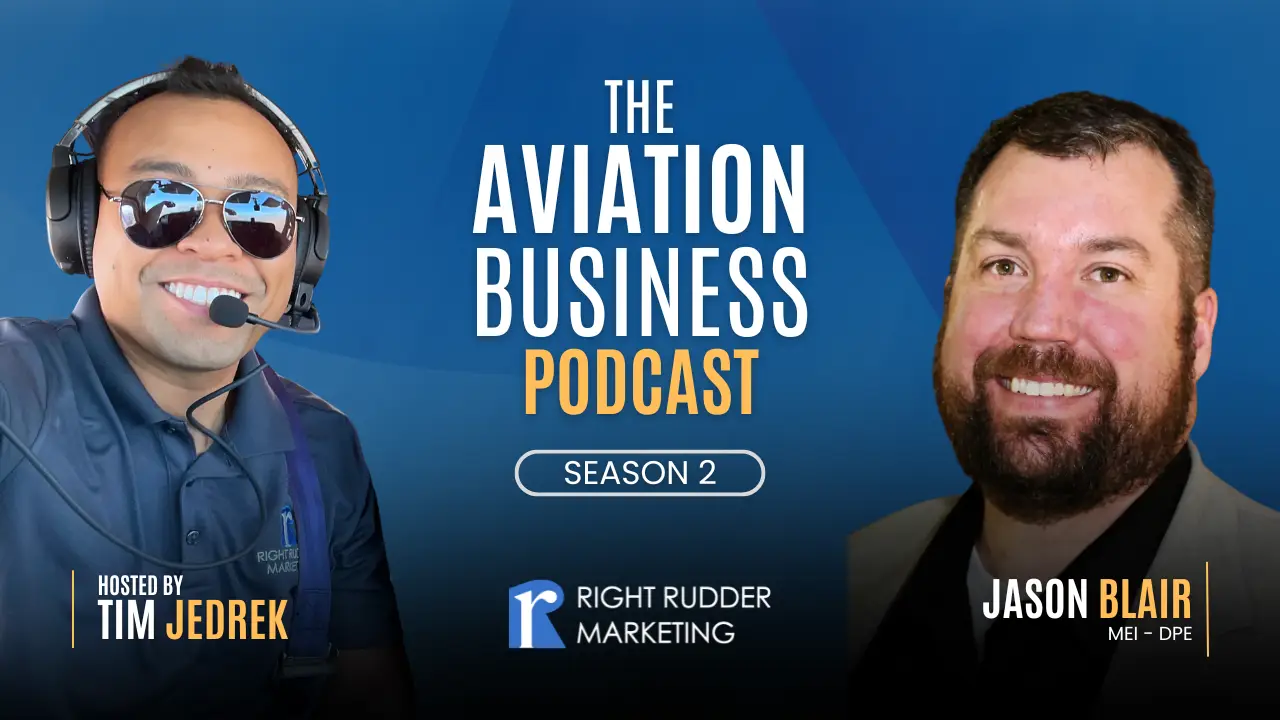
Last week we ran a panel on MOSAIC with flight school owners and association people, and everyone had a different read on it. So this week we went the other direction and brought in one person who has been living inside the regulation since before it had a name.
Jason Blair has been a flight instructor since 2001 and a designated pilot examiner for close to 20 years. He was one of the first sport pilot examiners in the country, worked with the National Association of Flight Instructors at EAA during the original light sport push, writes seven of ASA’s oral exam guides, and serves as editor for the Flight School Association. When he had questions about how MOSAIC would actually be enforced, he called his contacts at the FAA and asked.
This episode is the answer to a question every operator is asking right now: is any of this worth touching, and if so, which part?
Episode Highlights
Your existing fleet just became sport pilot eligible
The old light sport limit was weight. Thirteen hundred and twenty pounds killed the whole thing for most flight schools, because nothing in your fleet qualified and buying a dedicated LSA never penciled out.
MOSAIC decoupled that. The standard now is a clean stall speed of 59 knots or less. Look at the bottom of the green arc. If it is 60 knots or under, a sport pilot can probably fly it.
That brings in 172s, Cherokees, Archers, Warriors, and a number of Diamonds. Airplanes you already own, already insure, and already dispatch.
Two cautions Jason raised that will save you a phone call from an examiner:
Model year matters. He points to the Cessna 177 Cardinal, where early models have a slower stall speed than later ones. Same airplane on the ramp, different eligibility. Check the POH or the type certificate data sheet for the specific aircraft.
It is judged as originally certificated. You cannot bolt a Horton STOL kit and vortex generators onto a 182, drop the indicated stall to 39 knots, and call it a sport pilot airplane. If it left the factory at 62 knots, it is a 62 knot airplane forever.
Do the work once per aircraft and you are done.
The sport pilot only CFI is where schools are going to get burned
This is the section every owner needs to sit with.
The sport pilot only CFI, the CFI-S, is getting new attention because it lets someone start instructing with fewer hours. That is a real opportunity. It is also a narrow one, and Jason has already seen instructors advertising services they cannot legally provide.
What a CFI-S can do:
- Train a student pilot toward solo
- Train toward a sport pilot certificate
- Provide flight reviews, tailwheel endorsements, and currency training for someone exercising sport pilot privileges
- Build cross country and landing experience that still counts toward the student’s total time
What a CFI-S cannot do:
- Provide the 61.129 training specific to the commercial certificate, including the two hour day and two hour night dual cross countries
- Provide a tailwheel endorsement that a private pilot can then use to fly three people in a Cessna 180
Jason called out the Facebook post that keeps circulating, the one where a CFI-S offers to knock out your commercial VFR cross country requirements. It does not work. Sport pilot is not the same thing as VFR, and the training has to come from someone authorized to give it.
His words on what happens next: “As mean old examiner looks at your logbook and says, hey, I see you’re getting ready for your check ride here, and that night cross country that you did was with a CFI-S, I can’t use that to qualify toward your commercial certificate.”
That is a student who paid for hours that do not count and now has to fly them again.
The same trap applies to flight reviews. A flight review from a CFI-S only authorizes sport pilot privileges. Your renter cannot then take three people up in the 172.
Where Jason does see real value: put your pre-CFI people on ground instruction. A commercial student working toward their CFI can teach ground at your school, earn money, and build teaching experience before they ever sit for the initial. That is a clean win with no regulatory ambiguity.
The endorsements are new, and one of them has a catch
MOSAIC added endorsements a sport pilot did not previously have access to. Three matter most.
Night. A sport pilot certificate holder needs about three hours of night training, similar to the private requirement with a shorter cross country, plus the endorsement. Here is the catch: they still need a medical to fly at night. Day flying on a driver’s license, night flying on a medical. Once they have had one medical they can move to BasicMed from there.
Retractable gear. Its own endorsement now, separate from complex.
Manual controllable pitch propeller. This one confused everyone, including Jason, so he asked. The language is deliberately not “constant speed.” The test is whether there is a knob in the cockpit that lets the pilot change the propeller angle. A Cirrus or Diamond with FADEC has no knob, so no endorsement is needed. An airplane with a prop control does, even if the gear does not retract.
Which means a sport pilot can now fly a retractable gear airplane with a constant speed prop, carrying two endorsements. That was unthinkable under the old LSA rules.
Is sport pilot worth it for your school
Jason’s answer is honest, and it is not a sales pitch.
From 2005 through 2025, the entire country issued 8,958 sport pilot certificates. That is a couple hundred a year. There is no add-on path from sport pilot to private the way there is from single engine commercial to multi. Changing certificate levels means new experience requirements, a new knowledge test, and a new practical test.
So if you run a career pipeline, this is not your market. A student who knows they want to fly for a living should start at private.
Where it does work is the personal flying side of your business. The 40, 50, and 60 year old who wants to fly the lakeshore with their family and has no interest in an instrument rating. The owner with manageable high blood pressure who could get a special issuance but does not want to go through the process. The 65 year old who has flown the same 172 for 20 years and wants to keep flying it without the medical paperwork.
Those people are already at your airport. Now you can train and rent to them in airplanes you already have.
One operational note Jason flagged: talk to your insurance carrier and adjust your dispatch process. Most underwriters have been fine with it so far, but your scheduling software is probably checking for a current medical before it releases an airplane. If George is flying as a sport pilot, that check no longer applies, and you need your system to know the difference.
The aircraft side is the bigger story
Ask Jason where MOSAIC actually changes the industry and he does not say pilots. He says airplanes.
The certification path moved to the ASTM standard, which is dramatically faster and cheaper than Part 23. Combine that with the weight limit going away and manufacturers can finally build a real airplane.
What already happened, within days of Oshkosh:
- A manufacturer launched a multi-engine MOSAIC compliant airplane, something Jason had told a room full of people probably would not exist for years
- Multiple airplanes were approved for IFR flight, which was impossible under the old LSA rules
- Four or five different aircraft were announced as MOSAIC compliant
The numbers are what should get your attention. Jason is seeing price points around $200,000 to $250,000 against legacy trainers running $600,000 to $700,000. Two or three airplanes for the price of one, with the same training utility.
Some of these are clean sheet designs built specifically for flight training. One manufacturer is planning three seats instead of four, because what a school actually needs is a pilot, an instructor, and an observer. Another is targeting parts availability through common distribution so you can order an alternator or a tire and have it the next morning instead of waiting on a shipment from three continents away. Lower fuel burn, higher uptime, modern design.
The legacy manufacturers are going to have to respond or lose the training market.
Fuel, powered lift, and what is coming behind this
MOSAIC is also laying framework for things that do not exist yet.
The regulation contemplates simplified direction control aircraft, the joystick controlled automated designs pointing toward EVTOL. Powered lift airman certification standards are already out. Right now the civilian powered lift population is basically a handful of people who own ex-military Harriers, but the FAA is building the training pipeline the same way it always does: manufacturer led training, then FAA staff, then instructors, then examiners.
On fuel, the EAGLE initiative is targeting 2030 for the unleaded transition. Every MOSAIC focused manufacturer is designing engines with that in mind, whether that is Rotax running alternate fuels, diesel options, or eventually battery. Jason runs 92 rec fuel in his 1947 Stinson because that airplane was designed for 80/87 in the first place.
If you are planning facilities, this is your problem too. Multiple fuel types means multiple tanks. Electric trainers mean charging infrastructure, and as Jason put it, that is not an extension cord draped across the ramp.
Then we got into check rides
We had time left, so we went where every flight school owner wants to go with a DPE.
The volume numbers explain a lot. In 2012 the industry ran about 67,000 check rides a year with roughly 900 examiners. Last year it was 156,000 check rides with about 1,100 examiners. Accelerated programs pushing students through private, instrument, commercial, multi, and CFI in six to nine months mean more check rides per student per year.
The FAA has responded by recruiting examiners who actually produce. Ten years ago more than half of all examiners did fewer than 50 check rides a year, and many did fewer than 25. The last two years were the first time more than half of examiners crossed 100 per year. Jason runs 280 to 300 test activities annually out of Michigan, where February might yield five flyable days.
Here is the part you control: roughly 30 to 35 percent of check rides get sent back before they start. Broken airplanes. Bad maintenance records. A 50 mile cross country that measures 32 miles. Missing endorsements.
Every one of those is a slot your school burned and a student who now waits weeks for another one.
Jason’s fix is not complicated. Send the packet ahead of time. A PDF or a shared folder with the maintenance records, the annual, the pitot static, the experience requirements, and the endorsement copies. If something is missing three days out, he can call you and you can fix it. If he finds it in an FBO lobby on check ride morning while your instructor is in a simulator in France, nobody is flying that day.
Do that consistently and you move to the front of the line. In Jason’s words, he is going to take the call from the school he knows will not waste his day before he takes the call from the one where the airplane is probably broken.
The number one thing to tell your students
Treat it like a conversation.
“I treat myself as a really annoying passenger on the check ride who just wants to ask questions. Imagine I’m your five year old brother that’s like, why? Why? What’s that?”
Practical version: breathe, take your time, stand up and walk around, bring a snack because a CFI ride can run four or five hours of ground and low blood sugar does not help anyone. Answer scenario questions like a pilot, not an engineer. Nobody is asking you to design an airplane.
And the thing your nervous students most need to hear, straight from an examiner: every examiner walks in wanting to pass you. It is easier for everyone. You are passing until you give them a reason not to.
Notable Quotes
- “Look at the bottom of the green arc in the airplane. If that’s 60 knots or less, you’re probably gonna be able to fly that as a sport pilot.”
- “If we look at from 2005 when we started doing sport pilot certs through 2025, we only did 8,958 total.”
- “The sport pilot only CFI cannot provide that training under 61.129 that is specific to the commercial certificate.”
- “I can’t like take my 182 out and mod it out with big Horton STOL kits and VGs and be, ha, my stall speed’s down at 39 now.”
- “If you look at a six or seven hundred thousand dollar legacy airplane and a flight school says, man, I can buy two or three for the price of one, have the same effective training.”
- “One of them that I talked to is like, we’re targeting our parts availability to be Amazon deliverable.”
- “They thought 30, 35 percent of our check rides are being sent back because they’re not able to proceed.”
- “If you can’t show me your own qualifications, I don’t have a whole lot of confidence you’re ready to teach students.”
- “Every examiner I know goes into the check ride thinking, I want to pass you. You are passing until you give me a reason to give you a disapproval.”
- “I think we’re gonna look back in five years and go, my God, a lot has happened.”
About Jason Blair
Jason Blair is a designated pilot examiner and has been a flight instructor since 2001. He has served as an examiner for nearly 20 years and was among the first designees authorized for sport pilot testing when the certificate was introduced.
His background includes work with the National Association of Flight Instructors at EAA during the original light sport rulemaking effort. He currently serves as editor for the Flight School Association and authors seven of ASA’s oral exam guides, including titles used by private, instrument, and commercial applicants across the country.
Based in Michigan, he conducts roughly 280 to 300 test activities per year and writes regularly on regulatory changes, examiner availability, and flight training industry issues at his website.
What This Means for Your Flight School
Three things to act on this week:
Audit your fleet. Pull the POH or type certificate data sheet for each training aircraft and note the clean stall speed as originally certificated. You may already own sport pilot capable airplanes. Do it once and keep the list.
Check what your instructors are advertising. If you have a CFI-S on staff or you are considering hiring one, make sure they know the 61.129 line and the flight review limitation. A student who logs uncountable hours is a refund conversation and a reputation problem.
Fix your check ride packet. If a third of check rides nationally get sent home, some of yours are in that number. Build a standard PDF for every applicant with maintenance records, experience requirements, and endorsement copies, and send it to the examiner three days out.
Connect
Jason Blair publishes articles and resources, including a solid piece on MOSAIC, at jasonblair.net.
If you run a flight school and want to enroll more students, visit rightruddermarketing.com.
Want to be a guest on the Aviation Business Podcast? Call us at 314-804-1200 or reach out through the site.
Find the show on YouTube, Spotify, Apple Podcasts, Facebook, and Instagram. Subscribe, follow, and join the community.
We will be at NAFI in Dallas next month, sitting down with John and Martha King later this year, at the Flight School Association conference in the spring, and at Redbird. Come find us.