On this page
On this page
6 min read
How to Fill Your Flight School’s Schedule This Winter (Replay)
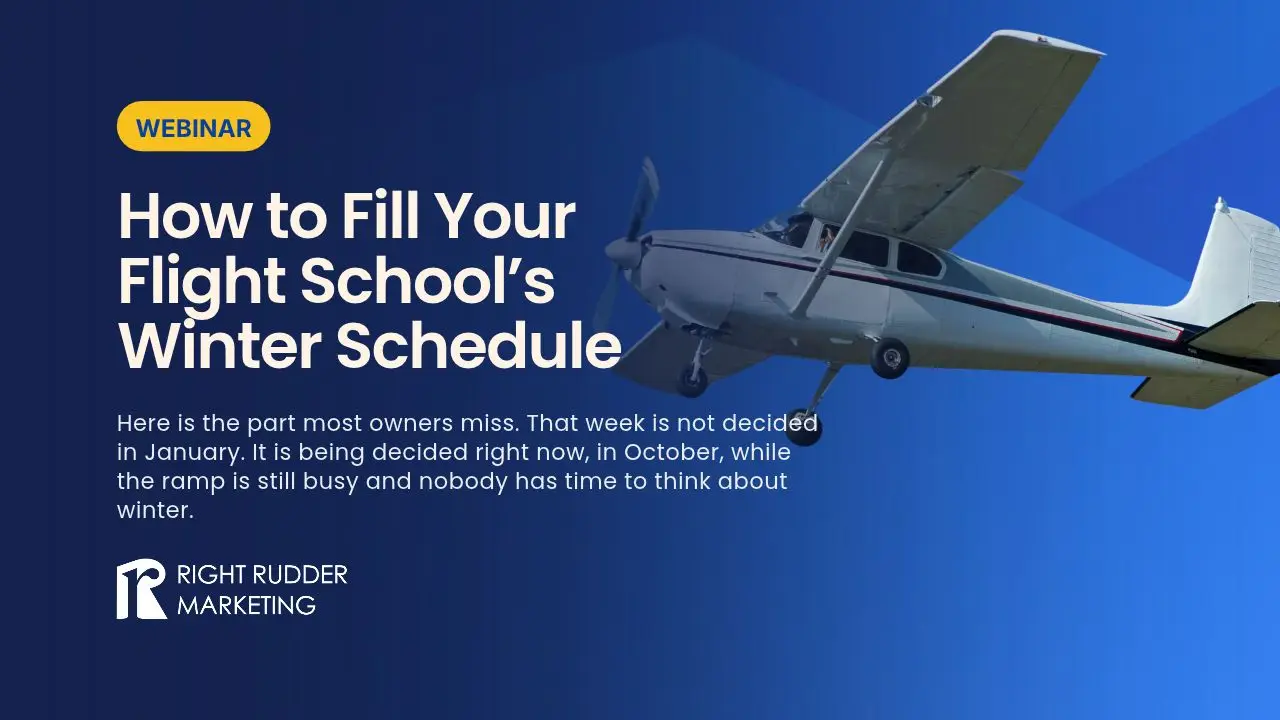
On Thursday, October 22, Tim Jedrek, founder of Right Rudder Marketing, went live with flight school owners to talk about the hardest stretch of the year: October through February.
His main point was simple. The marketing you do this winter decides how full your schedule is next spring and summer. If you coast through the holidays, January starts slow, and a slow first quarter usually means a slow start to the whole year.
The replay is above. Below is a summary of what Tim covered, including the four moves he recommends every flight school make before the end of the year.
Why Winter Is Slow for Flight Schools
Most owners blame the weather, and some of it is the weather. In the Midwest and on the East Coast, November and December bring low ceilings, freezing temperatures, and icing that keep airplanes on the ground.
Tim argued that weather is only part of it. The bigger factor is what’s on your future students’ minds. Between October and December, the people you want to reach are thinking about going home for the holidays, not about flight training.
That’s why October can feel fine. You’re still running on the momentum from summer. By January, if nobody put energy into marketing during the fall, the schedule stalls.
Current students matter here too. Tim pointed out that the students who keep flying through winter are usually the ones already committed to their next rating. Everyone else needs a reason to keep going, and a nudge from you.
Four Moves to Make Before the End of the Year
Tim walked through four moves aimed at the people most likely to reach out to a flight school between now and New Year’s: gift buyers, people who already contacted you this year, and people making a New Year’s resolution to finally learn to fly.
1. Sell discovery flights as gifts
Tim told his own story here. He had a good job in manufacturing and had thought about flying for years, but never acted on it. Then his father bought him a discovery flight. That gift is why he’s a pilot today.
A lot of your future students are in the same spot. They won’t sign up on their own, but a parent, spouse, or grandparent might buy them a first flight. Tim recommends a gift version of your discovery flight page, and he only recommends pushing it during the holiday season, because that’s when people buy gifts.
What the page needs:
- A clear offer and price. Tim noted that most discovery flights run $100 to $200, and few schools go past $300.
- Low friction. Many buyers aren’t pilots and don’t know how airports work. Make it easy to buy without calling.
- A certificate. Something the buyer can give, and something the student keeps after their first flight.
- A deadline. A time-bound offer gives people a reason to decide now instead of later.
And when the gift recipient shows up, be ready with a tour, your pricing, your programs, and your testimonials, so the first flight can turn into an enrollment.
2. Follow up with everyone who contacted you this year
If you did any marketing in 2026, you have a list of people who called, filled out a form, sent a message, or took a discovery flight and never enrolled. Tim called this a sales push more than a marketing push.
His advice: every person who contacted your school since January deserves a phone call or an email before 2027. Invite them back for an open house or another discovery flight. And ask two questions:
- Why didn’t you sign up? Their answer tells you what to fix.
- Where did you find us? If most of them came from Instagram, that tells you where to spend. If they came from Google, maybe it’s time to invest more in search.
No sales team? Then this one falls to the owner, and it still applies.
3. Run a winter ground school class
There are fewer flying days in winter, especially in the Midwest and on the East Coast. Tim recommends turning that into an advantage with a batch ground school class: enroll students in October and November, and start the class in December or January, led by your CFIs.
The payoff comes in spring. In Tim’s experience, the students who finish their written exam and their medical before they get in the airplane are the ones who solo quickly and pass their checkride on time. A winter class sends you students in March who are ready to fly and ready to spend.
If you don’t have the curriculum in-house, Tim pointed to options like King Schools, Part Time Pilot, Sporty’s, Boldmethod, and Gold Seal.
4. Build your authority with reviews
The easiest and cheapest way to show up higher on Google and in AI search is reviews. Tim suggested asking at a milestone: after a discovery flight, after a first solo, or after a passed checkride. Have a QR code or a link ready so you can text it on the spot.
Then reply to every review, good or bad. If you’ve let reviews pile up since January, now is the time to catch up.
This matters because a student pilot only shops around so much. Tim noted that many schools he talks to, some of them seven-figure operations, have around 20 reviews, while schools in competitive markets like Mesa and Florida often have 200. The school with more reviews is more likely to get the first call, and the first call is the one you want.
Build in Winter, Enroll in Spring
Tim’s closing theme was that flight school marketing pays off on a delay. As he put it, his own business’s results today depend on what the team did three and six months ago, not on what it did this week. Flight training is a long decision, and most of your prospects have been thinking about it for a while before they act.
He laid out the year like this:
- October to February: build. Run the four moves. Gift flights, follow-up calls, a ground school class, and a review push.
- March to May: enroll. Keep pushing. Run the ads, update the website, keep up the SEO, and let the automations work.
- Summer: operate. Ease off marketing a little and focus on the business: aircraft, CFIs, curriculum, and the students already flying.
- Fall: upgrade. Market to your own students. Private pilots toward instrument, instrument toward commercial, commercial toward CFI.
The students who enroll in spring are the ones who carry your revenue through the following winter. A weak spring makes for a weak year.
If you train somewhere warm
For schools in Florida, the Phoenix and Mesa area, California, and south Texas, the calendar flips. Summer heat is the slow season, and winter is busy. Tim’s advice still applies, on your own calendar: build during your slow months so your busy season is full.
Start With Where You Are Now
The replay runs about 52 minutes and is chaptered, so you can jump straight to the move you need. Tim’s story about the gift that made him a pilot starts at 23:13, and the ground school section starts at 35:26.
If you’d rather have someone look at your school with you, that starts with an audit. We review your website, your search visibility, your ads, and your reviews against the schools you compete with, then send back a plan built for your market. It costs nothing.
Right Rudder Marketing is a pilot-owned agency that works with flight schools only, more than 40 of them across the country.