On this page
On this page
4 min read
Picture your schedule board. One name hasn’t been on it for three weeks.
That student didn’t fail a stage check. They never called to say the money ran out. Weather canceled two lessons in a row. Their instructor got the airline call, and a new one took over. Nobody asked how they were doing, so they stopped booking.
Students almost never call to quit. They just don’t rebook, and the school notices the gap weeks later.
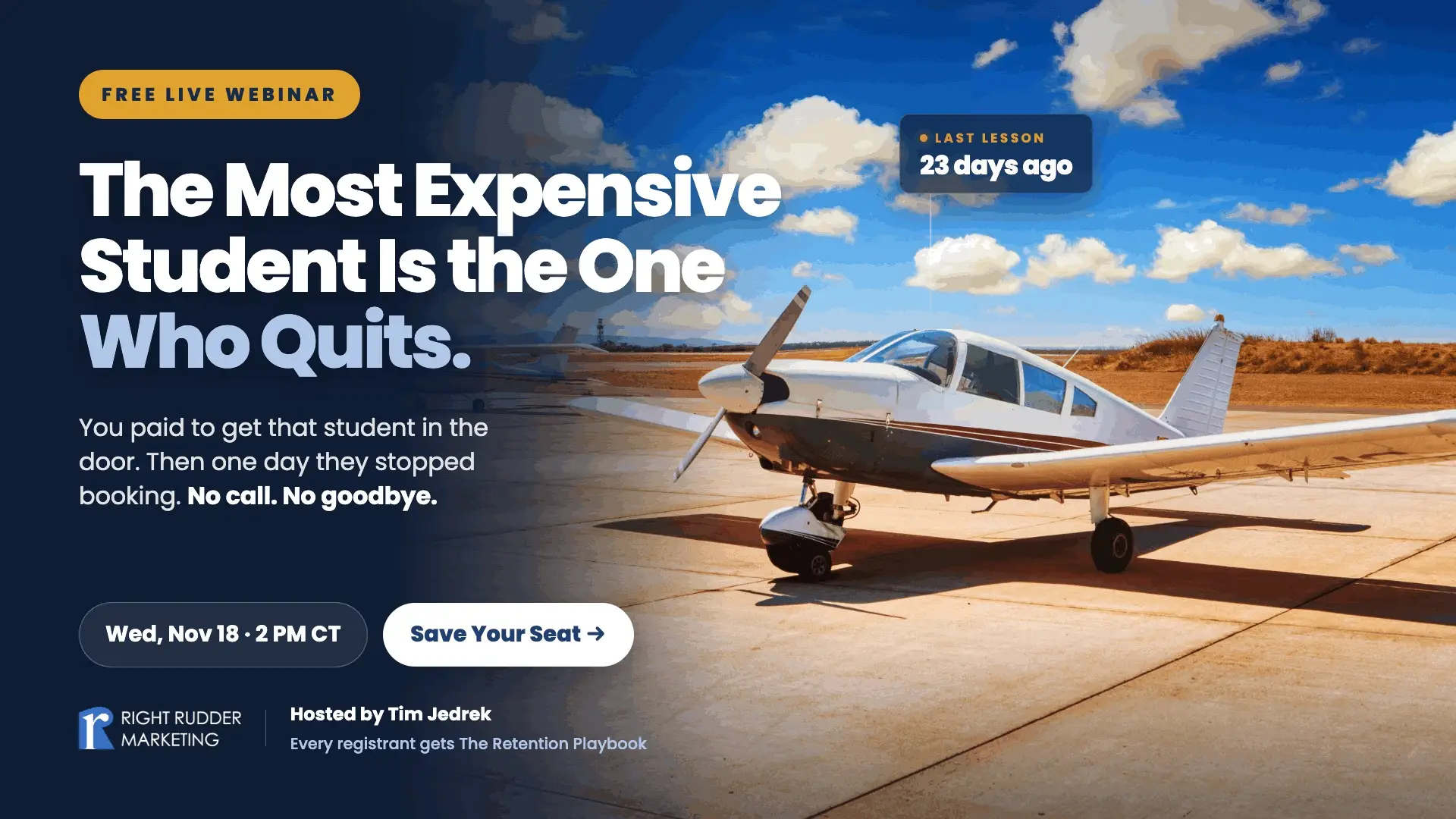
On Wednesday, November 18 at 2:00 PM Central, Tim Jedrek, founder of Right Rudder Marketing, walks through the moments students drift away and what to send them before they do. It’s live and free. Here’s what we’ll cover.
What a quitting student really costs
You paid to get that student. Ads, your website, the discovery flight, the follow-up calls. A student who quits at hour 20 cost you just as much to bring in as one who made it to the checkride.
The return is very different. Rotate estimates that a student who finishes a private pilot certificate is worth about $15,000 to $35,000 to a school. A student who quits early is worth about $4,000 to $6,000.
Training also costs more than it used to. The median private pilot certificate cost $16,500 in 2025, up from $9,000 in 2020, according to Redbird’s 2026 State of Flight Training report. A higher price means a quiet student has more to worry about, and you have more to lose.
Here’s a simple way to see it. Say you keep three more students a year, and each one is worth $10,000 more if they finish. That’s $30,000 from students you already had, without a single new lead.
Students don’t quit flight training. They quit flight schools.
Most owners believe students leave because of money or weather, and that nothing can be done about either. The research points somewhere else.
In Redbird’s 2026 report, students rated their flight instructors 4.3 out of 5. They rated their flight schools 3.4. They still love flying. The experience around it is what they rate low.
AOPA studied why students quit back in 2010. It found four things that shape the training experience: the quality of instruction, how responsive the school is, a sense of belonging, and keeping students informed. Instruction quality mattered most, more than time or money. Three of those four are about communication.
Instructor changes make it harder. Redbird found that 74% of active students had more than one primary CFI in 2025, up from 66% in 2023. Every time a student changes instructors, the school can lose them.
Marketing can’t fix the weather, and it can’t fix maintenance. It can fix silence, confusion, cost surprises, and the feeling of being alone. Those cover most of the leak.
The five moments students drift away
On the webinar, we walk through five danger zones. Each one comes with a ten-second check you can run on your own school.
- The first 30 days. The student was excited on the discovery flight and confused by week three. Nobody told them about ground school, the medical, the written, or the real cost.
- The gap. Weather cancels two lessons. A busy week at work follows. Ten days pass, then twenty, and coming back starts to feel like starting over.
- The plateau. Stuck on landings before solo, lesson after lesson. Every pilot hits this wall. Most students think they’re the only one.
- The handoff. Their instructor leaves, and they wonder if they have to start over. Their loyalty was to the instructor, so when the instructor goes, so does their reason to stay.
- The money moment. The account balance runs low or a bill comes in higher than expected. The student goes quiet instead of asking about options.
Here’s one check, free, right now. Without looking it up, can you name every student who hasn’t flown in the last 14 days?
Most owners can’t. That’s where we start.
Ten messages that keep them flying
Most flight schools use a CRM, or something like one, to chase leads. Once the student enrolls and moves into the scheduling software, the CRM goes quiet, right when the student starts paying.
Tim shows how to keep that pipeline going after enrollment, from the first lesson to the checkride. You’ll see ten simple messages, when to send each one, and who should send it. They include a welcome from the student’s instructor, a roadmap of the next 60 days and what they’ll cost, a progress report every 10 hours, and a first-solo message that asks for a review.
Two of them, free:
The 7-day gap nudge, from the student’s instructor:
“Haven’t seen you in a week. Want me to hold Tuesday at 9 for you?”
The handoff intro, from the new instructor:
“Hi Sam, I’m Maria. I’ve read your training record. We’ll pick up where you left off, with steep turns.”
And one rule we’ll cover in detail: at 21 days without a flight, stop emailing and pick up the phone.
We’ll also cover how to build a sense of belonging, how to keep automated messages sounding human, and how to get consent before you text a student.
[Internal link suggestion: The Flight School Marketing System → rightruddermarketing.com/marketing-system/]
What you’ll leave with
Every registrant gets The Retention Playbook:
- A map of the five danger zones
- The ten message templates, ready to copy
- A student handoff checklist for when an instructor changes
- A retention scorecard with five numbers to track
We’ll also show what this looks like at your size, whether you fly two airplanes or twenty. A small school can start with three messages this month.
Questions owners ask before registering
Is this a sales pitch? No. Right Rudder Marketing markets flight schools. We don’t sell retention services. We’re giving you the playbook, and it’s yours whether you ever talk to us or not.
I run a small school. Is this for me? Yes. If you fly one to three airplanes, every student counts for more. We’ll show you the three messages to start with.
My students quit because of money. Can messages really help? Sometimes money is the reason. But AOPA found instruction quality mattered more than time or money. A cost surprise is also a communication problem, and a clear roadmap fixes part of it.
Do I need special software? You need a CRM that can send messages. If your scheduling software can send data out, you can connect the two. If not, a weekly list of last-flight dates works on day one.
Do I have to attend live? We send the replay to everyone who registers. Live attendees can ask Tim questions directly.
Bring that student back to the schedule
Go back to that name on your board. Imagine their instructor had texted at seven days. Imagine you had checked in at fourteen and offered a sim session. All they needed was someone to notice.
Join us and learn how to make sure every student gets noticed, from the first lesson to the checkride.
[Save Your Seat] for The Most Expensive Student Is the One Who Quits. Wednesday, November 18, 2:00 PM Central. Sixty minutes, live, no cost.
3:00 PM Eastern · 1:00 PM Mountain · 12:00 PM Pacific