On this page
On this page
5 min read
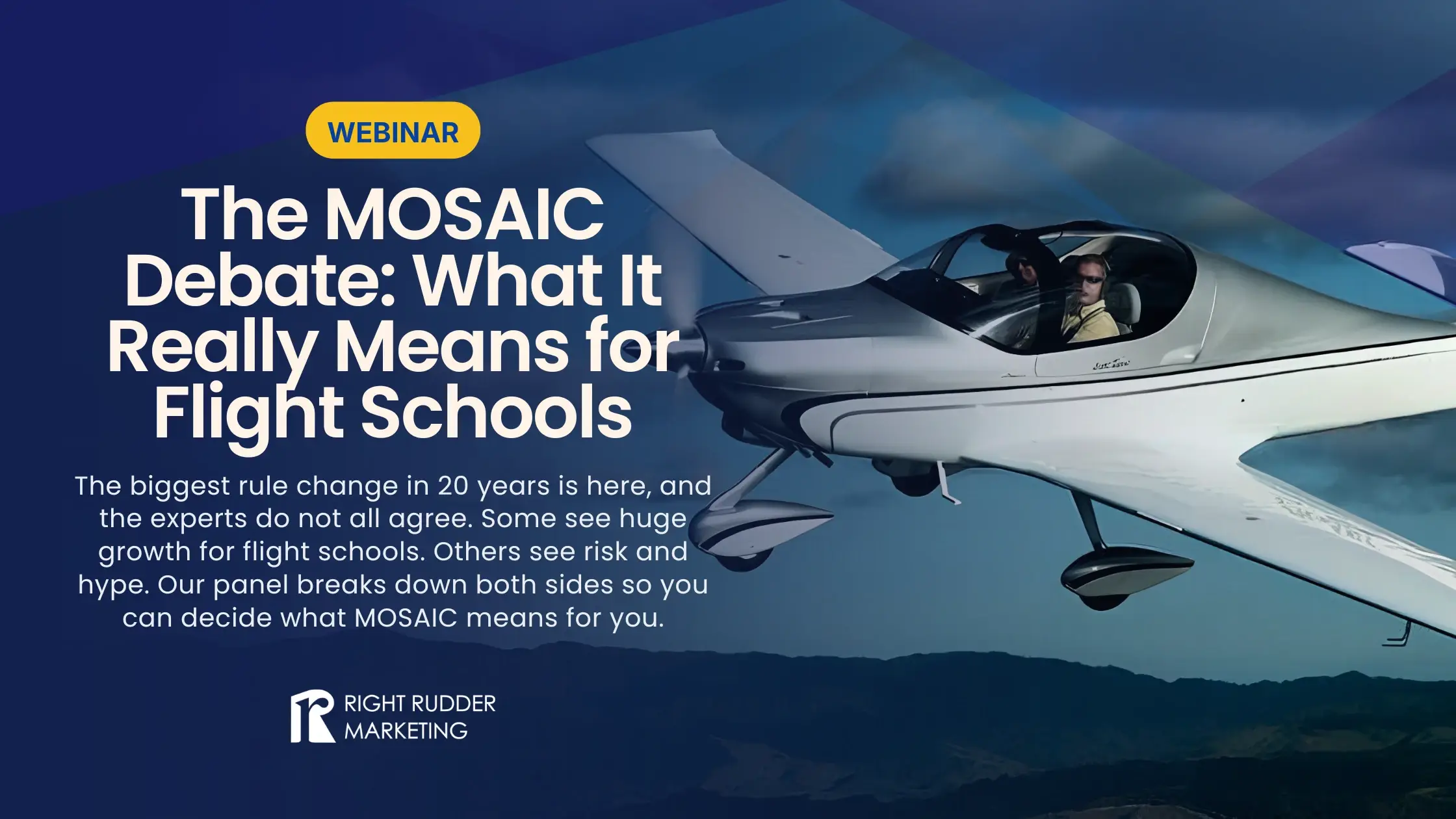
Two MOSAIC-certified airplanes exist in the world right now. Both are RV-12s, and Van’s Aircraft delivered them.
That number came from Hans Laitinen on our live panel Friday, and it tells you most of what you need to know about where MOSAIC actually stands. The rule is real. The fleet is not here yet. And the schools sorting out the difference are the ones who will move first.
We brought four people together to argue about what happens next. Here is what they said.
Who Was on the Panel
We built this as a debate, not a lecture. The idea came from talking to flight school owners who fell into two camps. Some knew sport pilot privileges expanded but had no idea what else was in the rule. Others worried the whole thing moves too fast and lowers the bar.
So we put four people on the same call who see it from four different seats.
Tom Charpentier, Government Relations Director at EAA. The EAA advocacy and safety team led much of the advocacy behind MOSAIC, alongside other groups.
Hans Laitinen, Van’s Aircraft. Sales and delivery representative for the certified Part 22 RVs coming off the factory line. Van’s sat on the ASTM committee that helped write the standards in partnership with the FAA and other manufacturers.
Lute Atieh, Flytech Pilot Academy. Runs a Northwest Missouri operation with about 21 aircraft, including one MOSAIC-eligible light sport airplane he has been flying for almost two years.
Elliott Seguin, BYE Aerospace. Experimental test pilot with 20 years in research and development, going back to SpaceShipTwo, with later work at ICON on spin resistance and at Skyryse on fly-by-wire.
RRM founder Tim Jedrek moderated and spent much of the hour arguing the other side.
MOSAIC Split the Pilot From the Airplane
Tom started in 2004, when the original sport pilot and light sport rules came out. Those rules tied everything to one definition in Part 1.1. A light sport aircraft meant two seats, 1,320 pounds, and a stall speed limit. That single definition governed both what the aircraft could be and what the pilot could fly.
Tom said the 1,320-pound number was never magic. It came from a European standard. It is 600 kilograms.
MOSAIC broke that link. Pilot rules and aircraft rules are now separate. Sport pilot is its own rating with its own eligibility list. Part 22 is the new home for light sport aircraft certification, and Tom said the weight limit there is simply gone.
For sport pilots, the line is now 59 knots clean stall speed, up to four seats, with retractable gear and a constant speed prop allowed under the right endorsements. Tom put it plainly. A sport pilot can now fly just about any primary trainer on a typical flight school flight line, up to something around the size of a Cessna 182.
For manufacturers, the aircraft line is 61 knots in landing configuration. Limits on the type and number of engines are gone.
Why Stall Speed Beat Weight
We asked why stall speed is a better dividing line than pounds.
Hans said the FAA looked at safety data across light sport, experimental, CAR 3, and Part 23 aircraft. The light sport category performed well. Stall speed turned out to be a better predictor of a controllable airplane a beginner could handle than weight ever was.
Tom agreed the old cap made sense for its moment and became arbitrary as the industry moved past it.
What Van’s Can Build Now
Hans gave the clearest picture of what Part 22 changes for a manufacturer.
Before MOSAIC, Van’s could build exactly one airplane as a light sport aircraft: the RV-12. Now the company can build across the line, all the way up to the four-seat RV-10 with a 260 horsepower engine.
That matters for what a flight school can buy. Hans said getting that kind of performance used to mean building the airplane yourself or having it built. Now it can come as a factory flyaway airplane without the certification overhead of a CAR 3 or Part 23 aircraft.
He also named the change flight schools ask about most. The MOSAIC RV-12 can fly in IMC.
Hans expected many more MOSAIC aircraft to follow quickly. Manufacturers are already updating existing light sport designs under the new rule to gain capability.
The Number That Got Everyone’s Attention
Lute has operated his light sport airplane for almost two years and pushed it past 1,800 hours. He has graduated a handful of sport certificate holders.
Then he talked about fuel.
At his fields, 100LL runs between $6.25 and $7.50 a gallon. His light sport burns a hybrid of 91 octane and 100LL at roughly four gallons an hour, which puts his fuel cost under $4. He said the fuel price increase alone over the past year would bankrupt most flight schools that did not pass it along to students.
He also bought the airplane new for about a third of what a new Cessna 172 costs today.
Tim pushed back hard on this. You can still buy a 1970s 172 for around $80,000, and for the price of one new light sport airplane you could put two or three older airplanes on the line. In a business that needs seats filled, more airframes can beat better airframes.
Lute’s answer: career-track students demand modern avionics because they need to learn in what they will fly. Buy the $80,000 Cessna and you will spend close to another $100,000 getting the panel, autopilot, and paint right. At that point you are near the price of a new airplane anyway.
Sport Pilot Is Not Just for Sport Pilots
This was the point the panel kept circling back to, and it is the one most owners miss.
Lute runs a mostly career-focused school. He still produced three or four sport pilots this year. He compared it to the associate degree on the way to a bachelor’s. Students stall out at 35 or 40 hours because of a life event, and they walk away with nothing. A sport certificate gives them something to hold.
He said standing up a sport program is not difficult. The ground school curriculum already exists. Instructors follow it. You drop controlled airspace, night, and a handful of other items. The rest is the same.
Tom added the piece schools should watch: the sport pilot instructor certificate. You can earn it without an instrument rating or a commercial certificate. He described the instructor it produces as the enthusiast with real experience who does not want the career track but will teach weekends for the love of flying. He called that instructor cadre something that could serve flight schools well.
And the aircraft side reaches every student, not just sport students. A career-track student who never touches a sport certificate still trains on cheaper airplanes with better avionics. Lower operating costs can improve your margin and lower the student’s bill at the same time.
Where the Panel Disagreed
Tim spent most of the hour as the skeptic, and the sharpest exchange was about safety.
Elliott made the case for envelope protection. Take an off-the-shelf autopilot, limit the aircraft’s envelope, and you remove risks students currently train to manage. He argued Part 22 gives that technology a path into the market sooner. His line was that the technology can lower the bar for who becomes a pilot and raise safety at the same time.
Tim did not buy all of it. He argued students need to feel a real stall, including the sight picture and the drop in your stomach. Train someone in a protected airplane, then let them fly a 172 that has no protection, and they may not understand what they are missing. He compared it to handing more control to an iPad.
Elliott gave ground on stall training and held the larger point. He also raised the reliability question honestly. A Part 25 airliner is built to a 10 to the minus nine standard. The autopilot servos in a typical general aviation panel were never designed to that level, which is why Garmin Autoland is an emergency system rather than something you lean on. He said the industry is still working out where the right line sits under Part 22.
Tom noted the practical reality. Sport pilot testing standards are mostly identical to private pilot standards. The industry still teaches fundamental airmanship.
Lute’s closing on this was the bluntest line of the hour. He said everyone needs to relax. DPEs still do their job. CFIs still do their job. The system did not change, some technical parts of it improved.
The Ruling Schools Should Watch
Tom raised an FAA interpretation that has already caused problems in the field.
A sport pilot CFI has always been limited to training toward the sport pilot certificate. Dual logged with a sport CFI still counts toward higher ratings, as long as the student earns the sport certificate first. That part is settled and makes sense.
The new interpretation goes further. When a sport CFI gives an endorsement or a flight review to a higher-rated pilot, that endorsement applies only to sport pilot privileges. So a tailwheel endorsement from a sport CFI covers you when you fly under sport pilot privileges, and not under your private, commercial, or ATP.
Tom said that was not standard practice for some people in the field, and that EAA believes it should be rolled back. If you employ or plan to employ a sport CFI, this one affects how you use them.
Two other details worth writing down. Night flying under sport pilot privileges requires an FAA medical or BasicMed before you can even get the endorsement. And the constant speed prop endorsement depends on the control, not the propeller. A single-lever or FADEC setup does not require it. The blue knob does.
Where Electric Actually Fits
Elliott made the case that flight training is the best first market for electric aircraft, and the reasoning was more grounded than the usual pitch.
Electric aircraft live or die on energy storage. So the first real use is wherever energy demand is lowest. Training fits. You take off and land at the same airport. And you are not limited by range on paper, you are limited by a student’s attention span, which he put at 45 minutes to an hour and 15.
On cost, he said energy runs about 20 percent of what you pay for 100LL, an 80 percent reduction. BYE’s eFlyer 2 is designed to be the first all-electric trainer to be certified, and he said about 1,500 orders are on the books.
On timing, he was direct. The fastest certification path BYE sees is around 12 months, and it could run longer, since the Part 22 certification environment is still being understood.
Tom added a use case outside flight training. Many original ultralight designs used two-cycle engines that are hard to find now. Electric works well for short local flights in that world.
What This Means for Your School
Strip out the debate and four things hold up.
Your existing fleet probably already qualifies. Sport pilot eligibility runs on stall speed now, and most primary trainers clear it. That is a marketing change, not a purchase.
A sport program is cheaper to start than owners assume. The curriculum exists. Your instructors can teach it. Lute’s school did it while staying career focused.
New airplanes are coming, slowly. Two exist today. More arrive over the next months and years, and the four-seat models Hans described are a real fleet planning question for 2027 and beyond, not this quarter.
Operating cost is where the math gets interesting. Fuel burn under $4 an hour against $6.25 to $7.50 a gallon changes what a training hour costs, whether the student is chasing a sport certificate or an airline seat.
Common Questions
Can sport pilots fly IFR now? No. Sport pilot privileges remain VFR only. Some MOSAIC aircraft can be equipped and certified for IMC, and the RV-12 is one of them, but flying in instrument conditions still requires an instrument rating and at least a private pilot certificate.
How many MOSAIC aircraft can I actually buy today? As of the panel, Hans said two MOSAIC-certified airplanes existed, both RV-12s delivered by Van’s. He expected that number to grow quickly.
Do I need a medical for sport pilot? Not for day VFR, if you hold a valid driver’s license and your most recent FAA medical was not denied, revoked, or suspended. Night flying requires an FAA medical or BasicMed.
How many hours does a sport certificate take? The FAA minimum is 20 hours and Tom said nobody hits it. EAA’s own sport pilot academy at Oshkosh gets students through in under 40 hours, and he cited a Wisconsin school flying Cubs from a non-towered field doing the same.
Can a sport CFI train my private pilot students? No. A sport pilot CFI trains toward the sport pilot certificate. That dual counts toward higher ratings once the student earns the sport certificate.
Two airplanes on the ramp today. More coming. A rule that changed what your current fleet can do, and a fuel bill that is already changing what a training hour costs.
Watch the full panel recording, then look at your own flight line and ask which airplanes just changed jobs.