
On this page
On this page
8 min read
$110 an hour for a Cessna 150, fuel included. $60 an hour for the instructor. That’s a lesson at DeAero in Litchfield, Minn., about an hour west of Minneapolis.
Most people who want to learn to fly west of the Twin Cities have never heard those numbers. They assume flight training means driving into the metro and paying metro prices. DeAero’s job is to prove them wrong, and as of this week, it’s running the full Flight School Marketing System with Right Rudder Marketing to help.
This post covers who they are, why a small school at a small airport is hard to find online, what we’ve already built and what the first 90 days look like.
A Mechanic Who Bought an Airplane
DeAero started the way a lot of good flight schools do. Someone wanted to fly more and couldn’t make the math work.
Owner and Flight Instructor Dan Berryhill bought an airplane to make his own flying more affordable. He rented it to other pilots and used it for flight instruction, and those hours paid down the cost. Over time, the arrangement grew into a flight school.
Berryhill has flown since he was 15. He holds commercial pilot and flight instructor certificates, plus an airframe and powerplant mechanic certificate with inspection authorization. That last part matters. When a DeAero airplane needs work, the owner turns the wrenches himself, in the same hangar where students meet their instructor.
Flight and Instrument Instructor Austin Koistinen rounds out the team. He earned his private pilot certificate in high school, then finished his instrument, commercial, CFI and CFII ratings at Lake Area Technical College in Watertown, S.D., graduating with a Professional Fixed-Wing Pilot degree in 2025.
Three Airplanes, One of Them a Taildragger
DeAero flies out of Litchfield Municipal Airport (KLJF), a non-towered field with a lake beside the runway. The fleet is small and honest:
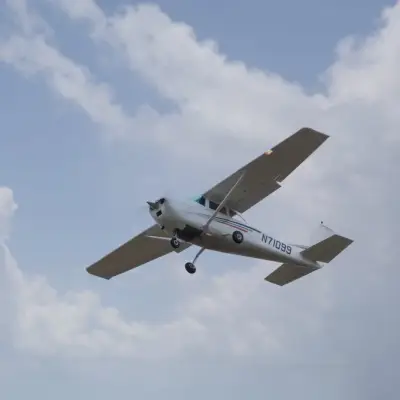
- A Cessna 150K with uAvionix AV-30 avionics, IFR capable, at $110 an hour wet
- An Aeronca 7AC Champ, an 85-horsepower taildragger, at $95 an hour wet
- A four-seat Piper PA-28-160 Cherokee
Students can train from sport pilot through private, instrument, commercial and flight instructor. Pilots come in for flight reviews, instrument proficiency checks and tailwheel endorsements in the Champ. Anyone who owns an airplane can train in their own.
Training is pay-as-you-go. There’s no deposit and no prepaid package. Lessons run weekdays and Saturdays, booked one at a time, and students driving in from the metro can book longer blocks to make the trip worth it.
“I work on the airplanes myself and keep the rates where a regular person can afford to learn,” Berryhill said. “Now we need more people around Litchfield to know we’re out here.”
Why Good Small Schools Stay Invisible
Here’s the problem DeAero shares with hundreds of small-airport schools. The training is good, the price is fair, and almost nobody searching for it can find it.
Someone in Willmar or Buffalo types “flight lessons near me” into Google. The results lean toward the bigger names in the metro, with years of reviews and pages that have ranked for a long time. A two-instructor school at a county airport usually shows up late, or not at all. The student never learns that a lesson 30 minutes away costs less than the one an hour away.
The usual fixes don’t help much. A Facebook page that posts once a month doesn’t show up in search. A boosted post brings likes from pilots who already fly. A cheap website with no prices, no instructor photos and an email form that goes nowhere gives a curious student every reason to keep scrolling.
The Hard Part: Two Instructors and a Minnesota Winter
A small school has a problem a big school doesn’t. It can’t absorb a flood of leads.
DeAero has two instructors. If a campaign brought in 60 inquiries in a week, most of them would wait days for a callback, and plenty would be gone by then. The marketing has to bring in the right students at a pace the schedule can handle, and every lead has to get a real answer.
Then there’s the weather. Minnesota winters cut into flying days, and interest in learning to fly tends to drop when the ramp is covered in snow. A plan that treats January like June will spend money in the wrong months. We’d rather say that now than explain it in March.
What We Built First: The Website
DeAero’s site at deaero.us was the first piece of the system to go live. We built it around the questions a future student asks before they ever pick up the phone.
The first question is usually cost, so the site answers it. The rates are posted plainly, airplane by airplane, with fuel included and instruction listed separately. The discovery flight has its own page: $100, about an hour, a preflight alongside the instructor, time at the controls and no obligation afterward.
Each airplane gets its own photos, specs and tail number, from the Champ’s simple panel to the Cessna 150’s refreshed cabin. Dan and Austin each have a bio with their certificates. A FAQ covers rental requirements and scheduling, and an online scheduler lets students book a lesson without calling.
The site also gives search engines something local to read. The site tells students driving in from Willmar, Cold Spring, Buffalo and St. Cloud what to expect, and the blog has articles on what it costs to rent a plane in 2026, how to rent one at DeAero step by step, and giving a discovery flight as a holiday gift.
The Flight Plan: DeAero’s First 90 Days
DeAero is running all five parts of the Flight School Marketing System: the website, SEO, paid ads, reputation and a sales process backed by a CRM. With the website live, the first 90 days shift to everything around it.
Days 1 to 30: Sharpen the Story, Fix the Profile
We learn how DeAero actually sells, from the first phone call to the second lesson. We map which towns students drive in from and who they compare DeAero against. Then the positioning gets tightened around what DeAero does best: affordable, stick-and-rudder training at a small airport.
The Google Business Profile gets built out completely. For a lot of students, the map listing is the first thing they see, and it should show the airplanes, the hours and the reviews as clearly as the website does.
Days 31 to 60: Turn On the Traffic
Search takes time, so paid ads carry the early load. Campaigns launch aimed at future pilots in central and west central Minnesota, with the $100 discovery flight as the front door.
DeAero also gets onboarded onto the CRM, with training on how to use it. Every inquiry gets logged, answered and tracked to the end, whether that’s a booked discovery flight or a “maybe next spring.” For a two-instructor school, that’s how a busy Saturday keeps a lead from slipping through.
Days 61 to 90: Start Building the History
Backlinks, local search work and a steady review rhythm begin stacking up. Every student who finishes a discovery flight is a chance for a review, and a small school needs every one of them.
Search work pays off later. The pages built now are what rank months from now. After day 90, the 12-month plan keeps going with lead magnets, more location pages, a video and photo media day and a full KPI review at month six.
What We’ll Measure
There are no results to report yet. What we can show is the scoreboard.
Every month, we’ll track four numbers with Dan:
- Leads, counting calls and form fills
- Discovery flight bookings
- Enrollments
- Cost per enrolled student
Paid ads will move first. Organic search will be slower. Winter will show up in the numbers, and we’ll judge those months against what’s normal for a Minnesota school, not against July. The first real read comes at the six-month review, and if something isn’t working, that’s when it changes.
What Other Small-School Owners Can Take From This
You don’t need a taildragger to learn from DeAero’s setup. Three questions are worth asking about your own school this week, or let us run the free growth audit for you:
- Can a student find your price in under a minute? If the answer is “call us,” some of them won’t.
- How fast do you answer a new inquiry? If you have one or two instructors, decide now who calls back and how soon.
- Do the towns you draw from know you exist? Search your own school from 30 miles away and see what comes up.
Back to the $110 Lesson
Somewhere in Willmar or St. Cloud tonight, someone is searching for flight lessons and wondering whether they can afford it. Right now, they’ll probably find a school in the metro first. Over the next 12 months, the goal is simple: they find the $110 Cessna 150 in Litchfield instead, book the $100 discovery flight and come back for the second lesson.
Dan and Austin will do the flying. We’ll hand them the map, keep the numbers honest and report back at month six.
If you want to see your own school’s map first, start here. Get Your Free Growth Audit. You keep the findings either way.